MARBILab, CREF - Centro Ricerche Enrico Fermi, Roma, 00184, Italy.
Fondazione Santa Lucia IRCCS, Roma, Italy.
Hum Brain Mapp. 2021 Apr 15;42(6):1805-1828. doi: 10.1002/hbm.25332. Epub 2021 Feb 2.
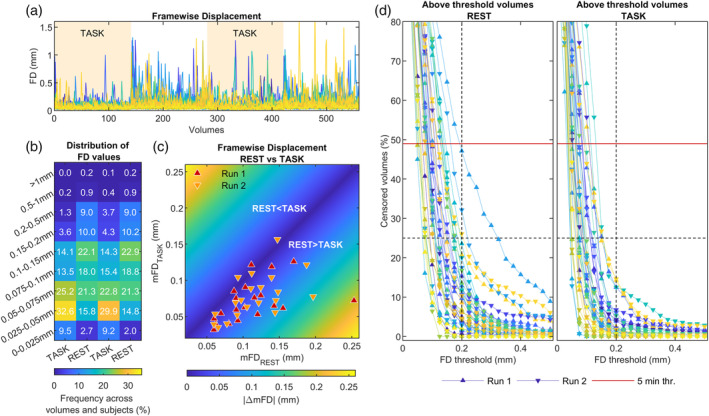
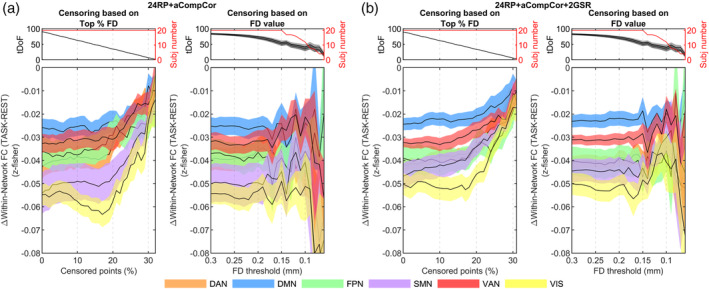
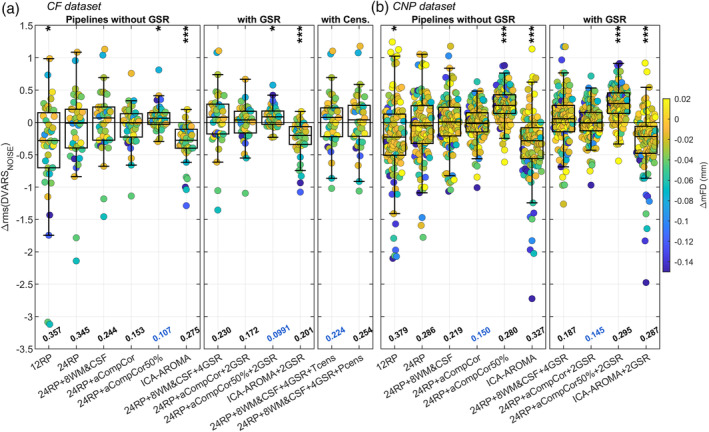
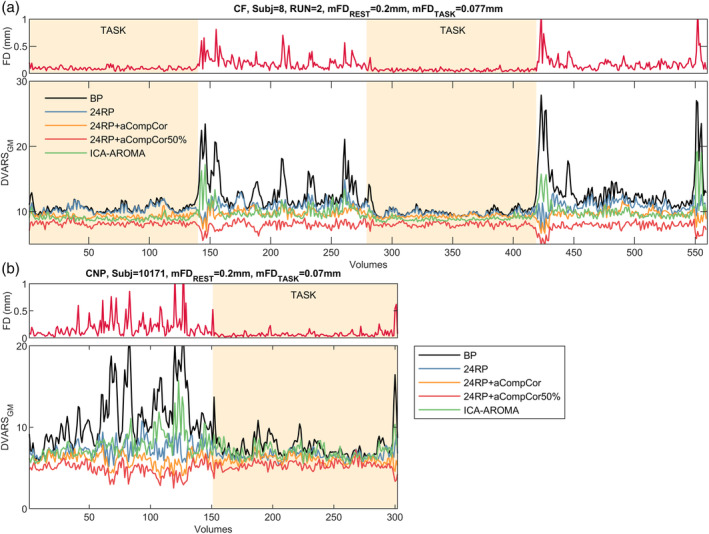
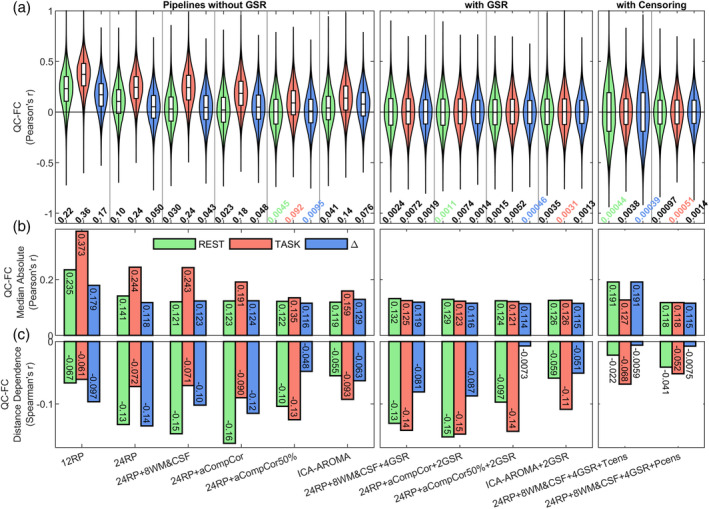
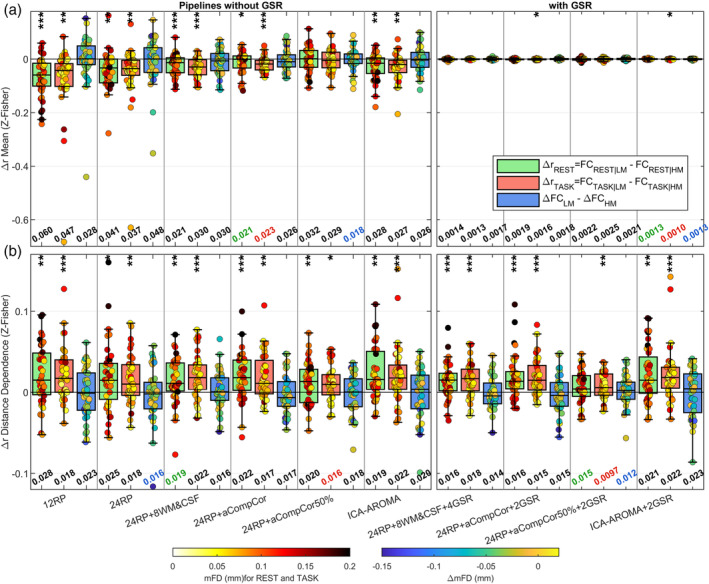
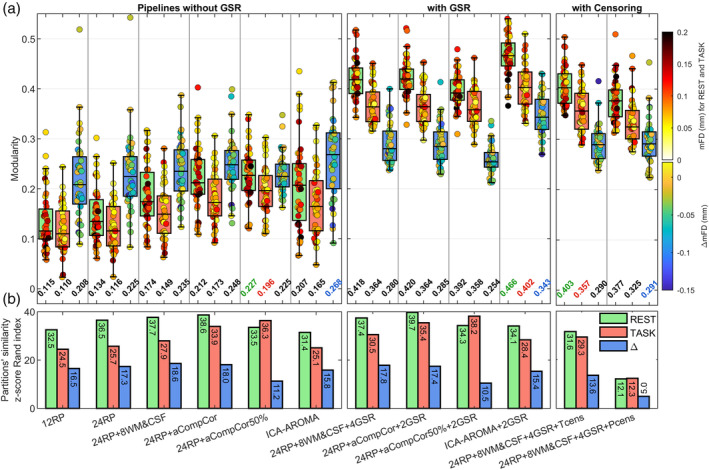
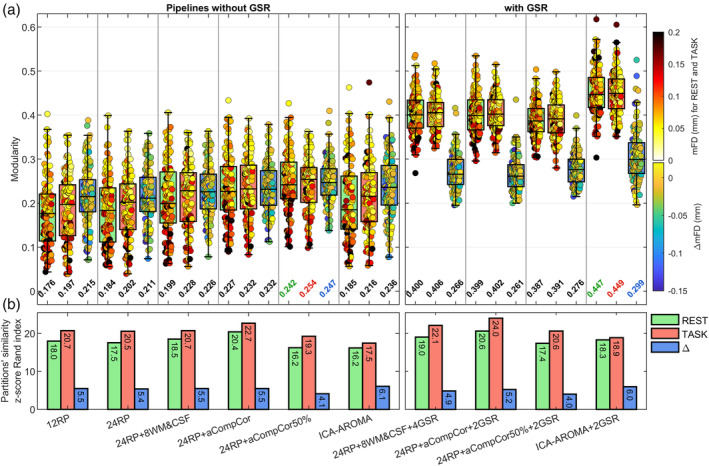
In-scanner head motion represents a major confounding factor in functional connectivity studies and it raises particular concerns when motion correlates with the effect of interest. One such instance regards research focused on functional connectivity modulations induced by sustained cognitively demanding tasks. Indeed, cognitive engagement is generally associated with substantially lower in-scanner movement compared with unconstrained, or minimally constrained, conditions. Consequently, the reliability of condition-dependent changes in functional connectivity relies on effective denoising strategies. In this study, we evaluated the ability of common denoising pipelines to minimize and balance residual motion-related artifacts between resting-state and task conditions. Denoising pipelines-including realignment/tissue-based regression, PCA/ICA-based methods (aCompCor and ICA-AROMA, respectively), global signal regression, and censoring of motion-contaminated volumes-were evaluated according to a set of benchmarks designed to assess either residual artifacts or network identifiability. We found a marked heterogeneity in pipeline performance, with many approaches showing a differential efficacy between rest and task conditions. The most effective approaches included aCompCor, optimized to increase the noise prediction power of the extracted confounding signals, and global signal regression, although both strategies performed poorly in mitigating the spurious distance-dependent association between motion and connectivity. Censoring was the only approach that substantially reduced distance-dependent artifacts, yet this came at the great cost of reduced network identifiability. The implications of these findings for best practice in denoising task-based functional connectivity data, and more generally for resting-state data, are discussed.
在功能连接研究中,扫描内头部运动是一个主要的混杂因素,特别是当运动与感兴趣的效应相关时,更是如此。例如,研究的重点是由持续认知要求任务引起的功能连接调制。事实上,认知参与通常与无约束或最小约束条件下的扫描内运动相比,运动明显减少。因此,功能连接的条件依赖性变化的可靠性依赖于有效的去噪策略。在这项研究中,我们评估了常见去噪管道的能力,以最小化和平衡静息态和任务条件之间的残留运动相关伪影。去噪管道,包括重新定位/基于组织的回归、基于 PCA/ICA 的方法(分别为 aCompCor 和 ICA-AROMA)、全局信号回归和运动污染体积的剔除,根据一组旨在评估残留伪影或网络可识别性的基准进行评估。我们发现管道性能存在明显的异质性,许多方法在静息和任务条件之间表现出不同的效果。最有效的方法包括 aCompCor,它经过优化,以增加提取的混杂信号的噪声预测能力,以及全局信号回归,尽管这两种策略在减轻运动与连接之间的虚假距离依赖性关联方面表现不佳。剔除是唯一一种显著减少距离依赖性伪影的方法,但这是以降低网络可识别性为代价的。这些发现对基于任务的功能连接数据去噪的最佳实践,以及更一般的静息态数据去噪的最佳实践具有重要意义。