Department of Medicine and Surgery, University of Milano-Bicocca, Monza, Italy.
Department of Informatics, Systems, and Communication, University of Milano-Bicocca, Milano, Italy.
Eur Psychiatry. 2021 Feb 3;64(1):e17. doi: 10.1192/j.eurpsy.2021.3.
The fight against the COVID-19 pandemic seems to encompass a social media debate, possibly resulting in emotional contagion and the need for novel surveillance approaches. In the current study, we aimed to examine the flow and content of tweets, exploring the role of COVID-19 key events on the popular Twitter platform.
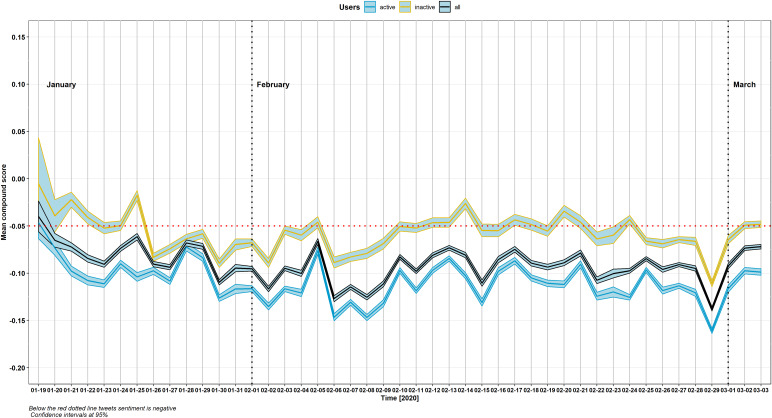
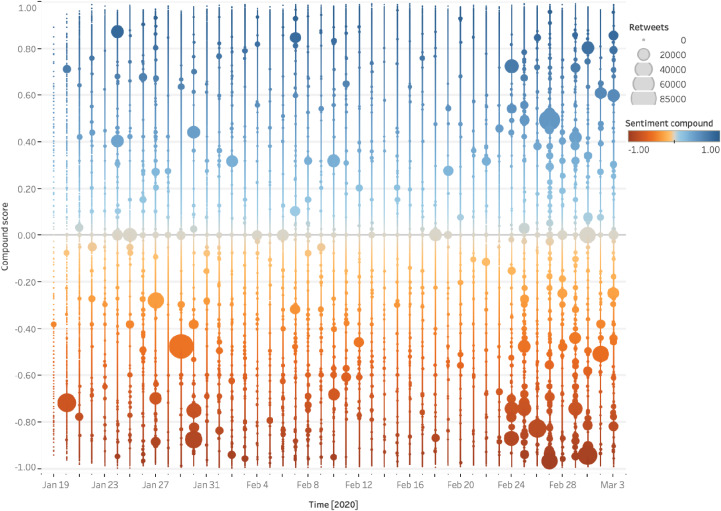
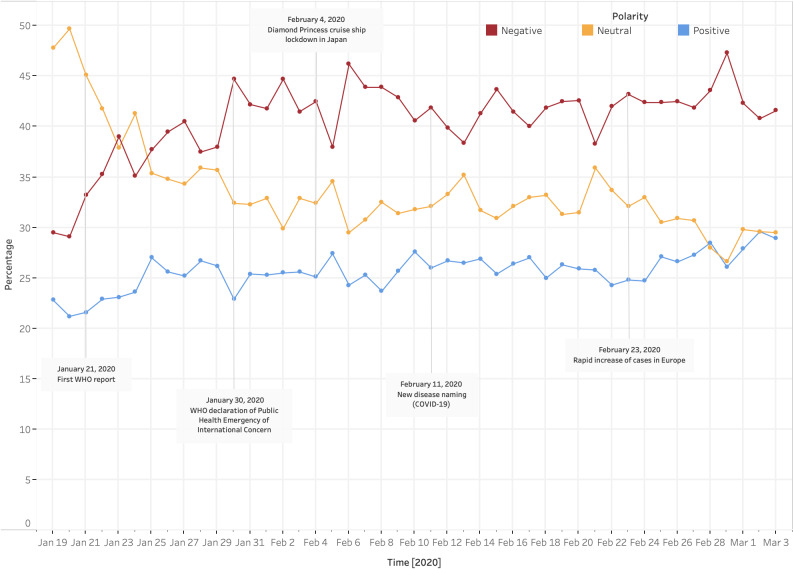
Using representative freely available data, we performed a focused, social media-based analysis to capture COVID-19 discussions on Twitter, considering sentiment and longitudinal trends between January 19 and March 3, 2020. Different populations of users were considered. Core discussions were explored measuring tweets' sentiment, by both computing a polarity compound score with 95% Confidence Interval and using a transformer-based model, pretrained on a large corpus of COVID-19-related Tweets. Context-dependent meaning and emotion-specific features were considered.
We gathered 3,308,476 tweets written in English. Since the first World Health Organization report (January 21), negative sentiment proportion of tweets gradually increased as expected, with amplifications following key events. Sentiment scores were increasingly negative among most active users. Tweets content and flow revealed an ongoing scenario in which the global emergency seems difficult to be emotionally managed, as shown by sentiment trajectories.
Integrating social media like Twitter as essential surveillance tools in the management of the pandemic and its waves might actually represent a novel preventive approach to hinder emotional contagion, disseminating reliable information and nurturing trust. There is the need to monitor and sustain healthy behaviors as well as community supports also via social media-based preventive interventions.
抗击 COVID-19 疫情的斗争似乎包含了一场社交媒体辩论,这可能导致情绪感染,并需要新的监测方法。在本研究中,我们旨在研究推文的流向和内容,探索 COVID-19 关键事件在流行的 Twitter 平台上的作用。
我们使用具有代表性的免费可用数据,通过基于社交媒体的重点分析来捕捉 Twitter 上的 COVID-19 讨论,考虑了 2020 年 1 月 19 日至 3 月 3 日之间的情绪和纵向趋势。考虑了不同的用户群体。通过计算具有 95%置信区间的极性复合得分和使用基于转换器的模型来探索核心讨论,该模型在大量与 COVID-19 相关的推文语料库上进行了预训练。考虑了上下文相关的含义和特定于情感的特征。
我们收集了 3,308,476 条用英语书写的推文。自世界卫生组织第一次报告(1 月 21 日)以来,推文的负面情绪比例逐渐增加,这是预料之中的,关键事件之后出现了放大效应。最活跃的用户中,情绪得分越来越低。推文的内容和流向揭示了一种持续的情况,即全球紧急情况似乎难以在情感上得到管理,这反映在情绪轨迹上。
将像 Twitter 这样的社交媒体整合为大流行及其波次管理的重要监测工具,实际上可能代表了一种防止情绪感染的新预防方法,传播可靠的信息并培养信任。需要通过基于社交媒体的预防干预措施来监测和维持健康行为和社区支持。