Han Chuanliang, Wang Tian, Wu Yujie, Li Yang, Yang Yi, Li Liang, Wang Yizheng, Xing Dajun
State Key Laboratory of Cognitive Neuroscience and Learning & IDG/McGovern Institute for Brain Research, Beijing Normal University, Beijing 100875, China.
Beijing Institute of Basic Medical Sciences, Beijing 100850, China.
Neural Plast. 2021 Jan 18;2021:8874516. doi: 10.1155/2021/8874516. eCollection 2021.
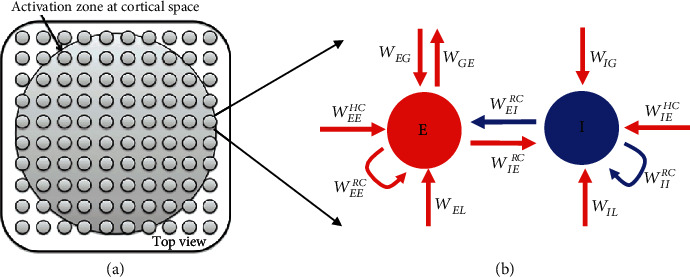
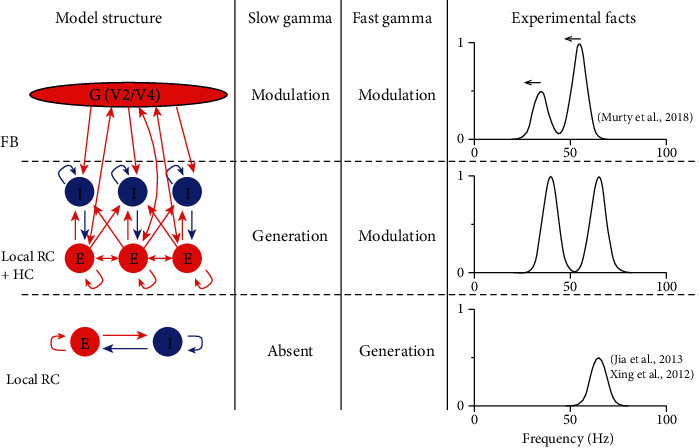
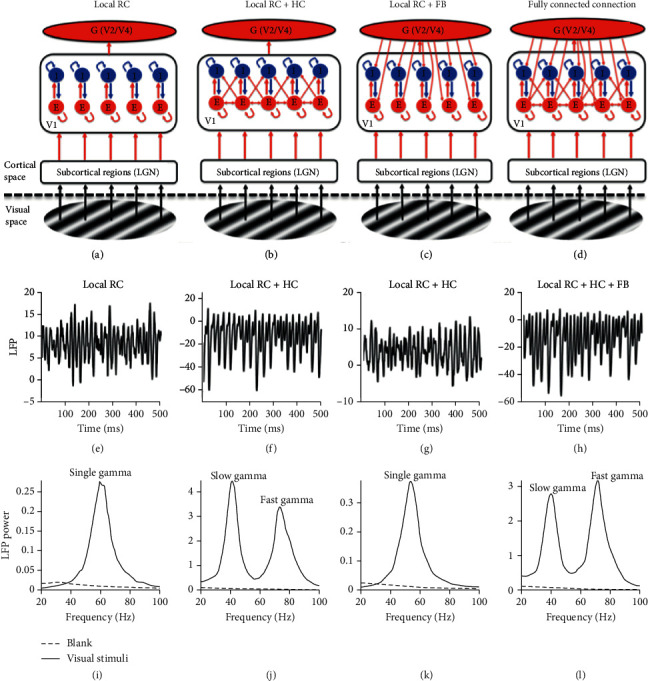
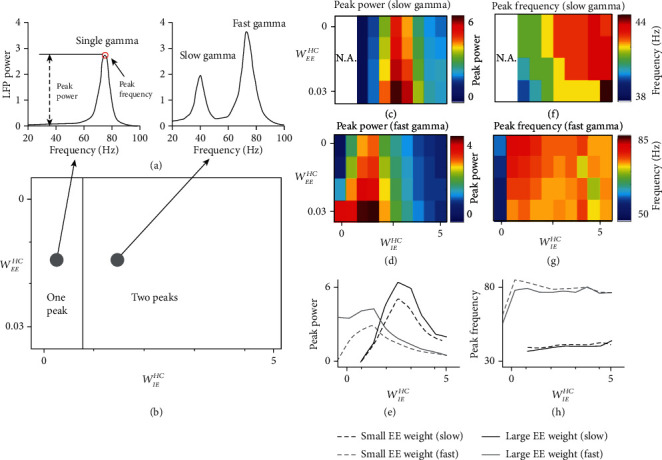
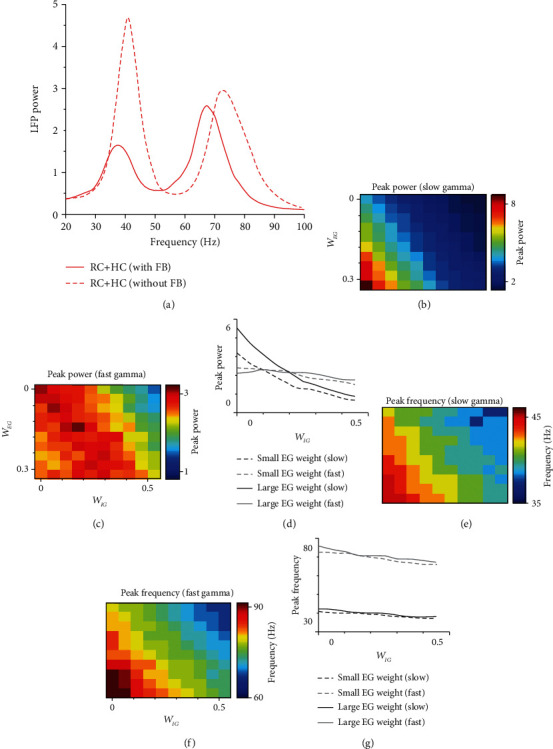
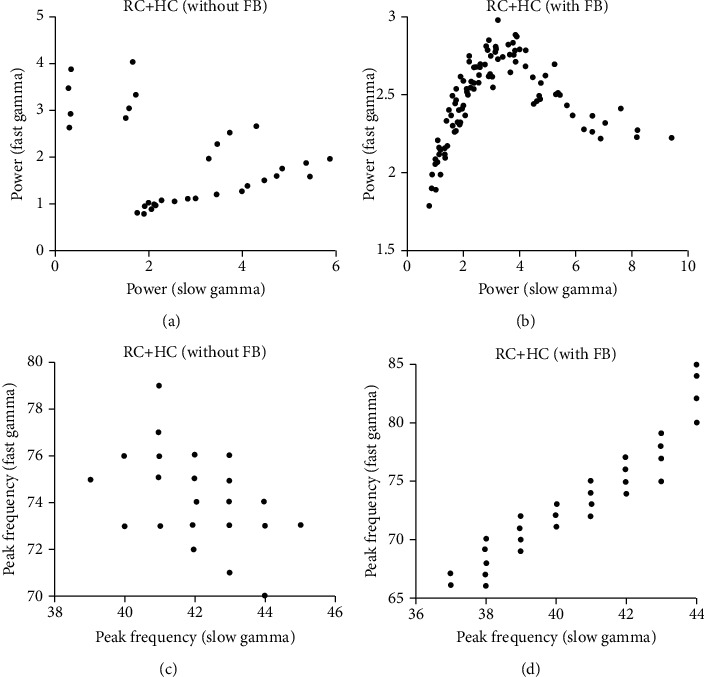
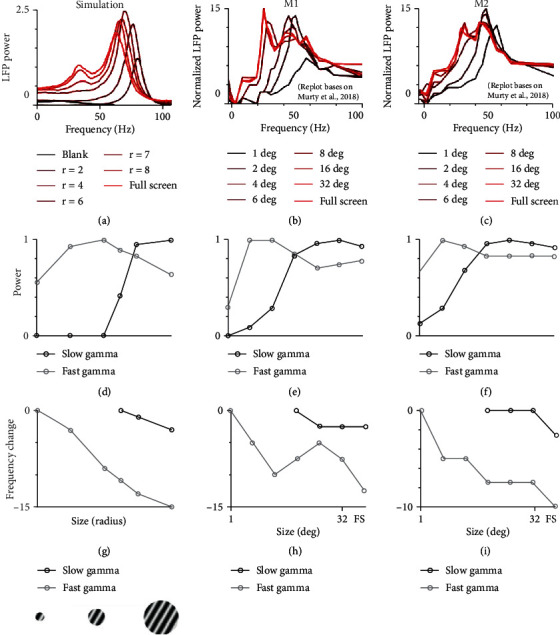
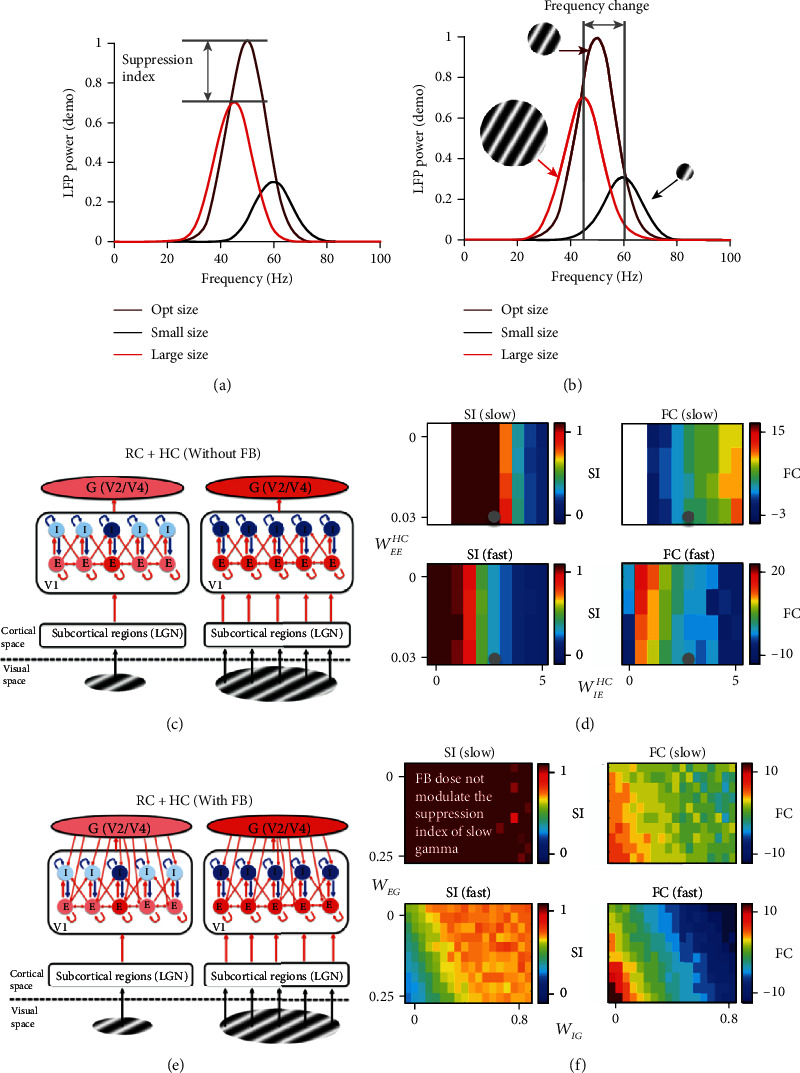
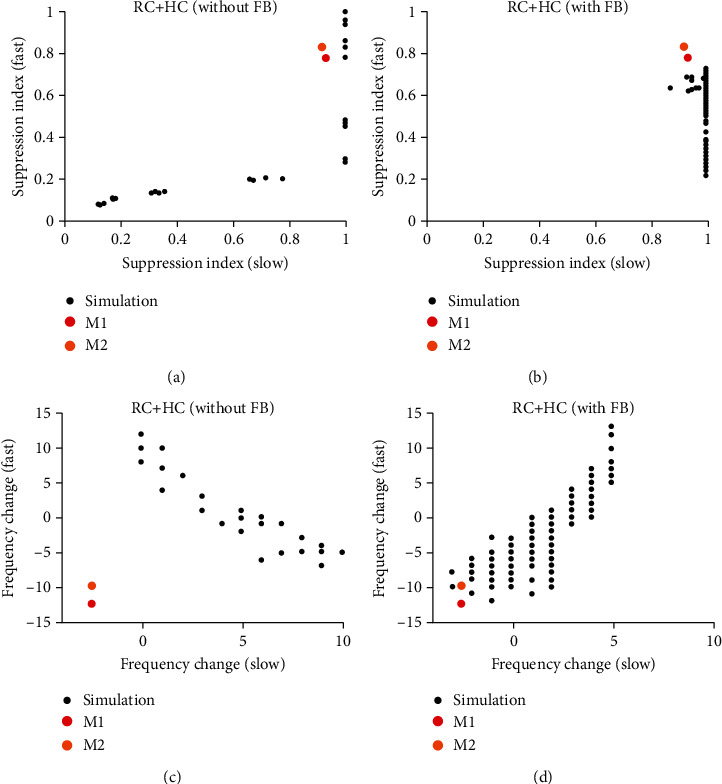
Gamma oscillation (GAMMA) in the local field potential (LFP) is a synchronized activity commonly found in many brain regions, and it has been thought as a functional signature of network connectivity in the brain, which plays important roles in information processing. Studies have shown that the response property of GAMMA is related to neural interaction through local recurrent connections (RC), feed-forward (FF), and feedback (FB) connections. However, the relationship between GAMMA and long-range horizontal connections (HC) in the brain remains unclear. Here, we aimed to understand this question in a large-scale network model for the primary visual cortex (V1). We created a computational model composed of multiple excitatory and inhibitory units with biologically plausible connectivity patterns for RC, FF, FB, and HC in V1; then, we quantitated GAMMA in network models at different strength levels of HC and other connection types. Surprisingly, we found that HC and FB, the two types of large-scale connections, play very different roles in generating and modulating GAMMA. While both FB and HC modulate a fast gamma oscillation (around 50-60 Hz) generated by FF and RC, HC generates a new GAMMA oscillating around 30 Hz, whose power and peak frequency can also be modulated by FB. Furthermore, response properties of the two GAMMAs in a network with both HC and FB are different in a way that is highly consistent with a recent experimental finding for distinct GAMMAs in macaque V1. The results suggest that distinct GAMMAs are signatures for neural connections in different spatial scales and they might be related to different functions for information integration. Our study, for the first time, pinpoints the underlying circuits for distinct GAMMAs in a mechanistic model for macaque V1, which might provide a new framework to study multiple gamma oscillations in other cortical regions.
局部场电位(LFP)中的伽马振荡(GAMMA)是在许多脑区普遍存在的一种同步活动,它被认为是大脑中网络连接的功能特征,在信息处理中发挥着重要作用。研究表明,GAMMA的响应特性与通过局部递归连接(RC)、前馈(FF)和反馈(FB)连接的神经相互作用有关。然而,GAMMA与大脑中长程水平连接(HC)之间的关系仍不清楚。在此,我们旨在通过一个针对初级视觉皮层(V1)的大规模网络模型来理解这个问题。我们创建了一个计算模型,该模型由多个兴奋性和抑制性单元组成,具有V1中RC、FF、FB和HC的生物学合理连接模式;然后,我们在不同强度水平的HC和其他连接类型的网络模型中对GAMMA进行了量化。令人惊讶的是,我们发现HC和FB这两种大规模连接在产生和调节GAMMA方面发挥着非常不同的作用。虽然FB和HC都调节由FF和RC产生的快速伽马振荡(约50 - 60Hz),但HC产生一种新的约30Hz振荡的GAMMA,其功率和峰值频率也可由FB调节。此外,在同时具有HC和FB的网络中,两种GAMMA的响应特性在某种程度上是不同的,这与猕猴V1中不同GAMMA的最近实验发现高度一致。结果表明,不同的GAMMA是不同空间尺度神经连接的特征,它们可能与信息整合的不同功能有关。我们的研究首次在猕猴V1的机制模型中确定了不同GAMMA的潜在回路,这可能为研究其他皮层区域的多种伽马振荡提供一个新框架。