Wang Jixian, Li Guofeng, Deng Lidong, Mamtilahun Muyassar, Jiang Lu, Qiu Weibao, Zheng Hairong, Sun Junfeng, Xie Qing, Yang Guo-Yuan
1Department of Rehabilitation, Ruijin Hospital, Shanghai Jiao Tong University School of Medicine, Shanghai 200025, China.
3Shenzhen Institutes of Advanced Technology Chinese Academy of Sciences, Shenzhen 518055, China.
Aging Dis. 2021 Feb 1;12(1):50-60. doi: 10.14336/AD.2020.0623. eCollection 2021 Feb.
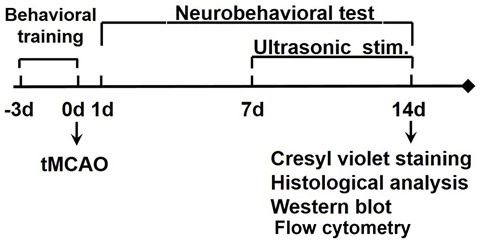
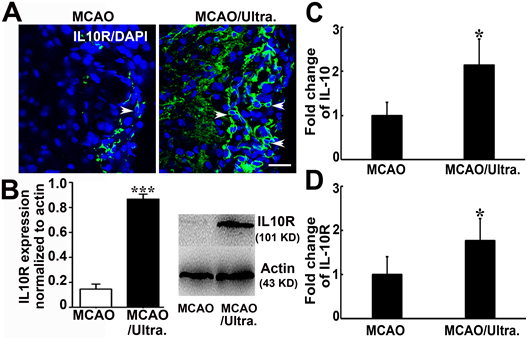
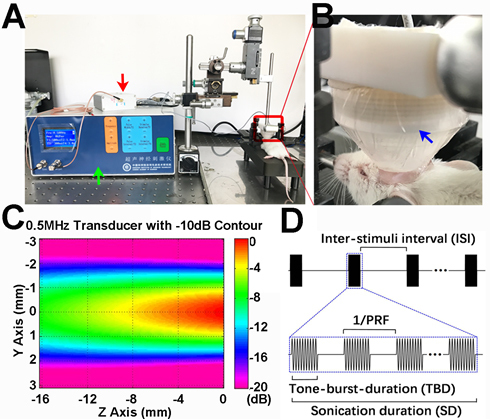
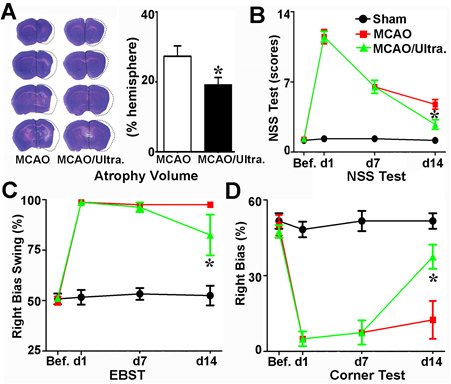
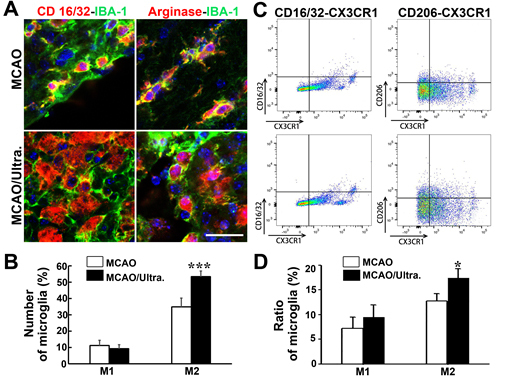
Transcranial focused ultrasound stimulation (tFUS) regulates neural activity in different brain regions in humans and animals. However, the role of ultrasound stimulation in modulating neural activity and promoting neurorehabilitation in the ischemic brain is largely unknown. In the present study, we explored the effect of tFUS on neurological rehabilitation and the underlying mechanism. Adult male ICR mice (n=42) underwent transient middle cerebral artery occlusion. One week after brain ischemia, low frequency (0.5 MHz) tFUS was applied to stimulate the ischemic hemisphere of mice for 7 consecutive days (10 minutes daily). Brain infarct volume, neurobehavioral tests, microglia activation, IL-10 and IL-10R levels were further assessed for up to 14 days. We found that the brain infarct volume was significantly reduced in the tFUS treated mice compared to that in the non-treated mice (<0.05). Similarly, neurological severity scores, elevated body swing test, and corner test improved in the tFUS treated mice (<0.05). We also demonstrated that tFUS resulted in increased M2 microglia in the ischemic brain region. The expression of IL-10R and IL-10 levels were also substantially upregulated (<0.05). We concluded that tFUS served as a unique technique to promote neurorehabilitation after brain ischemia by promoting microglia polarization and further regulating IL-10 signaling in the ischemic brain.
经颅聚焦超声刺激(tFUS)可调节人和动物不同脑区的神经活动。然而,超声刺激在调节缺血性脑的神经活动和促进神经康复中的作用在很大程度上尚不清楚。在本研究中,我们探讨了tFUS对神经康复的影响及其潜在机制。成年雄性ICR小鼠(n = 42)接受短暂性大脑中动脉闭塞。脑缺血一周后,应用低频(0.5 MHz)tFUS连续7天刺激小鼠的缺血半球(每天10分钟)。在长达14天的时间里,进一步评估脑梗死体积、神经行为测试、小胶质细胞活化、IL-10和IL-10R水平。我们发现,与未治疗的小鼠相比,接受tFUS治疗的小鼠脑梗死体积显著减小(<0.05)。同样,接受tFUS治疗的小鼠神经严重程度评分、抬高身体摆动试验和转角试验均有所改善(<0.05)。我们还证明,tFUS导致缺血脑区M2小胶质细胞增加。IL-10R和IL-10水平的表达也显著上调(<0.05)。我们得出结论,tFUS是一种独特的技术,可通过促进小胶质细胞极化并进一步调节缺血脑中的IL-10信号传导来促进脑缺血后的神经康复。