Department of Rheumatology, Peking Union Medical College Hospital, Peking Union Medical College & Chinese Academy of Medical Sciences, National Clinical Research Center for Dermatologic and Immunologic Diseases, Ministry of Science & Technology, Key Laboratory of Rheumatology and Clinical Immunology, Ministry of Education, No. 1 Shuaifuyuan, Beijing 100730, China.
Department of Radiology, Peking Union Medical College Hospital, Peking Union Medical College & Chinese Academy of Medical Sciences, No. 1 Shuaifuyuan, Beijing 100730, China.
J Immunol Res. 2021 Jan 18;2021:1349042. doi: 10.1155/2021/1349042. eCollection 2021.
To identify the clinical characteristics, magnetic resonance imaging (MRI) results, and prognostic factors of neuropsychiatric (NP) systemic lupus erythematosus (SLE; NPSLE) in a relatively large patient series in China.
Data of patients with NPSLE at Peking Union Medical College Hospital (PUMCH) were collected retrospectively from June 2012 to June 2016. NPSLE patients were compared with 220 non-NPSLE patients. Survival rates were evaluated using the Kaplan-Meier curves, log-rank test, and Cox proportional hazards modeling. Cranial MRI results were also studied.
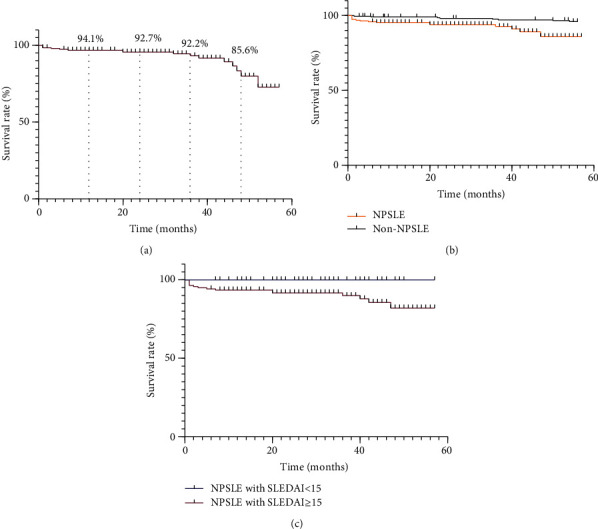
Of the 194 included patients, sixteen subtypes of NPSLE were identified, and the most common manifestations were seizure (36.6%), acute confusional state (25.3%), and cerebral vascular disease (15.5%). Compared with the non-NPSLE group, NPSLE patients were significantly more likely to have typical lupus symptoms, higher Systemic Lupus Erythematosus Disease Activity Index 2000 (SLEDAI-2K) scores ( = 0.002), and positive rate of anti-ribosomal P protein antibodies ( = 0.008). Patients with seizure were more likely to have higher SLEDAI-2K scores and positive anti-2GP1 than non-NPSLE patients. Sixteen patients died during follow-up. The most common cause of death was infection (37.5%). NPSLE significantly decreased survival rates of SLE patients. Patients with elevated serum creatinine ( = 0.001), hypocomplementemia ( = 0.031), and SLEDAI - 2K scores ≥ 15 ( = 0.014) had shorter survival periods. Eighty-two patients underwent detailed cranial MRI analysis; of these, 50 (61.0%) had abnormal results. Small vessel disease was the most common abnormal finding, followed by inflammatory-like lesions and large vessel disease.
High disease activity and positive rate of anti-ribosomal P protein antibodies may be risk factors for NPSLE. NPSLE decreases survival rates of SLE patients. Renal insufficiency and high disease activity are predictive of poor prognoses for NPSLE patients.
在中国较大的患者系列中确定神经精神(NP)系统性红斑狼疮(SLE;NPSLE)的临床特征、磁共振成像(MRI)结果和预后因素。
回顾性收集 2012 年 6 月至 2016 年 6 月在北京协和医院就诊的 NPSLE 患者数据。将 NPSLE 患者与 220 例非 NPSLE 患者进行比较。使用 Kaplan-Meier 曲线、对数秩检验和 Cox 比例风险模型评估生存率。还研究了颅 MRI 结果。
在纳入的 194 例患者中,确定了 16 种 NPSLE 亚型,最常见的表现为癫痫发作(36.6%)、急性意识混乱状态(25.3%)和脑血管疾病(15.5%)。与非 NPSLE 组相比,NPSLE 患者更有可能出现典型狼疮症状、更高的系统性红斑狼疮疾病活动指数 2000(SLEDAI-2K)评分(=0.002)和抗核糖体 P 蛋白抗体阳性率(=0.008)。癫痫发作患者更有可能具有更高的 SLEDAI-2K 评分和阳性抗 2GP1。在随访期间,有 16 名患者死亡。最常见的死亡原因是感染(37.5%)。NPSLE 显著降低了 SLE 患者的生存率。血清肌酐升高(=0.001)、低补体血症(=0.031)和 SLEDAI-2K 评分≥15(=0.014)的患者生存时间更短。82 例患者进行了详细的颅 MRI 分析;其中,50 例(61.0%)结果异常。小血管疾病是最常见的异常发现,其次是炎症样病变和大血管疾病。
高疾病活动度和抗核糖体 P 蛋白抗体阳性率可能是 NPSLE 的危险因素。NPSLE 降低了 SLE 患者的生存率。肾功能不全和高疾病活动度是 NPSLE 患者预后不良的预测因素。