Laboratory for Manufacturing Systems and Automation, Department of Mechanical Engineering and Aeronautics, University of Patras, 26504 Patras, Greece.
Sensors (Basel). 2021 Feb 1;21(3):972. doi: 10.3390/s21030972.
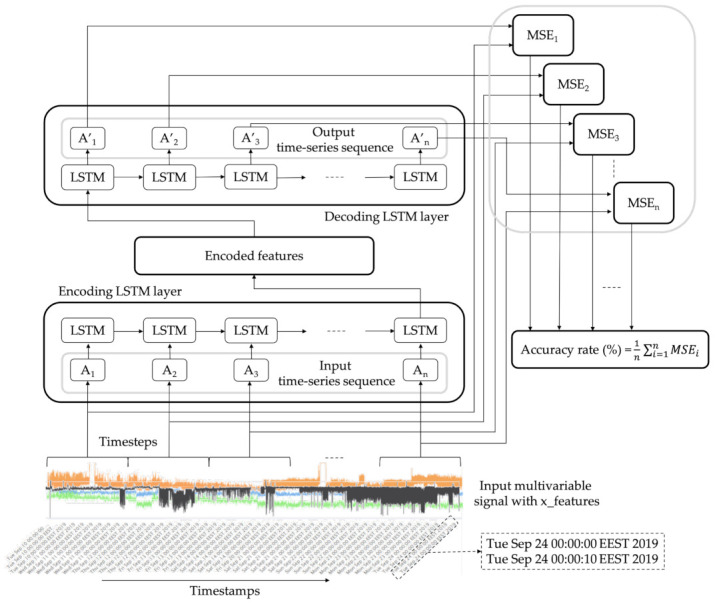
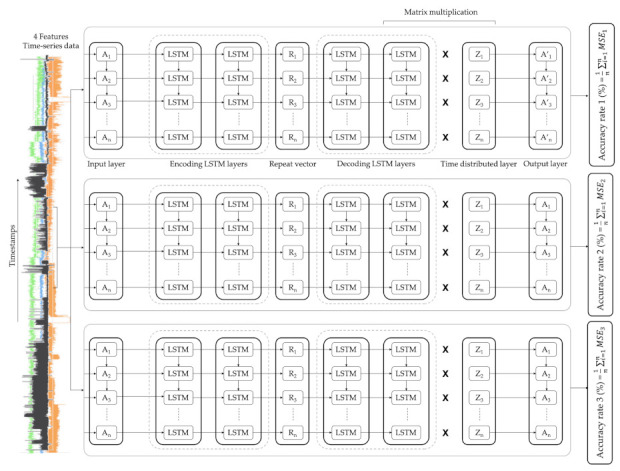
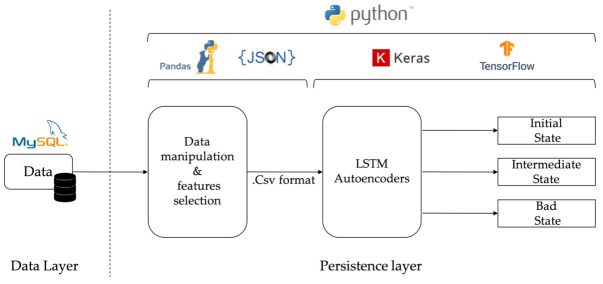
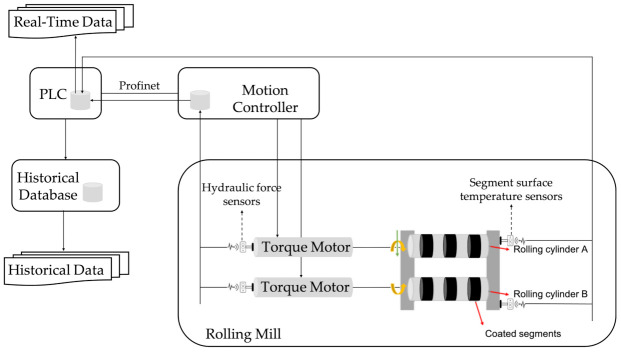
Condition monitoring of industrial equipment, combined with machine learning algorithms, may significantly improve maintenance activities on modern cyber-physical production systems. However, data of proper quality and of adequate quantity, modeling both good operational conditions as well as abnormal situations throughout the operational lifecycle, are required. Nevertheless, this is difficult to acquire in a non-destructive approach. In this context, this study investigates an approach to enable a transition from preventive maintenance activities, that are scheduled at predetermined time intervals, into predictive ones. In order to enable such approaches in a cyber-physical production system, a deep learning algorithm is used, allowing for maintenance activities to be planned according to the actual operational status of the machine and not in advance. An autoencoder-based methodology is employed for classifying real-world machine and sensor data, into a set of condition-related labels. Real-world data collected from manufacturing operations are used for training and testing a prototype implementation of Long Short-Term Memory autoencoders for estimating the remaining useful life of the monitored equipment. Finally, the proposed approach is evaluated in a use case related to a steel industry production process.
工业设备的状态监测,结合机器学习算法,可能会显著改善现代网络物理生产系统的维护活动。然而,需要具有适当质量和足够数量的数据,对整个运行生命周期中的良好运行条件和异常情况进行建模。然而,这很难通过非破坏性方法来获取。在这种情况下,本研究探讨了一种方法,使从预定时间间隔的预防性维护活动过渡到预测性维护活动成为可能。为了在网络物理生产系统中实现这种方法,使用了深度学习算法,根据机器的实际运行状态而不是提前计划维护活动。采用基于自动编码器的方法对实际机器和传感器数据进行分类,形成一组与条件相关的标签。从制造操作中收集的实际数据用于训练和测试长短期记忆自动编码器的原型实现,以估计监测设备的剩余使用寿命。最后,在所涉及的钢铁行业生产过程的用例中评估了所提出的方法。