Weiss Eileen Oberwelland, Kruppa Jana A, Fink Gereon R, Herpertz-Dahlmann Beate, Konrad Kerstin, Schulte-Rüther Martin
Translational Brain Research in Psychiatry and Neurology, Department of Child and Adolescent Psychiatry, Psychosomatics, and Psychotherapy, University Hospital Aachen, Aachen, Germany.
Cognitive Neuroscience, Institute of Neuroscience and Medicine (INM-3), Jülich Research Centre, Jülich, Germany.
Front Neurosci. 2021 Jan 18;14:536596. doi: 10.3389/fnins.2020.536596. eCollection 2020.
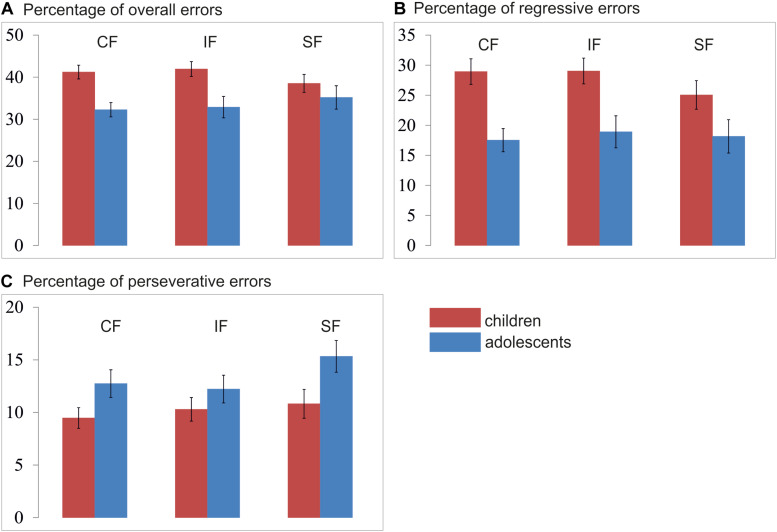
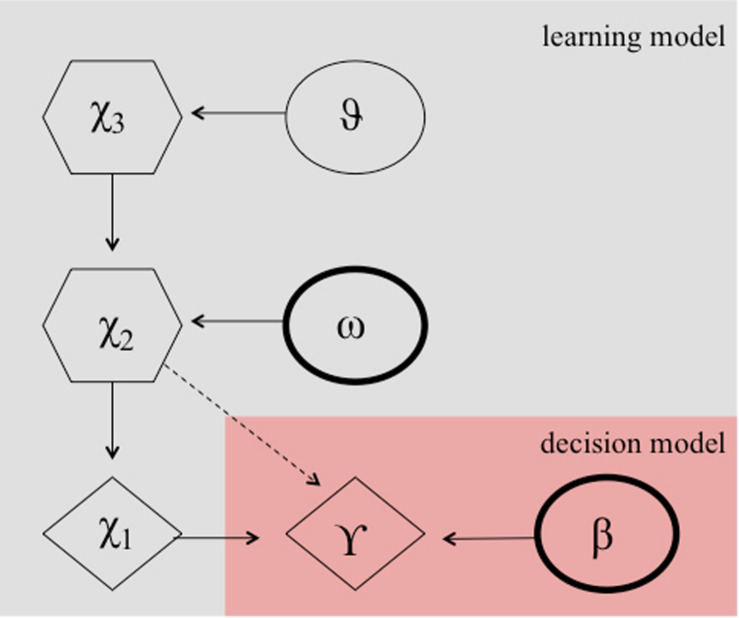
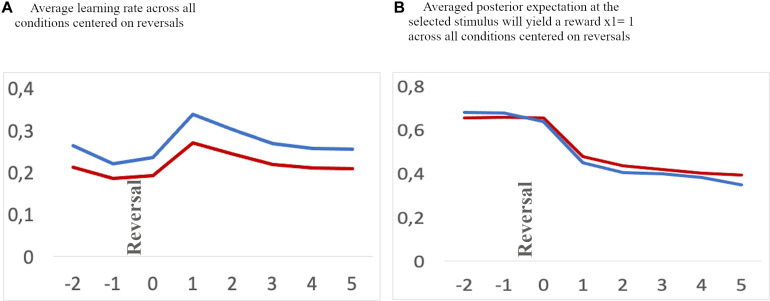
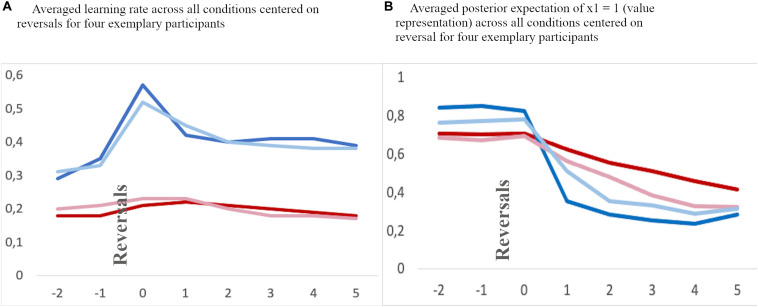
Cognitive flexibility helps us to navigate through our ever-changing environment and has often been examined by reversal learning paradigms. Performance in reversal learning can be modeled using computational modeling which allows for the specification of biologically plausible models to infer psychological mechanisms. Although such models are increasingly used in cognitive neuroscience, developmental approaches are still scarce. Additionally, though most reversal learning paradigms have a comparable design regarding timing and feedback contingencies, the type of feedback differs substantially between studies. The present study used hierarchical Gaussian filter modeling to investigate cognitive flexibility in reversal learning in children and adolescents and the effect of various feedback types. The results demonstrate that children make more overall errors and regressive errors (when a previously learned response rule is chosen instead of the new correct response after the initial shift to the new correct target), but less perseverative errors (when a previously learned response set continues to be used despite a reversal) adolescents. Analyses of the extracted model parameters of the winning model revealed that children seem to use new and conflicting information less readily than adolescents to update their stimulus-reward associations. Furthermore, more subclinical rigidity in everyday life (parent-ratings) is related to less explorative choice behavior during the probabilistic reversal learning task. Taken together, this study provides first-time data on the development of the underlying processes of cognitive flexibility using computational modeling.
认知灵活性有助于我们在不断变化的环境中应对自如,并且常通过反转学习范式进行研究。反转学习中的表现可以通过计算建模来模拟,这种建模允许指定具有生物学合理性的模型,以推断心理机制。尽管此类模型在认知神经科学中越来越常用,但发展性研究方法仍然很少。此外,虽然大多数反转学习范式在时间安排和反馈条件方面具有可比的设计,但不同研究之间的反馈类型差异很大。本研究使用分层高斯滤波器建模来研究儿童和青少年在反转学习中的认知灵活性以及各种反馈类型的影响。结果表明,儿童在总体上犯的错误更多,并且会犯回归错误(即在最初转向新的正确目标后,选择之前学到的反应规则而不是新的正确反应),但在坚持错误方面(即在出现反转后仍继续使用之前学到的反应集)比青少年少。对获胜模型提取的模型参数进行分析后发现,与青少年相比,儿童似乎不太容易使用新的和相互冲突的信息来更新他们的刺激 - 奖励关联。此外,在日常生活中(父母评价)更多的亚临床僵化与概率反转学习任务中较少的探索性选择行为有关。综上所述,本研究首次使用计算建模提供了关于认知灵活性潜在过程发展的数据。