Waltz James A, Gold James M
Maryland Psychiatric Research Center, University of Maryland School of Medicine, Baltimore, Maryland 21228, United States.
Schizophr Res. 2007 Jul;93(1-3):296-303. doi: 10.1016/j.schres.2007.03.010. Epub 2007 May 7.
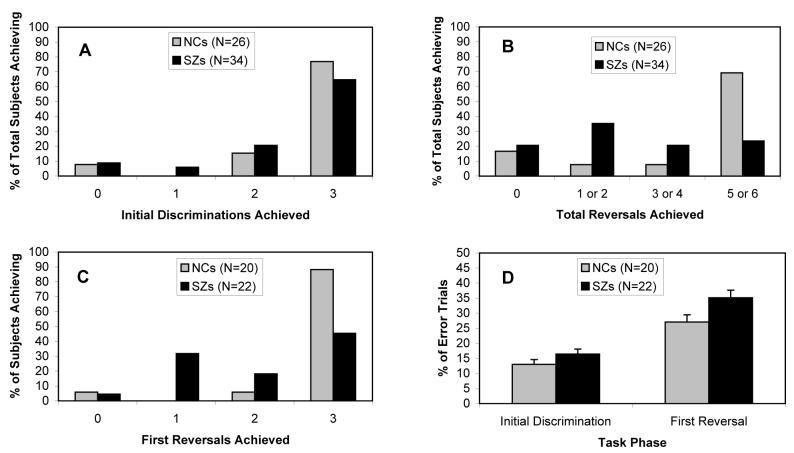
Impairments in feedback processing and reinforcement learning appear to be prominent aspects of schizophrenia (SZ), which may relate to symptoms of the disorder. Evidence from cognitive neuroscience investigations indicates that disparate brain systems may underlie different kinds of feedback-driven learning. The ability to rapidly shift response tendencies in the face of negative feedback, when reinforcement contingencies are reversed, is an important type of learning thought to depend on ventral prefrontal cortex (PFC). Schizophrenia has long been associated with dysfunction in dorsolateral areas of PFC, but evidence for ventral PFC impairment in more mixed. In order to assess whether SZ patients experience particular difficulty in carrying out a cognitive function commonly linked to ventral PFC function, we administered to 34 patients and 26 controls a modified version of an established probabilistic reversal learning task from the experimental literature [Cools, R., Clark, L., Owen, A.M., Robbins, T.W., 2002. Defining the neural mechanisms of probabilistic reversal learning using event-related functional magnetic resonance imaging. J. Neurosci. 22, 4563-4567]. Although SZ patients and controls performed similarly on the initial acquisition of probabilistic contingencies, patients showed substantial learning impairments when reinforcement contingencies were reversed, achieving significantly fewer reversals [chi(2)(6)=15.717, p=0.008]. Even when analyses were limited to subjects who acquired all probabilistic contingencies initially (22 patients and 20 controls), patients achieved significantly fewer reversals [chi(2)(3)=9.408, p=0.024]. These results support the idea that ventral PFC dysfunction is a prevalent aspect of schizophrenic pathophysiology, which may contribute to deficits in reinforcement learning exhibited by patients. Further studies are required to investigate the roles of dopaminergic systems in these impairments.
反馈处理和强化学习方面的障碍似乎是精神分裂症(SZ)的突出特征,这可能与该疾病的症状有关。认知神经科学研究的证据表明,不同的脑系统可能是不同类型反馈驱动学习的基础。当强化条件反转时,面对负面反馈迅速改变反应倾向的能力是一种重要的学习类型,被认为依赖于腹侧前额叶皮层(PFC)。长期以来,精神分裂症一直与PFC背外侧区域的功能障碍有关,但关于腹侧PFC损伤的证据则较为复杂。为了评估SZ患者在执行通常与腹侧PFC功能相关的认知功能时是否存在特殊困难,我们对34名患者和26名对照者进行了一项基于实验文献[Cools, R., Clark, L., Owen, A.M., Robbins, T.W., 2002. 使用事件相关功能磁共振成像定义概率反转学习的神经机制。《神经科学杂志》22, 4563 - 4567]中既定概率反转学习任务的修改版测试。尽管SZ患者和对照者在概率条件的初始习得方面表现相似,但当强化条件反转时,患者表现出明显的学习障碍,反转次数显著减少[卡方(2)(6)=15.717, p = 0.008]。即使分析仅限于最初习得所有概率条件的受试者(22名患者和20名对照者),患者的反转次数仍显著减少[卡方(2)(3)=9.408, p = 0.024]。这些结果支持了腹侧PFC功能障碍是精神分裂症病理生理学普遍特征的观点,这可能导致患者强化学习缺陷。需要进一步研究来探讨多巴胺能系统在这些损伤中的作用。