Rus Meta, Groselj Urh
University Children's Hospital, University Medical Centre Ljubljana, Bohoričeva 20, 1000 Ljubljana, Slovenia.
Department of Endocrinology, Diabetes and Metabolic Diseases, University Children's Hospital, University Medical Centre Ljubljana, Bohoričeva 20, 1000 Ljubljana, Slovenia.
Vaccines (Basel). 2021 Feb 2;9(2):113. doi: 10.3390/vaccines9020113.
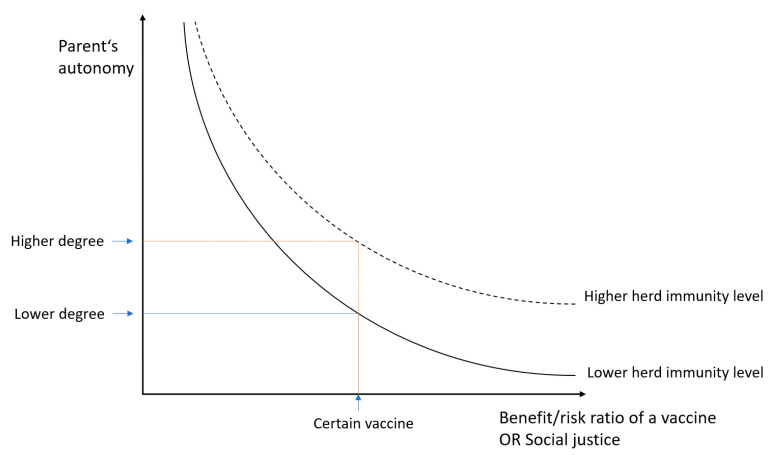
Although vaccination is recognised as the top public health achievement of the twentieth century, unequivocal consensus about its beneficence does not exist among the general population. In countries with well-established immunisation programmes, vaccines are "victims of their own success", because low incidences of diseases now prevented with vaccines diminished the experience of their historical burdens. Increasing number of vaccine-hesitant people in recent years threatens, or even effectively disables, herd immunity levels of the population and results in outbreaks of previously already controlled diseases. We aimed to apply a framework for ethical analysis of vaccination in childhood based on the four principles of biomedical ethics (respect for autonomy, nonmaleficence, beneficence and justice) to provide a comprehensive and applicable model on how to address the ethical aspects of vaccination at both individual and societal levels. We suggest finding an "ethical equilibrium", which means that the degree of respect for parents' autonomy is not constant, but variable; it shall depend on the level of established herd immunity and it is specific for every society. When the moral obligation of individuals to contribute to herd immunity is not fulfilled, mandatory vaccination policies are ethically justified, because states bear responsibility to protect herd immunity as a common good.
尽管疫苗接种被公认为是二十世纪最重要的公共卫生成就,但普通大众对其益处并未达成明确共识。在免疫规划完善的国家,疫苗成了“自身成功的受害者”,因为如今通过疫苗预防的疾病发病率降低,人们对这些疾病历史负担的感受也相应减少。近年来,越来越多的人对疫苗犹豫不决,这威胁甚至实际上破坏了人群的群体免疫水平,导致以前已得到控制的疾病再度爆发。我们旨在应用一个基于生物医学伦理学四项原则(尊重自主权、不伤害、有益和公正)的儿童疫苗接种伦理分析框架,提供一个全面且适用的模型,以说明如何在个人和社会层面处理疫苗接种的伦理问题。我们建议找到一种“伦理平衡”,这意味着对父母自主权的尊重程度并非一成不变,而是可变的;它取决于已建立的群体免疫水平,且因每个社会而异。当个人为群体免疫做贡献的道德义务未得到履行时,强制疫苗接种政策在伦理上是合理的,因为国家有责任将群体免疫作为公共利益加以保护。