Department of Family and Preventive Medicine, University of Arkansas for Medical Sciences, Little Rock.
Department of Biostatistics and Data Science, School of Public Health, University of Texas Health Science Center at Houston, Houston.
JAMA Netw Open. 2021 Feb 1;4(2):e2036809. doi: 10.1001/jamanetworkopen.2020.36809.
Studying long-term changes in neighborhood socioeconomic status (SES) may help to better understand the associations between neighborhood exposure and weight outcomes and provide evidence supporting neighborhood interventions. Little previous research has been done to examine associations between neighborhood SES and weight loss, a risk factor associated with poor health outcomes in the older population.
To determine whether improvements in neighborhood SES are associated with reduced likelihoods of excessive weight gain and excessive weight loss and whether declines are associated with increased likelihoods of these weight outcomes.
DESIGN, STUDY, AND PARTICIPANTS: This cohort study was conducted using data from the National Institutes of Health-AARP (formerly known as the American Association of Retired Persons) Diet and Health study (1995-2006). The analysis included a cohort of 126 179 adults (aged 50-71 years) whose neighborhoods at baseline (1995-1996) were the same as at follow-up (2004-2006). All analyses were performed from December 2018 through December 2020.
Living in a neighborhood that experienced 1 of 8 neighborhood SES trajectories defined based on a national neighborhood SES index created using data from the US Census and American Community Survey. The 8 trajectory groups, in which high, or H, indicated rankings at or above the sample median of a specific year and low, or L, indicated rankings below the median, were HHH (ie, high in 1990 to high in 2000 to high in 2010), or stable high; HLL, or early decline; HHL, or late decline; HLH, or transient decline; LLL, or stable low; LHH, or early improvement; LLH, or late improvement; and LHL, or transient improvement.
Excessive weight gain and loss were defined as gaining or losing 10% or more of baseline weight.
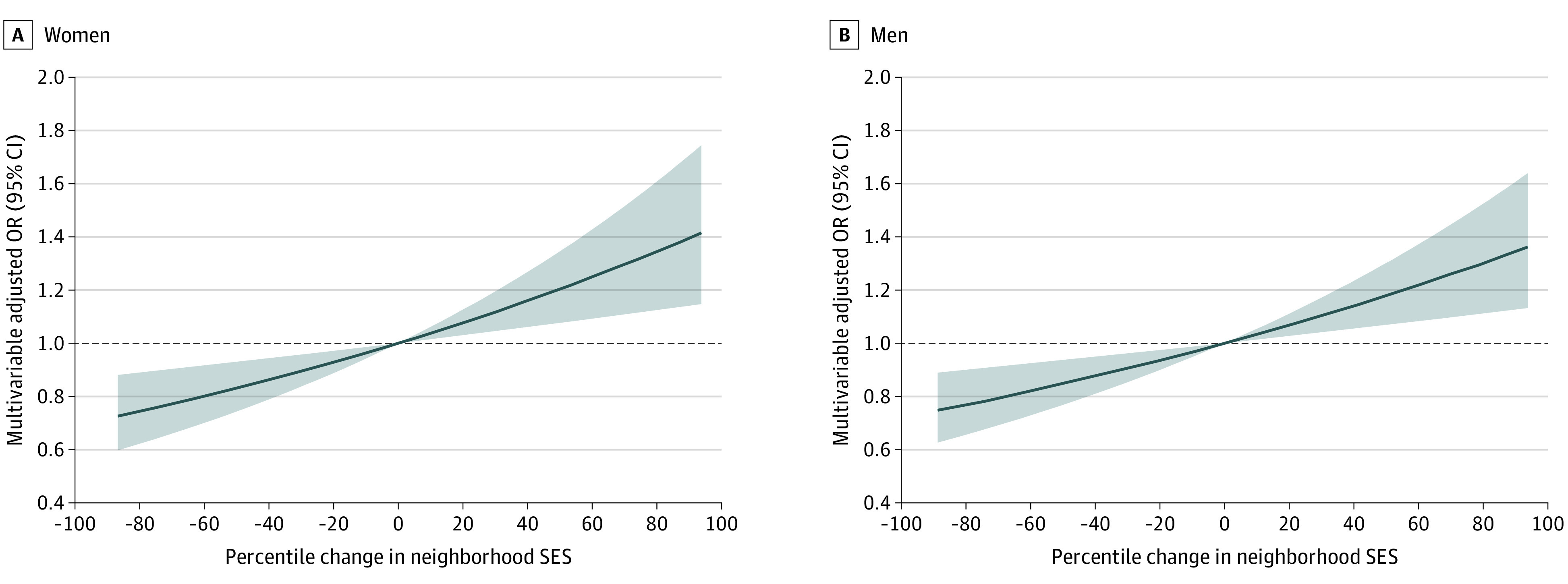
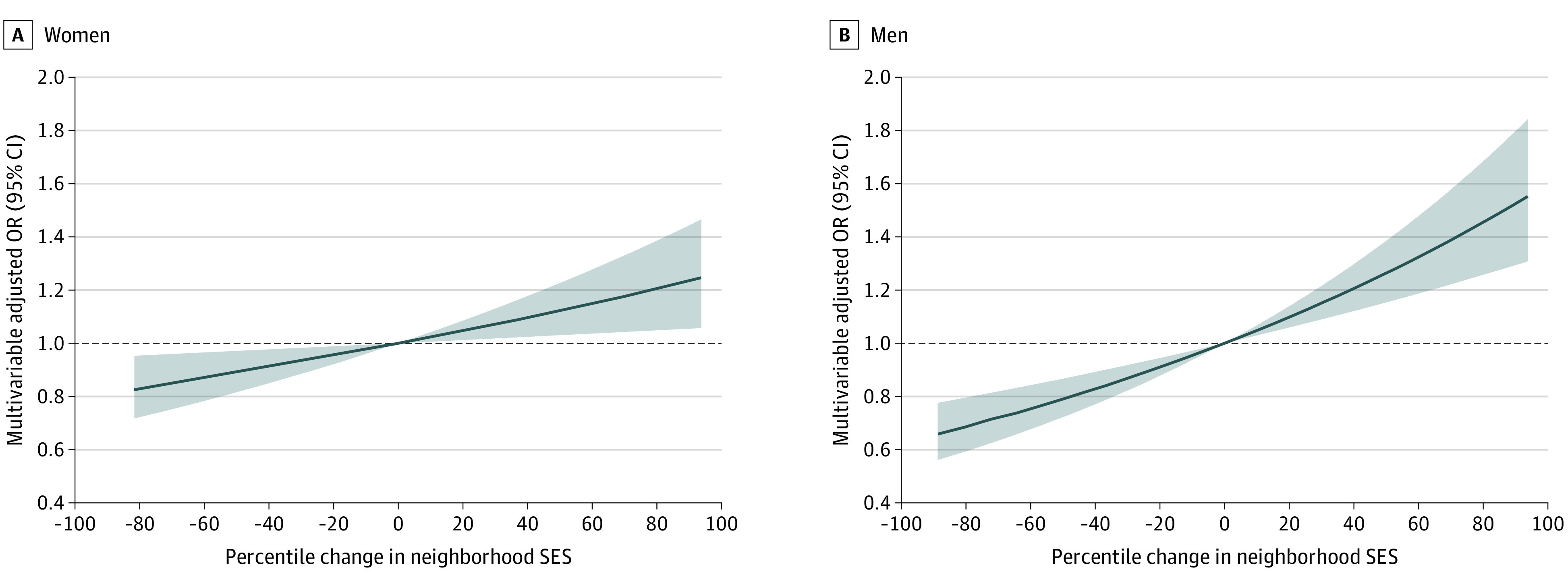
Among 126 179 adults, 76 225 (60.4%) were men and the mean (SD) age was 62.1 (5.3) years. Improvements in neighborhood SES were associated with lower likelihoods of excessive weight gain and weight loss over follow-up, while declines in neighborhood SES were associated with higher likelihoods of excessive weight gain and weight loss. Compared with the stable low group, the risk was significantly reduced for excessive weight gain in the early improvement group (odds ratio [OR], 0.87; 95% CI, 0.79-0.95) and for excessive weight loss in the late improvement group (OR, 0.89; 95% CI, 0.80-1.00). Compared with the stable high group, the risk of excessive weight gain was significantly increased for the early decline group (OR, 1.19; 95% CI, 1.08-1.31) and late decline group (OR, 1.13; 95% CI, 1.04-1.24) and for excessive weight loss in the early decline group (OR, 1.15; 95% CI, 1.02-1.28). The increases in likelihood were greater when the improvement or decline in neighborhood SES occurred early in the study period (ie, 1990-2000) and was substantiated throughout the follow-up (ie, the early decline and early improvement groups). Overall, we found a linear association between changes in neighborhood SES and weight outcomes, in which every 5 percentile decline in neighborhood SES was associated with a 1.2% to 2.4% increase in the risk of excessive weight gain or loss (excessive weight gain: OR, 1.01; 95% CI, 1.00-1.02 for women; OR, 1.02; 95% CI, 1.01-1.03 for men; excessive weight loss: OR, 1.02; 95% CI, 1.01-1.03 for women; OR, 1.02; 95% CI, 1.01-1.03 for men; P for- trend < .0001).
These findings suggest that changing neighborhood environment was associated with changes in weight status in older adults.
重要性:研究邻里社会经济地位(SES)的长期变化,可能有助于更好地理解邻里暴露与体重结果之间的关系,并为邻里干预提供证据支持。之前很少有研究探讨邻里 SES 与体重减轻之间的关系,而体重减轻是老年人群中与健康结果不良相关的一个风险因素。
目的:确定邻里 SES 的改善是否与降低过度体重增加和体重减轻的可能性相关,以及下降是否与这些体重结果的可能性增加相关。
设计、研究和参与者:这项队列研究使用了美国国立卫生研究院-美国退休人员协会(AARP)饮食与健康研究(1995-2006 年)的数据。分析包括一个队列,共 126179 名成年人(年龄 50-71 岁),他们在基线(1995-1996 年)和随访(2004-2006 年)时的邻里环境相同。所有分析均于 2018 年 12 月至 2020 年 12 月进行。
暴露:生活在一个根据美国人口普查和美国社区调查数据创建的全国邻里 SES 指数确定的 8 个邻里 SES 轨迹之一的社区中。8 个轨迹组中,高(H)表示特定年份的排名高于或等于样本中位数,低(L)表示排名低于中位数,分别为 HHH(即,1990 年高到 2000 年高到 2010 年高)或稳定高;HLL,或早期下降;HHL,或晚期下降;HLH,或短暂下降;LLL,或稳定低;LHH,或早期改善;LLH,或晚期改善;LHL,或短暂改善。
主要结果和措施:过度体重增加和减轻定义为体重增加或减轻 10%或更多的基线体重。
结果:在 126179 名成年人中,76225 人(60.4%)为男性,平均(SD)年龄为 62.1(5.3)岁。邻里 SES 的改善与随访期间过度体重增加和体重减轻的可能性降低相关,而邻里 SES 的下降与过度体重增加和体重减轻的可能性增加相关。与稳定低组相比,早期改善组过度体重增加的风险显著降低(优势比[OR],0.87;95%CI,0.79-0.95),晚期改善组过度体重减轻的风险显著降低(OR,0.89;95%CI,0.80-1.00)。与稳定高组相比,早期下降组过度体重增加的风险显著增加(OR,1.19;95%CI,1.08-1.31)和晚期下降组(OR,1.13;95%CI,1.04-1.24),以及早期下降组过度体重减轻的风险(OR,1.15;95%CI,1.02-1.28)。当邻里 SES 的改善或下降发生在研究早期(即 1990-2000 年)且在整个随访期间持续存在时(即早期下降和早期改善组),风险增加幅度更大。总体而言,我们发现邻里 SES 变化与体重结果之间存在线性关联,其中邻里 SES 每下降 5 个百分点,与过度体重增加或减轻的风险增加 1.2%至 2.4%相关(过度体重增加:女性 OR,1.01;95%CI,1.00-1.02;男性 OR,1.02;95%CI,1.01-1.03;过度体重减轻:女性 OR,1.02;95%CI,1.01-1.03;男性 OR,1.02;95%CI,1.01-1.03;趋势检验 P<0.0001)。
结论和相关性:这些发现表明,改变邻里环境与老年人的体重状况变化有关。