Vahidy Farhaan, Jones Stephen L, Tano Mauricio E, Nicolas Juan Carlos, Khan Osman A, Meeks Jennifer R, Pan Alan P, Menser Terri, Sasangohar Farzan, Naufal George, Sostman Dirk, Nasir Khurram, Kash Bita A
Houston Methodist, Houston, TX, United States.
JMIR Med Inform. 2021 Feb 23;9(2):e26773. doi: 10.2196/26773.
The COVID-19 pandemic has exacerbated the challenges of meaningful health care digitization. The need for rapid yet validated decision-making requires robust data infrastructure. Organizations with a focus on learning health care (LHC) systems tend to adapt better to rapidly evolving data needs. Few studies have demonstrated a successful implementation of data digitization principles in an LHC context across health care systems during the COVID-19 pandemic.
We share our experience and provide a framework for assembling and organizing multidisciplinary resources, structuring and regulating research needs, and developing a single source of truth (SSoT) for COVID-19 research by applying fundamental principles of health care digitization, in the context of LHC systems across a complex health care organization.
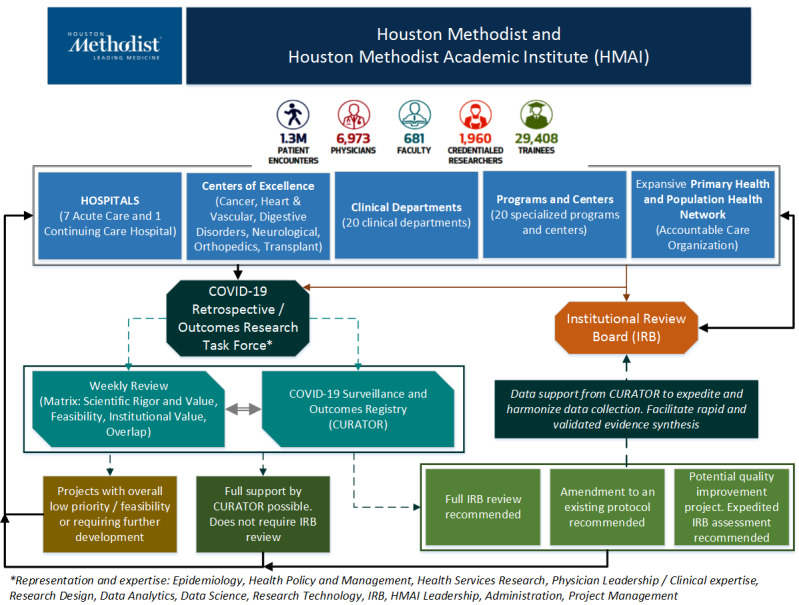
Houston Methodist (HM) comprises eight tertiary care hospitals and an expansive primary care network across Greater Houston, Texas. During the early phase of the pandemic, institutional leadership envisioned the need to streamline COVID-19 research and established the retrospective research task force (RRTF). We describe an account of the structure, functioning, and productivity of the RRTF. We further elucidate the technical and structural details of a comprehensive data repository-the HM COVID-19 Surveillance and Outcomes Registry (CURATOR). We particularly highlight how CURATOR conforms to standard health care digitization principles in the LHC context.
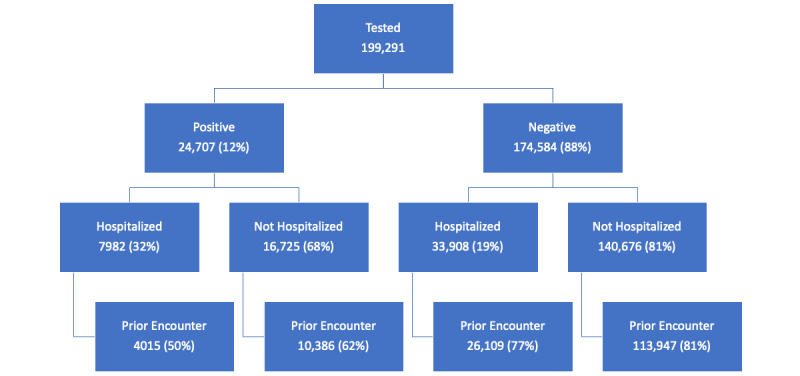
The HM COVID-19 RRTF comprises expertise in epidemiology, health systems, clinical domains, data sciences, information technology, and research regulation. The RRTF initially convened in March 2020 to prioritize and streamline COVID-19 observational research; to date, it has reviewed over 60 protocols and made recommendations to the institutional review board (IRB). The RRTF also established the charter for CURATOR, which in itself was IRB-approved in April 2020. CURATOR is a relational structured query language database that is directly populated with data from electronic health records, via largely automated extract, transform, and load procedures. The CURATOR design enables longitudinal tracking of COVID-19 cases and controls before and after COVID-19 testing. CURATOR has been set up following the SSoT principle and is harmonized across other COVID-19 data sources. CURATOR eliminates data silos by leveraging unique and disparate big data sources for COVID-19 research and provides a platform to capitalize on institutional investment in cloud computing. It currently hosts deeply phenotyped sociodemographic, clinical, and outcomes data of approximately 200,000 individuals tested for COVID-19. It supports more than 30 IRB-approved protocols across several clinical domains and has generated numerous publications from its core and associated data sources.
A data-driven decision-making strategy is paramount to the success of health care organizations. Investment in cross-disciplinary expertise, health care technology, and leadership commitment are key ingredients to foster an LHC system. Such systems can mitigate the effects of ongoing and future health care catastrophes by providing timely and validated decision support.
新冠疫情加剧了有意义的医疗数字化面临的挑战。快速且经过验证的决策需要强大的数据基础设施。专注于学习型医疗保健(LHC)系统的组织往往能更好地适应快速变化的数据需求。很少有研究表明在新冠疫情期间,LHC背景下的医疗系统成功实施了数据数字化原则。
我们分享经验,并提供一个框架,用于在复杂医疗组织的LHC系统背景下,通过应用医疗数字化的基本原则,整合和组织多学科资源、构建和规范研究需求,以及为新冠研究开发单一事实来源(SSoT)。
休斯顿卫理公会医院(HM)包括德克萨斯州大休斯顿地区的八家三级护理医院和广泛的初级护理网络。在疫情早期,机构领导层意识到需要简化新冠研究,并成立了回顾性研究特别工作组(RRTF)。我们描述了RRTF的结构、运作和生产力情况。我们进一步阐明了一个综合数据存储库——HM新冠监测与结果登记处(CURATOR)的技术和结构细节。我们特别强调了CURATOR在LHC背景下如何符合标准医疗数字化原则。
HM新冠RRTF包括流行病学、卫生系统、临床领域、数据科学、信息技术和研究监管方面的专业知识。RRTF于2020年3月首次召集,以确定新冠观察性研究的优先级并进行简化;迄今为止,它已审查了60多个方案,并向机构审查委员会(IRB)提出了建议。RRTF还为CURATOR制定了章程,该章程本身于2020年4月获得IRB批准。CURATOR是一个关系型结构化查询语言数据库,通过主要是自动化的提取、转换和加载程序,直接从电子健康记录中填充数据。CURATOR的设计能够对新冠检测前后的新冠病例和对照进行纵向跟踪。CURATOR是按照SSoT原则建立的,并与其他新冠数据源保持一致。CURATOR通过利用用于新冠研究的独特且不同的大数据源消除了数据孤岛,并提供了一个利用机构在云计算方面投资的平台。它目前存储了约20万名接受新冠检测者的深度表型化社会人口学、临床和结果数据。它支持多个临床领域的30多个经IRB批准的方案,并从其核心和相关数据源产生了大量出版物。
数据驱动的决策策略对于医疗组织的成功至关重要。对跨学科专业知识、医疗技术的投资以及领导层的承诺是培育LHC系统的关键要素。这样的系统可以通过提供及时且经过验证的决策支持来减轻当前和未来医疗灾难的影响。