Division of Respiratory Diseases, Ospedale L. Sacco, ASST Fatebenefratelli-Sacco, Via G.B. Grassi 74, 20157, Milano, Italy.
Division of Respiratory Diseases, Ospedale L. Sacco, ASST Fatebenefratelli-Sacco, Via G.B. Grassi 74, 20157, Milano, Italy; Department of Biomedical and Clinical Sciences (DIBIC), Università Degli Studi di Milano, Division of Respiratory Diseases, Luigi Sacco University Hospital, ASST Fatebenefratelli-Sacco, Via G.B. Grassi 74, 20157, Milano, Italy.
Respir Med. 2021 Mar;178:106323. doi: 10.1016/j.rmed.2021.106323. Epub 2021 Jan 30.
The therapeutic approach to COVID-19 and healthcare system preparedness improved during 2020. We compared characteristics and outcomes of hospitalized COVID-19 patients during the first 28 days of the March and October pandemic waves in Milan, Italy.
A prospective, observational study enrolling adult patients hospitalized with COVID-19 pneumonia during March 7-April 4 (1st period) and October 15-November 12 (2nd period). During the 1st period hydroxychloroquine, lopinavir/ritonavir and therapeutic enoxaparin when thrombosis was confirmed were administered; systemic corticosteroids were given in case of severe pneumonia. During the 2nd period dexamethasone, methylprednisolone, remdesivir, thromboprophylaxis or anticoagulation were administered according to international recommendations. Patients with respiratory distress on oxygen masks initiated CPAP. Outcomes were: length of hospital stay, all-cause in-hospital mortality and need for intubation.
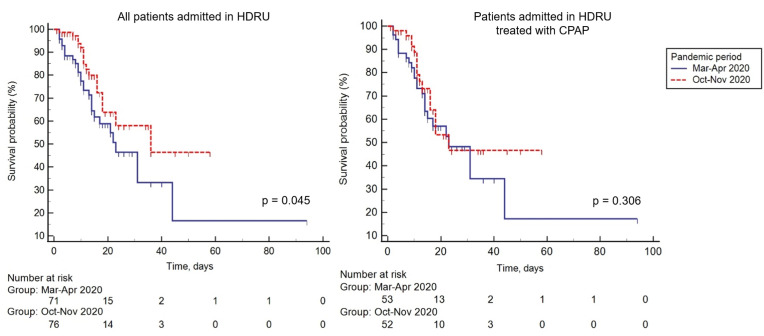
We included 70 patients (75% males) during the 1st and 76 patients (51% males, p = 0.522) during the 2nd period. Prevalence of severe respiratory failure (30% vs. 12%, p = 0.006), and D-dimer >3000 FEU (34% vs. 15%, P = 0.012) were reduced during the 2nd period, while anticoagulation and corticosteroids were more frequently administered (both p < 0.01). Mortality and time to referral were also reduced (39.4% vs. 22.4%, p = 0.019 and 6 vs. 5 days, p = 0.014), while need for intubation didn't change. Hospitalization length was comparable, but the proportion of patients discharged home was higher during the 2nd period (28.2% vs. 55.4%, p = 0.001).
Changing treatment paradigms and early referral might have reduced mortality in COVID-19 patients. The effects of specific therapeutic regimens needs further confirmation in future clinical studies.
2020 年期间,COVID-19 的治疗方法和医疗体系准备工作有所改善。我们比较了意大利米兰 3 月和 10 月大流行期间 COVID-19 住院患者在前 28 天的特征和结局。
一项前瞻性观察研究纳入了 3 月 7 日至 4 月 4 日(第 1 期)和 10 月 15 日至 11 月 12 日(第 2 期)期间因 COVID-19 肺炎住院的成年患者。第 1 期给予羟氯喹、洛匹那韦/利托那韦和确诊血栓时的依诺肝素;严重肺炎时给予全身皮质类固醇。第 2 期根据国际建议给予地塞米松、甲泼尼龙、瑞德西韦、血栓预防或抗凝治疗。需要用氧气面罩呼吸的呼吸窘迫患者开始使用 CPAP。结局包括:住院时间、全因院内死亡率和需要插管。
第 1 期纳入 70 例患者(75%为男性),第 2 期纳入 76 例患者(51%为男性,p=0.522)。第 2 期严重呼吸衰竭(30%比 12%,p=0.006)和 D-二聚体>3000 FEU(34%比 15%,P=0.012)的发生率降低,而抗凝和皮质类固醇的使用更为频繁(均 p<0.01)。死亡率和转介时间也有所降低(39.4%比 22.4%,p=0.019 和 6 比 5 天,p=0.014),而需要插管的患者没有变化。住院时间相似,但第 2 期出院回家的患者比例更高(28.2%比 55.4%,p=0.001)。
改变治疗模式和早期转介可能降低了 COVID-19 患者的死亡率。特定治疗方案的效果需要进一步在未来的临床研究中证实。