Belokopytova Polina, Fishman Veniamin
Natural Sciences Department, Novosibirsk State University, Novosibirsk, Russia.
Institute of Cytology and Genetics Siberian Branch of Russian Academy of Sciences (SB RAS), Novosibirsk, Russia.
Front Genet. 2021 Jan 22;11:617202. doi: 10.3389/fgene.2020.617202. eCollection 2020.
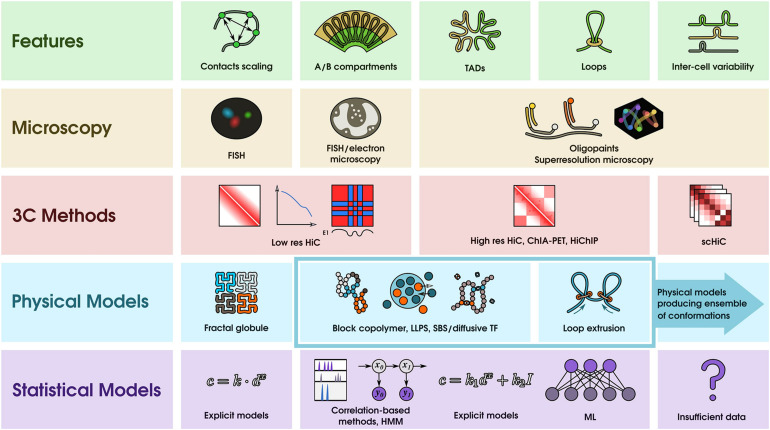
Genome architecture plays a pivotal role in gene regulation. The use of high-throughput methods for chromatin profiling and 3-D interaction mapping provide rich experimental data sets describing genome organization and dynamics. These data challenge development of new models and algorithms connecting genome architecture with epigenetic marks. In this review, we describe how chromatin architecture could be reconstructed from epigenetic data using biophysical or statistical approaches. We discuss the applicability and limitations of these methods for understanding the mechanisms of chromatin organization. We also highlight the emergence of new predictive approaches for scoring effects of structural variations in human cells.
基因组结构在基因调控中起着关键作用。利用高通量方法进行染色质分析和三维相互作用图谱绘制,可提供丰富的实验数据集,描述基因组的组织和动态变化。这些数据对连接基因组结构与表观遗传标记的新模型和算法的开发提出了挑战。在本综述中,我们描述了如何使用生物物理或统计方法从表观遗传数据重建染色质结构。我们讨论了这些方法在理解染色质组织机制方面的适用性和局限性。我们还强调了用于评估人类细胞结构变异影响的新预测方法的出现。