Han Mei-Wen, Wang Ming, Xu Meng-Ying, Qi Wei-Peng, Wang Peng, Xi Dong
Institute of Infectious Disease, Tongji Hospital, Tongji Medical College, Huazhong University of Science and Technology, Wuhan 430030, Hubei Province, China.
World J Clin Cases. 2021 Jan 26;9(3):528-539. doi: 10.12998/wjcc.v9.i3.528.
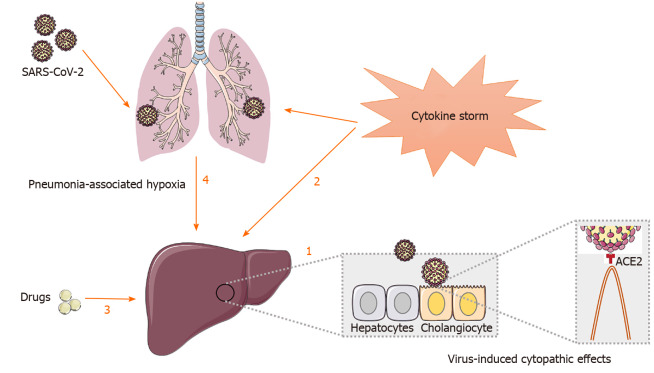
Coronavirus disease 2019 (COVID-19), caused by severe acute respiratory syndrome coronavirus 2, has posed a serious threat to global public health security. With the increase in the number of confirmed cases globally, the World Health Organization has declared the outbreak of COVID-19 an international public health emergency. Despite atypical pneumonia as the primary symptom, liver dysfunction has also been observed in many clinical cases and is associated with the mortality risk in patients with COVID-19, like severe acute respiratory syndrome and Middle East respiratory syndrome. Here we will provide a schematic overview of the clinical characteristics and the possible mechanisms of liver injury caused by severe acute respiratory syndrome coronavirus 2 infection, which may provide help for optimizing the management of liver injury and reducing mortality in COVID-19 patients.
2019冠状病毒病(COVID-19)由严重急性呼吸综合征冠状病毒2引起,对全球公共卫生安全构成了严重威胁。随着全球确诊病例数量的增加,世界卫生组织已宣布COVID-19疫情为国际公共卫生紧急事件。尽管非典型肺炎是主要症状,但在许多临床病例中也观察到肝功能障碍,并且它与COVID-19患者的死亡风险相关,类似于严重急性呼吸综合征和中东呼吸综合征。在此,我们将概述严重急性呼吸综合征冠状病毒2感染所致肝损伤的临床特征及可能机制,这可能有助于优化COVID-19患者肝损伤的管理并降低死亡率。