Graduate Department, Bengbu Medical College, Bengbu, Anhui 233030, China.
The Key Laboratory of Tumor Molecular Diagnosis and Individualized Medicine of Zhejiang Province, Zhejiang Provincial People's Hospital (People's Hospital of Hangzhou Medical College), Hangzhou, Zhejiang 310014, China.
J Immunol Res. 2021 Jan 22;2021:8816041. doi: 10.1155/2021/8816041. eCollection 2021.
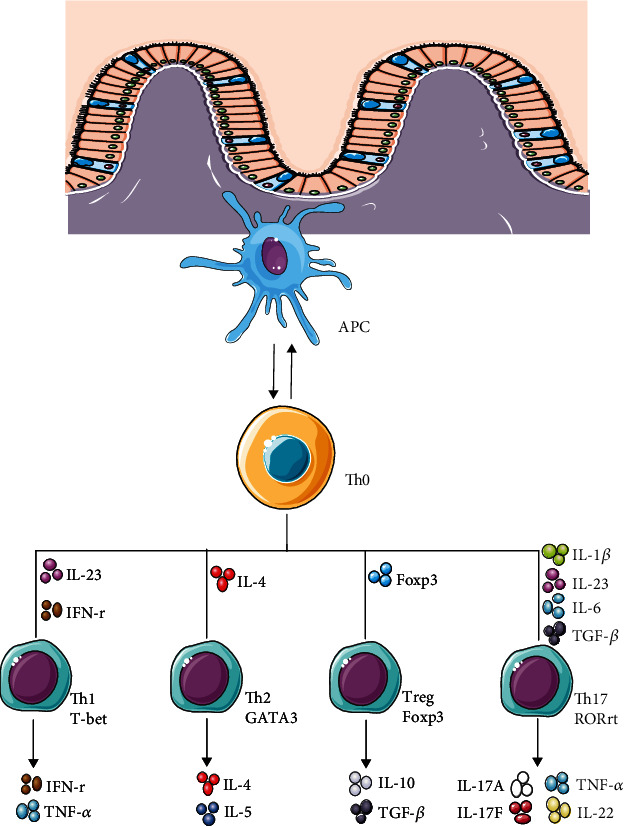
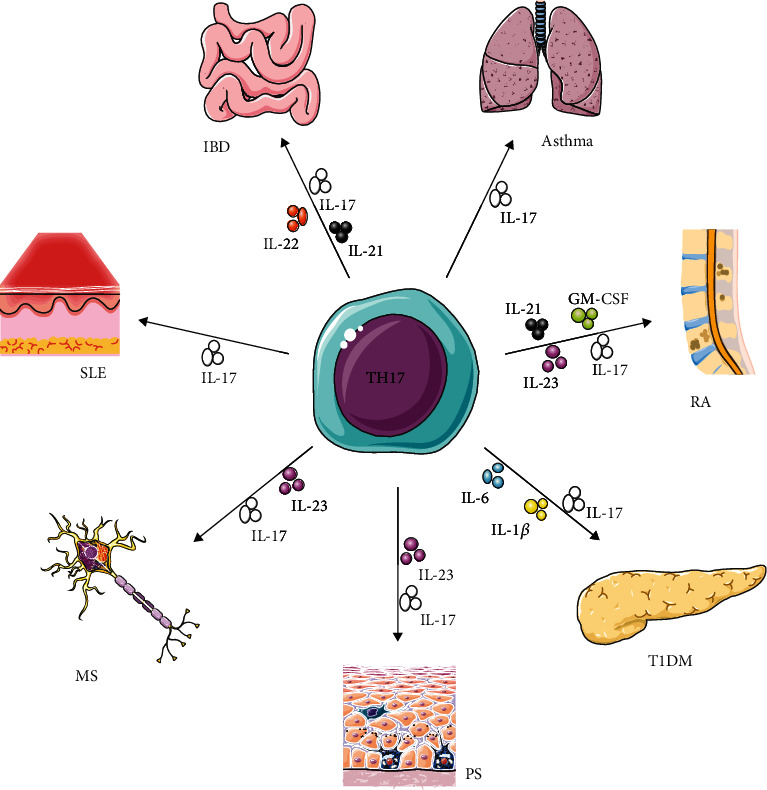
Autoimmune diseases (such as rheumatoid arthritis, asthma, autoimmune bowel disease) are a complex disease. Improper activation of the immune system or imbalance of immune cells can cause the immune system to transform into a proinflammatory state, leading to autoimmune pathological damage. Recent studies have shown that autoimmune diseases are closely related to CD4+ T helper cells (Th). The original CD4 T cells will differentiate into different T helper (Th) subgroups after activation. According to their cytokines, the types of Th cells are different to produce lineage-specific cytokines, which play a role in autoimmune homeostasis. When Th differentiation and its cytokines are not regulated, it will induce autoimmune inflammation. Autoimmune bowel disease (IBD) is an autoimmune disease of unknown cause. Current research shows that its pathogenesis is closely related to Th17 cells. This article reviews the role and plasticity of the upstream and downstream cytokines and signaling pathways of Th17 cells in the occurrence and development of autoimmune bowel disease and summarizes the new progress of IBD immunotherapy.
自身免疫性疾病(如类风湿关节炎、哮喘、自身免疫性肠病)是一种复杂的疾病。免疫系统的异常激活或免疫细胞的失衡可导致免疫系统转变为促炎状态,从而引发自身免疫性病理损伤。最近的研究表明,自身免疫性疾病与 CD4+T 辅助细胞(Th)密切相关。原始 CD4 T 细胞在激活后会分化为不同的 T 辅助(Th)亚群。根据细胞因子的不同,Th 细胞的类型也不同,产生谱系特异性细胞因子,在自身免疫稳态中发挥作用。当 Th 分化及其细胞因子不受调节时,会诱导自身免疫炎症。自身免疫性肠病(IBD)是一种病因不明的自身免疫性疾病。目前的研究表明,其发病机制与 Th17 细胞密切相关。本文综述了 Th17 细胞上游和下游细胞因子及信号通路在自身免疫性肠病发生发展中的作用及可塑性,并总结了 IBD 免疫治疗的新进展。