Department of Dermatology and Allergy, University Hospital, LMU Munich, Munich, Germany.
Int Wound J. 2021 Aug;18(4):536-542. doi: 10.1111/iwj.13553. Epub 2021 Feb 7.
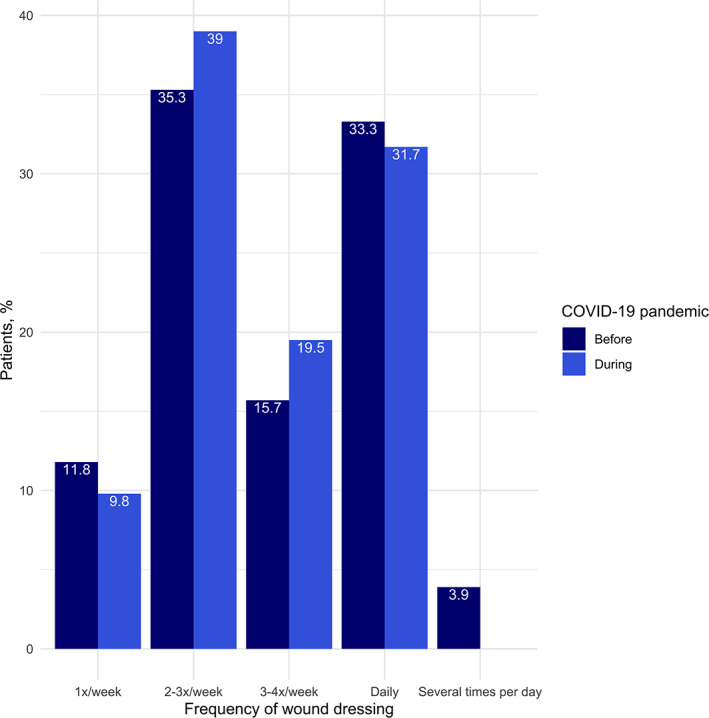
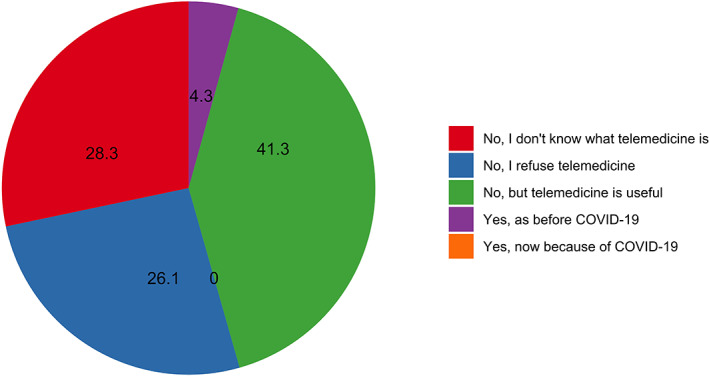
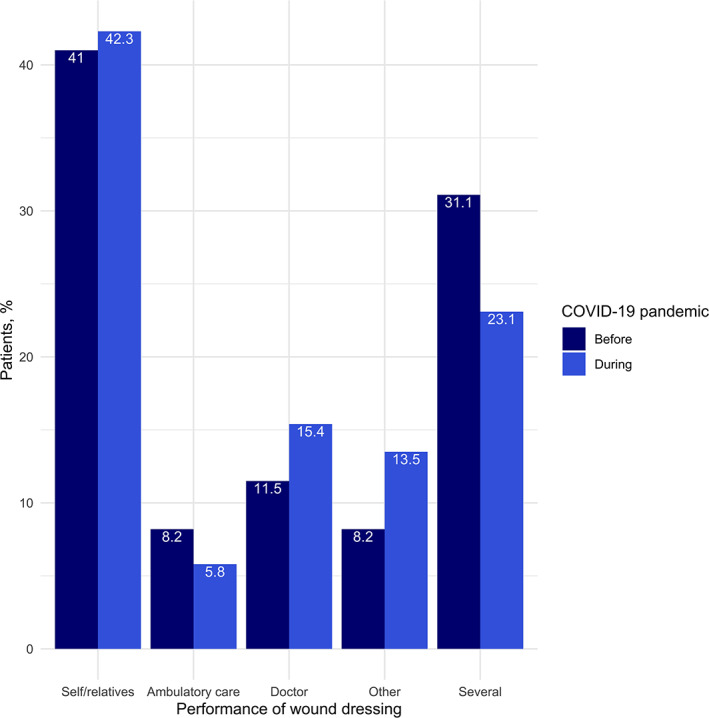
Recent studies showed that the COVID-19 pandemic caused collateral damage in health care in terms of reduced hospital submissions or postponed treatment of other acute or chronic ill patients. An anonymous survey was sent out by mail to patients with chronic wounds in order to evaluate the impact of the pandemic on wound care. Sixty-three patients returned the survey. In 14%, diagnostic workup or hospitalisation was cancelled or postponed. Thirty-six percent could not seek consultation by their primary care physician as usual. The use of public transport or long travel time was not related to limited access to medical service (P = .583). In ambulatory care, there was neither a significant difference in the frequency of changing wound dressings (P = .67), nor in the person, who performed wound care (P = .39). There were no significant changes in wound-specific quality of life (P = .505). No patient used telemedicine in order to avoid face-to-face contact or anticipate to pandemic-related restrictions. The COVID-19 pandemic impaired access to clinical management of chronic wounds in Germany. It had no significant impact on ambulatory care or wound-related quality of life. Telemedicine still plays a negligible role in wound care.
最近的研究表明,COVID-19 大流行对医疗保健造成了附带损害,表现为减少了医院提交的病例数或推迟了其他急性或慢性疾病患者的治疗。我们通过邮件向慢性伤口患者发送了一份匿名调查,以评估大流行对伤口护理的影响。共有 63 名患者回复了调查。其中 14%的患者的诊断检查或住院治疗被取消或推迟。36%的患者无法像往常一样向初级保健医生咨询。使用公共交通工具或长途旅行时间与获得医疗服务的机会有限无关(P=0.583)。在门诊护理中,更换伤口敷料的频率(P=0.67)和实施伤口护理的人员(P=0.39)均无显著差异。伤口特异性生活质量也没有显著变化(P=0.505)。没有患者使用远程医疗来避免面对面接触或预测与大流行相关的限制。COVID-19 大流行影响了德国慢性伤口的临床管理。它对门诊护理或与伤口相关的生活质量没有显著影响。远程医疗在伤口护理中的作用仍然微不足道。