Department of Environmental Health Sciences, Columbia University Mailman School of Public Health, New York, New York, USA.
Department of Epidemiology and Neurology, Columbia University, New York, New York, USA.
Environ Health Perspect. 2021 Feb;129(2):27003. doi: 10.1289/EHP7425. Epub 2021 Feb 8.
Adult-onset neurodegenerative diseases affect millions and negatively impact health care systems worldwide. Evidence suggests that air pollution may contribute to aggravation of neurodegeneration, but studies have been limited.
We examined the potential association between long-term exposure to particulate matter in aerodynamic diameter [fine particulate matter ()] and disease aggravation in Alzheimer's (AD) and Parkinson's (PD) diseases and amyotrophic lateral sclerosis (ALS), using first hospitalization as a surrogate of clinical aggravation.
We used data from the New York Department of Health Statewide Planning and Research Cooperative System (SPARCS 2000-2014) to construct annual county counts of first hospitalizations with a diagnosis of AD, PD, or ALS (total, urbanicity-, sex-, and age-stratified). We used annual concentrations estimated by a prediction model at a resolution, which we aggregated to population-weighted county averages to assign exposure to cases based on county of residence. We used outcome-specific mixed quasi-Poisson models with county-specific random intercepts to estimate rate ratios (RRs) for a 1-y exposure. We allowed for nonlinear exposure-outcome relationships using penalized splines and accounted for potential confounders.
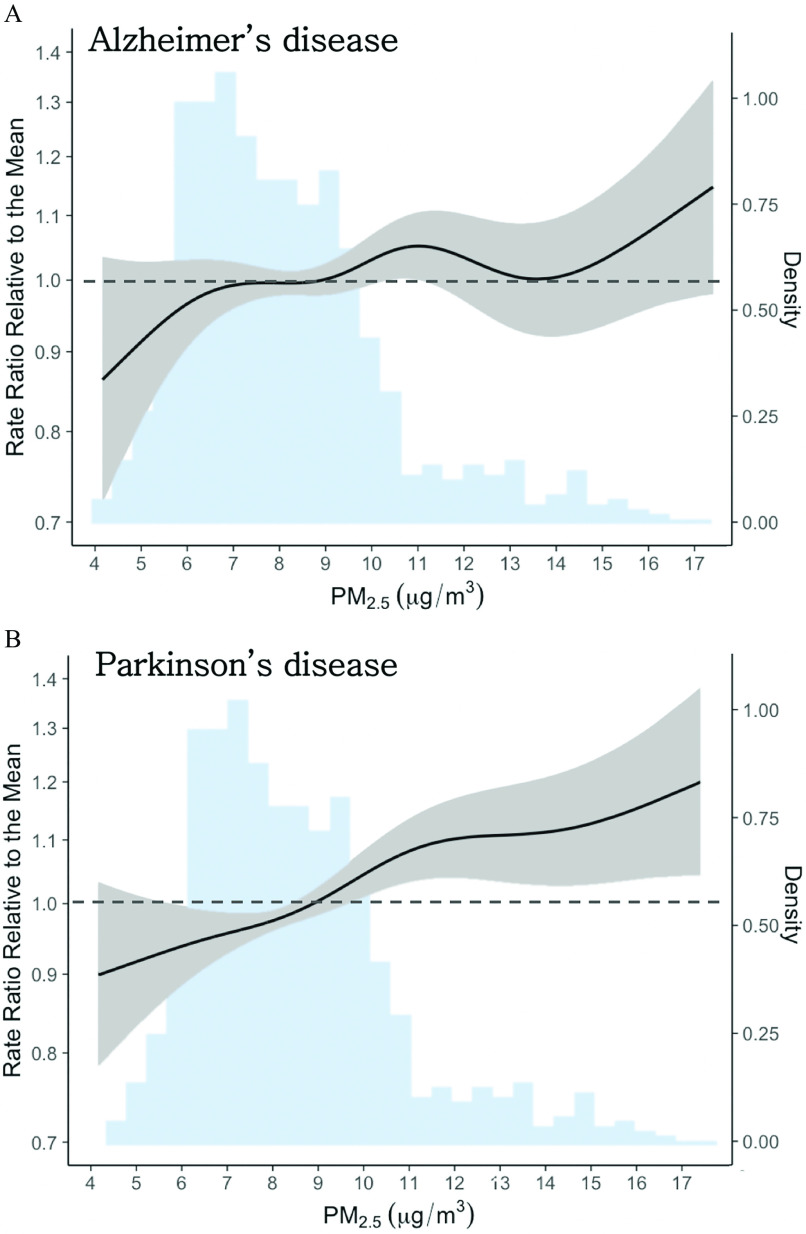
We found a positive nonlinear association that plateaued above (, 95% CI: 1.04, 1.14 for a increase from 8.1 to ). We also found a linear positive association (, 95% CI: 1.01, 1.09 per increase), and suggestive evidence of an association with AD. We found effect modification by age for PD and ALS with a stronger positive association in patients of age but found insufficient evidence of effect modification by sex or urbanization level for any of the outcomes.
Our findings suggest that annual increase in county-level concentrations may contribute to clinical aggravation of PD and ALS. Importantly, the average annual concentration in our study was , below the current American national standards, suggesting the standards may not adequately protect the aging population. https://doi.org/10.1289/EHP7425.
成人神经退行性疾病影响着数百万人,给全球的医疗保健系统带来了负面影响。有证据表明,空气污染可能会加剧神经退行性变,但相关研究还很有限。
我们通过首次住院作为临床恶化的替代指标,研究了在阿尔茨海默病(AD)、帕金森病(PD)和肌萎缩侧索硬化症(ALS)中,长期暴露于空气动力学直径下的颗粒物(细颗粒物 [PM2.5])与疾病恶化之间的潜在关联。
我们利用纽约州卫生署全州规划和研究合作系统(SPARCS 2000-2014 年)的数据,构建了 AD、PD 或 ALS 首次住院的县年度病例数(总病例数、城市化程度、性别和年龄分层)。我们使用预测模型估算了每年每 分辨率的浓度,并将其汇总到人口加权的县平均值,以根据居住的县为病例分配暴露情况。我们使用特定于结局的混合拟泊松模型,并使用县特定的随机截距,来估计每增加 1 年的暴露量的相对风险比(RR)。我们使用惩罚样条来考虑非线性暴露-结局关系,并考虑了潜在的混杂因素。
我们发现 PM2.5 存在一个正的非线性关联,在超过 (,RR:1.04,95%置信区间:1.01 至 1.14,与 8.1 增加至 )时趋于平稳。我们还发现了 PM2.5 与 PD 和 ALS 之间存在线性正关联(RR:每增加 ,95%置信区间:1.01 至 1.09),并且 AD 结局有与 PM2.5 相关的提示性证据。我们发现 PD 和 ALS 的年龄存在效应修饰,年龄较大的患者的正相关更强,但对于任何结局,我们都没有发现性别或城市化水平存在效应修饰的充分证据。
我们的研究结果表明,县一级 PM2.5 浓度的每年增加可能会导致 PD 和 ALS 的临床恶化。重要的是,我们研究中的平均年 PM2.5 浓度为 ,低于当前的美国国家标准,这表明这些标准可能不足以保护老年人群。