Johns Hopkins University School of Medicine, Baltimore, MD, United States.
University of Patras School of Medicine, Patras, Greece.
J Med Internet Res. 2021 Feb 8;23(2):e18773. doi: 10.2196/18773.
Cardiovascular disease (CVD) is the leading cause of death worldwide. Despite strong evidence supporting the benefits of cardiac rehabilitation (CR), over 80% of eligible patients do not participate in CR. Digital health technologies (ie, the delivery of care using the internet, wearable devices, and mobile apps) have the potential to address the challenges associated with traditional facility-based CR programs, but little is known about the comprehensiveness of these interventions to serve as digital approaches to CR. Overall, there is a lack of a systematic evaluation of the current literature on digital interventions for CR.
The objective of this systematic literature review is to provide an in-depth analysis of the potential of digital health technologies to address the challenges associated with traditional CR. Through this review, we aim to summarize the current literature on digital interventions for CR, identify the key components of CR that have been successfully addressed through digital interventions, and describe the gaps in research that need to be addressed for sustainable and scalable digital CR interventions.
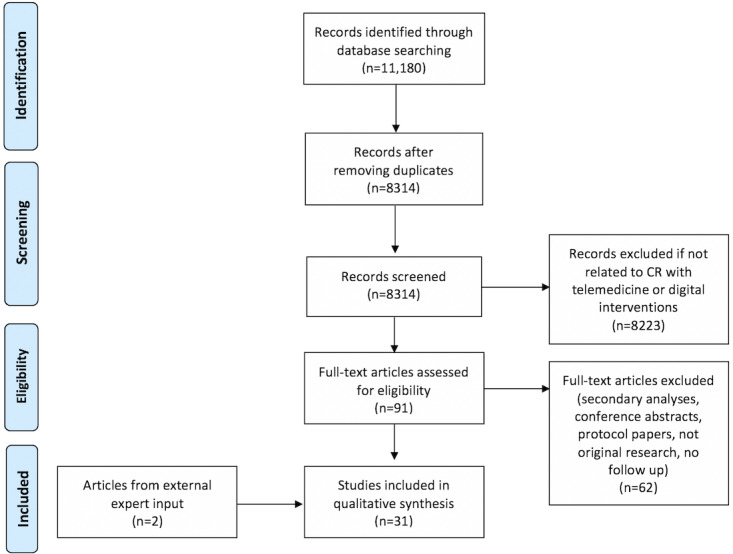
Our strategy for identifying the primary literature pertaining to CR with digital solutions (defined as technology employed to deliver remote care beyond the use of the telephone) included a consultation with an expert in the field of digital CR and searches of the PubMed (MEDLINE), Embase, CINAHL, and Cochrane databases for original studies published from January 1990 to October 2018.
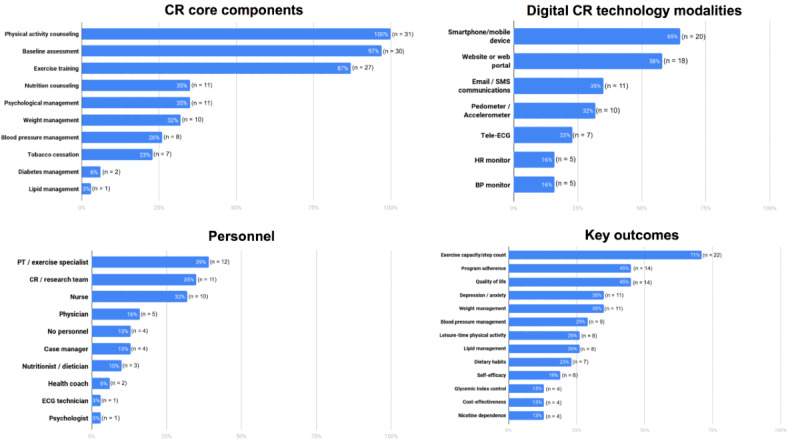
Our search returned 31 eligible studies, of which 22 were randomized controlled trials. The reviewed CR interventions primarily targeted physical activity counseling (31/31, 100%), baseline assessment (30/31, 97%), and exercise training (27/31, 87%). The most commonly used modalities were smartphones or mobile devices (20/31, 65%), web-based portals (18/31, 58%), and email-SMS (11/31, 35%). Approximately one-third of the studies addressed the CR core components of nutrition counseling, psychological management, and weight management. In contrast, less than a third of the studies addressed other CR core components, including the management of lipids, diabetes, smoking cessation, and blood pressure.
Digital technologies have the potential to increase access and participation in CR by mitigating the challenges associated with traditional, facility-based CR. However, previously evaluated interventions primarily focused on physical activity counseling and exercise training. Thus, further research is required with more comprehensive CR interventions and long-term follow-up to understand the clinical impact of digital interventions.
心血管疾病(CVD)是全球范围内的主要死因。尽管有强有力的证据支持心脏康复(CR)的益处,但超过 80%的合格患者未参加 CR。数字健康技术(即通过互联网、可穿戴设备和移动应用程序提供的护理)有可能解决传统基于设施的 CR 计划所面临的挑战,但对于这些干预措施作为 CR 的数字方法的全面性知之甚少。总体而言,目前关于 CR 的数字干预措施的文献缺乏系统评价。
本系统文献综述的目的是深入分析数字健康技术解决与传统 CR 相关挑战的潜力。通过本次综述,我们旨在总结有关 CR 的数字干预措施的现有文献,确定通过数字干预措施成功解决的 CR 的关键组成部分,并描述需要解决的研究空白,以实现可持续和可扩展的数字 CR 干预措施。
我们确定与数字解决方案相关的 CR 主要文献(定义为除使用电话外还用于远程护理的技术)的策略包括与数字 CR 领域的专家进行磋商,并在 PubMed(MEDLINE)、Embase、CINAHL 和 Cochrane 数据库中搜索 1990 年 1 月至 2018 年 10 月期间发表的原始研究。
我们的搜索返回了 31 项符合条件的研究,其中 22 项为随机对照试验。所审查的 CR 干预措施主要针对体力活动咨询(31/31,100%)、基线评估(30/31,97%)和运动训练(27/31,87%)。最常用的模式是智能手机或移动设备(20/31,65%)、基于网络的门户(18/31,58%)和电子邮件-SMS(11/31,35%)。大约三分之一的研究涉及营养咨询、心理管理和体重管理等 CR 的核心组成部分。相比之下,不到三分之一的研究涉及其他 CR 的核心组成部分,包括血脂、糖尿病、戒烟和血压管理。
数字技术有可能通过减轻传统基于设施的 CR 所面临的挑战,增加 CR 的可及性和参与度。然而,以前评估的干预措施主要侧重于体力活动咨询和运动训练。因此,需要进行更多涉及全面 CR 干预措施和长期随访的研究,以了解数字干预措施的临床影响。