Departamento de Ecología e Hidrología, Universidad de Murcia, Murcia, Spain.
Instituto Pirenaico de Ecología, Consejo Superior de Investigaciones Científicas, Zaragoza, Spain.
PLoS One. 2021 Feb 8;16(2):e0246335. doi: 10.1371/journal.pone.0246335. eCollection 2021.
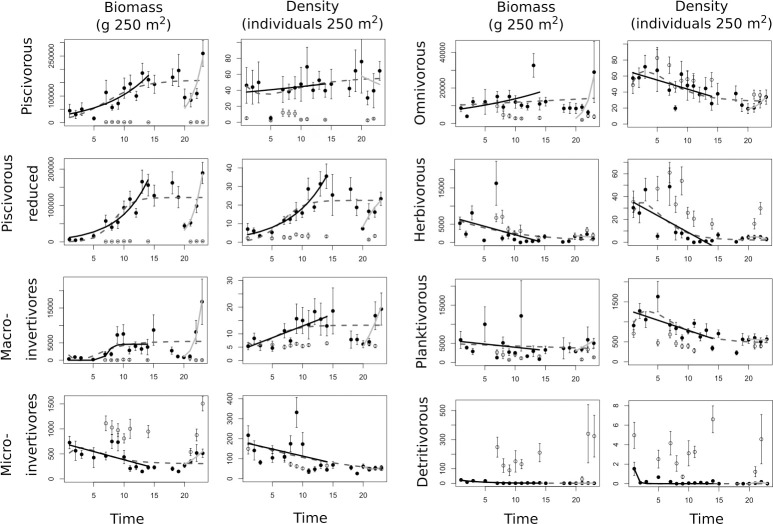
Marine Protected Areas (MPAs) help replenish fish assemblages, though different trophic levels may show diverse recovery patterns. Long-term protection is required to achieve total recovery but poaching events may prevent the achievement of full carrying capacity. Here, we have analysed the effect of long-term protection on the entire reef fish community and the different trophic levels in the Cabo de Palos-Islas Hormigas MPA (SE Spain; SW Mediterranean Sea) in order to assess their recovery patterns after 23 years of protection. We compared the values for carrying capacity obtained with the maximum values achieved at regional scale, and we assessed the effect of a reduction in the surveillance over a few years, during which poaching events increased, on the recovery patterns. We found that, overall, biomass of fishes increased with time while density diminished. In particular, piscivorous and macro-invertivore fish increased while the other trophic groups remained constant or declined, suggesting top-down processes. For the entire study period, those trophic groups were approaching carrying capacity; however, when accounting only for the period in which enforcement was high and constant, they grew exponentially, indicating that full carrying capacity may have not been achieved yet. When compared to other Mediterranean MPAs, the Cabo de Palos-Islas Hormigas MPA showed values for biomass that were disproportionately higher, suggesting that local factors, such as habitat structure and associated oceanographic processes, may be responsible for the dynamics found. Our results help to understand the potential trajectories of fish assemblages over a consolidated MPA and highlight empirically how the reduction of surveillance in a period may change the recovery patterns.
海洋保护区(MPAs)有助于补充鱼类群落,尽管不同的营养层次可能表现出不同的恢复模式。需要长期保护才能实现完全恢复,但偷猎事件可能会阻止达到最大承载能力。在这里,我们分析了长期保护对卡波德帕洛斯-伊斯拉斯霍里加斯 MPA(西班牙东南部;地中海西南部)整个珊瑚礁鱼类群落和不同营养层次的影响,以评估它们在 23 年的保护后恢复模式。我们比较了与区域尺度上获得的最大值相关的承载能力值,并评估了在几年内减少监测的效果,在此期间,偷猎事件增加,对恢复模式的影响。我们发现,总的来说,鱼类的生物量随着时间的推移而增加,而密度则减少。特别是,肉食性和大型无脊椎动物鱼类增加,而其他营养组保持不变或减少,表明存在自上而下的过程。在整个研究期间,这些营养组正在接近承载能力;然而,当仅考虑执法力度高且持续的时期时,它们呈指数增长,表明尚未达到最大承载能力。与其他地中海 MPAs 相比,卡波德帕洛斯-伊斯拉斯霍里加斯 MPA 的生物量值不成比例地较高,这表明局部因素,如栖息地结构和相关的海洋过程,可能是造成这种动态的原因。我们的研究结果有助于了解经过整合的 MPA 中鱼类群落的潜在轨迹,并从经验上突出说明在一段时间内减少监测可能会如何改变恢复模式。