Emory Vaccine Center, Emory University, Atlanta, Georgia, United States of America.
Yerkes National Primate Research Center, Emory University, Atlanta, Georgia, United States of America.
PLoS Pathog. 2021 Feb 8;17(2):e1009257. doi: 10.1371/journal.ppat.1009257. eCollection 2021 Feb.
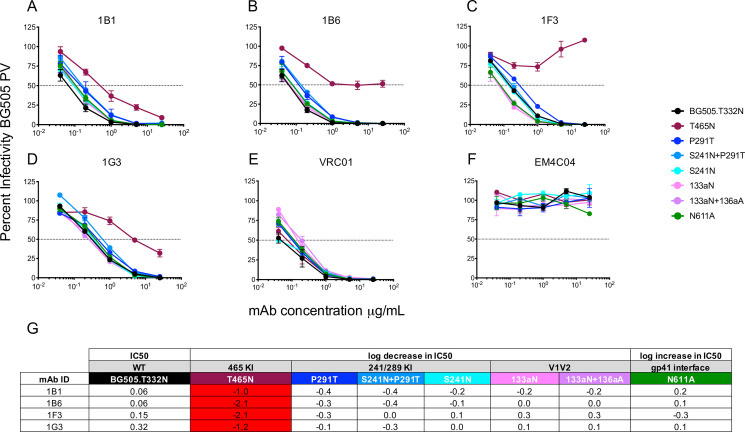
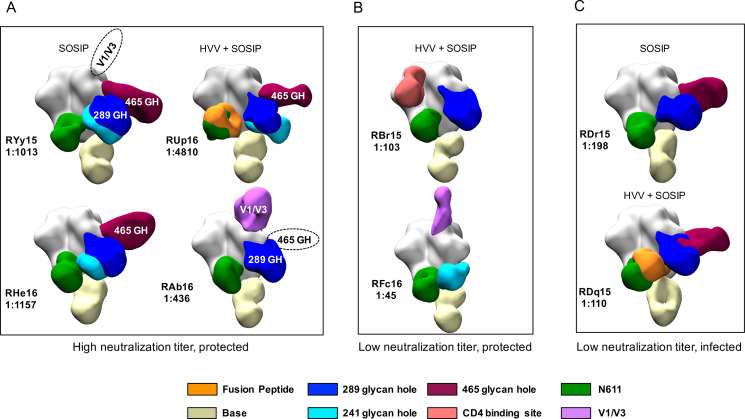
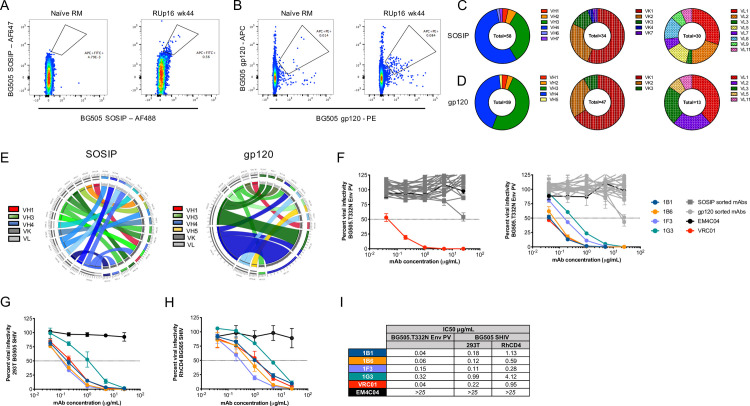
Stabilized HIV-1 envelope (Env) trimers elicit tier 2 autologous neutralizing antibody (nAb) responses in immunized animals. We previously demonstrated that BG505 SOSIP.664.T332N gp140 (BG505 SOSIP) immunization of rhesus macaques (RM) provided robust protection against autologous intra-vaginal simian-human immunodeficiency virus (SHIV) challenge that was predicted by high serum nAb titers. Here, we show that nAb in these protected RM targeted a glycan hole proximal to residue 465 in gp120 in all cases. nAb also targeted another glycan hole at residues 241/289 and an epitope in V1 at varying frequencies. Non-neutralizing antibodies directed at N611-shielded epitopes in gp41 were also present but were more prevalent in RM with low nAb titers. Longitudinal analysis demonstrated that nAb broadened in some RM during sequential immunization but remained focused in others, the latter being associated with increases in nAb titer. Thirty-eight monoclonal antibodies (mAbs) isolated from a protected RM with an exceptionally high serum neutralization titer bound to the trimer in ELISA, and four of the mAbs potently neutralized the BG505 Env pseudovirus (PV) and SHIV. The four neutralizing mAbs were clonally related and targeted the 465 glycan hole to varying degrees, mimicking the serum. The data demonstrate that the C3/465 glycan hole cluster was the dominant neutralization target in high titer protected RM, despite other co-circulating neutralizing and non-neutralizing specificities. The isolation of a neutralizing mAb family argues that clonotype expansion occurred during BG505 SOSIP immunization, leading to high titer, protective nAb and setting a desirable benchmark for HIV vaccines.
稳定的 HIV-1 包膜 (Env) 三聚体在免疫动物中引发 2 级同源中和抗体 (nAb) 反应。我们之前证明,BG505 SOSIP.664.T332N gp140(BG505 SOSIP)免疫恒河猴(RM)提供了针对同源阴道内猴免疫缺陷病毒(SHIV)挑战的强大保护,这是由高血清 nAb 滴度预测的。在这里,我们表明,在所有情况下,这些受保护的 RM 中的 nAb 靶向 gp120 中接近残基 465 的糖基空洞。nAb 还以不同频率靶向另一个位于残基 241/289 的糖基空洞和 V1 中的一个表位。针对 gp41 中 N611 屏蔽表位的非中和抗体也存在,但在 nAb 滴度较低的 RM 中更为普遍。纵向分析表明,在一些 RM 中,nAb 在连续免疫过程中有所扩大,但在其他 RM 中仍然集中,后者与 nAb 滴度的增加有关。从具有异常高血清中和滴度的受保护 RM 中分离出的 38 种单克隆抗体(mAb)在 ELISA 中结合三聚体,其中 4 种 mAb 能有效中和 BG505 Env 假病毒(PV)和 SHIV。这四种中和 mAb 是克隆相关的,并且以不同程度靶向 465 糖基空洞,模拟了血清。数据表明,在高滴度受保护的 RM 中,C3/465 糖基空洞簇是主要的中和靶标,尽管存在其他循环中和和非中和特异性。中和 mAb 家族的分离表明,在 BG505 SOSIP 免疫过程中发生了克隆型扩展,导致高滴度、保护性 nAb,并为 HIV 疫苗设定了理想的基准。