Burn and Soft Tissue Injury Research Department, US Army Institute of Surgical Research, JBSA Fort Sam Houston, Houston, TX 78234, USA.
Comparative Pathology Department, US Army Institute of Surgical Research, JBSA Fort Sam Houston, Houston, TX 78234, USA.
Int J Mol Sci. 2021 Feb 4;22(4):1590. doi: 10.3390/ijms22041590.
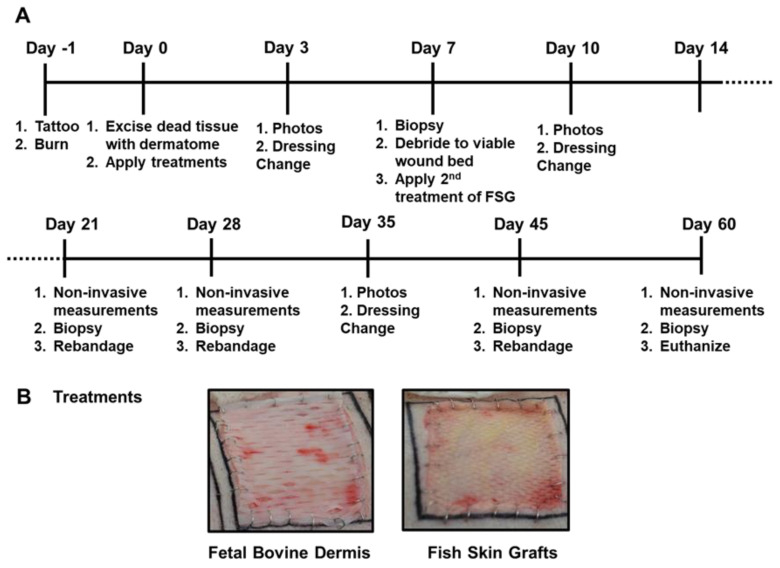
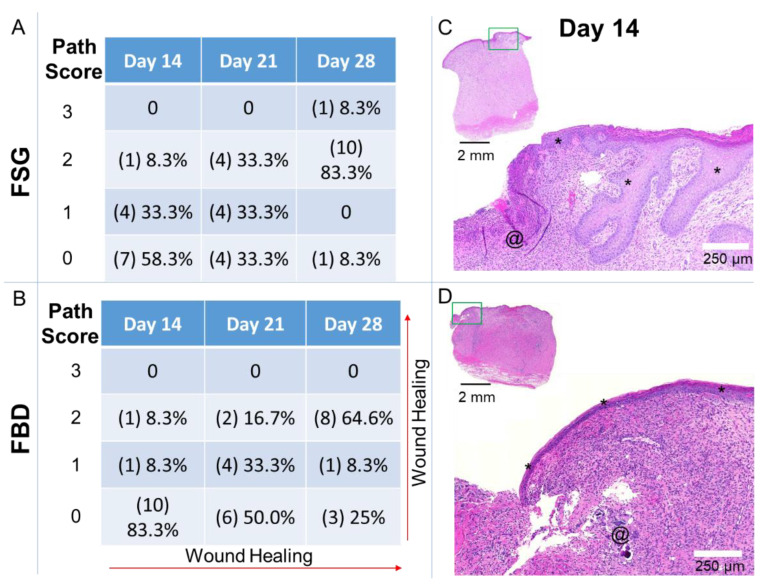
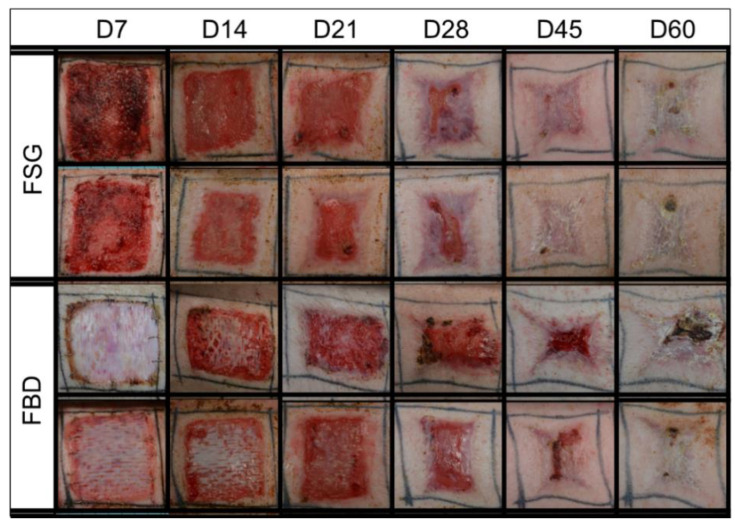
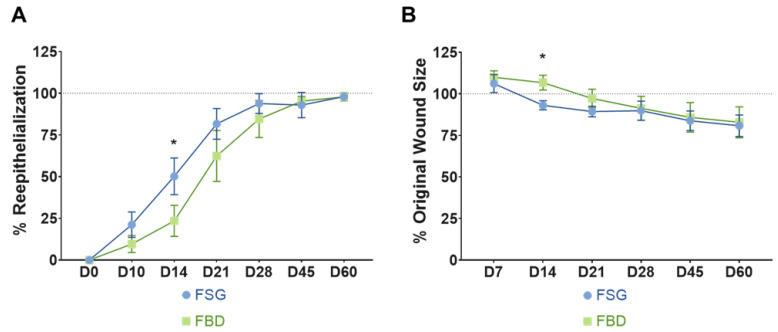
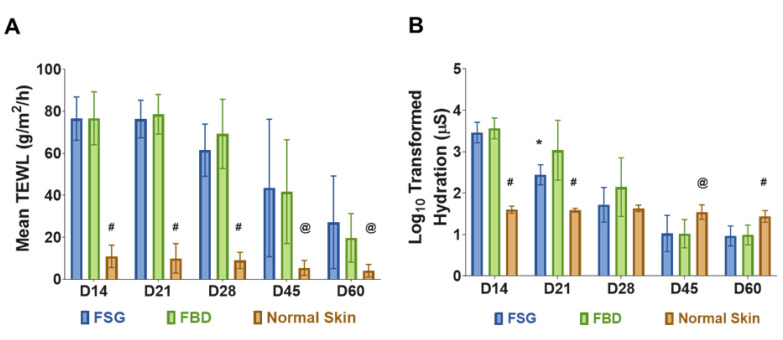
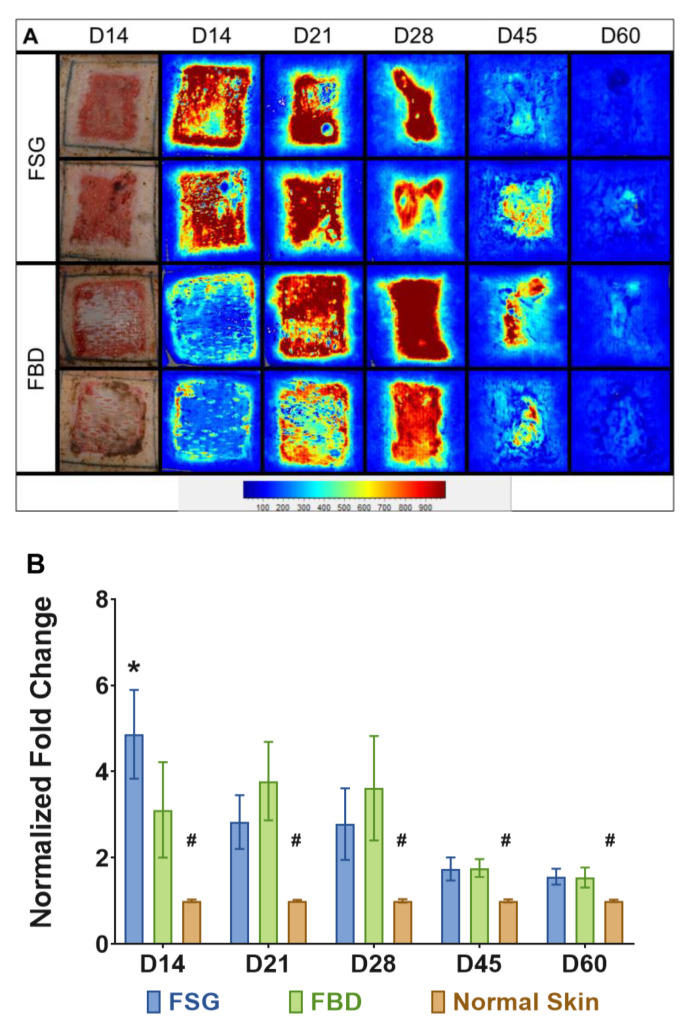
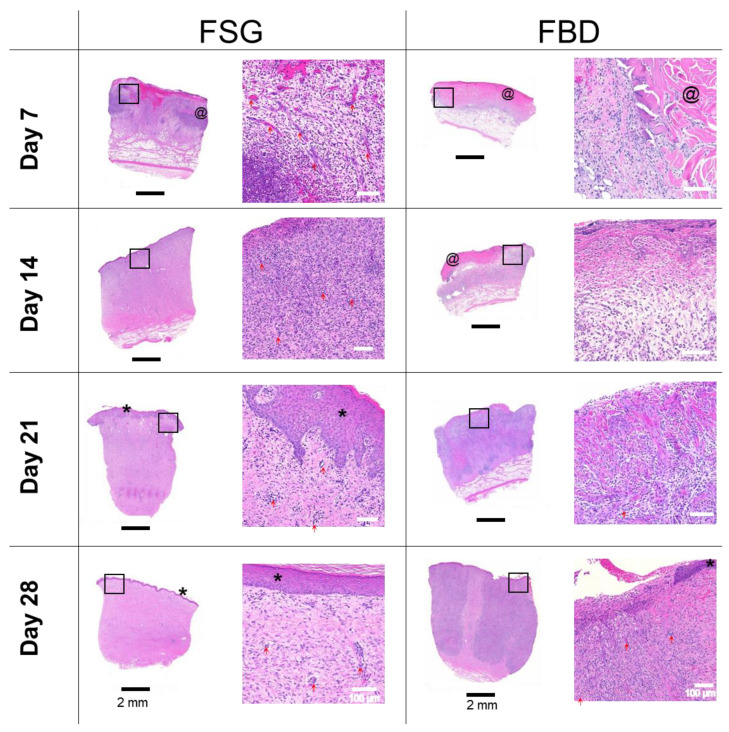
Thermal injuries are caused by exposure to a variety of sources, and split thickness skin grafts are the gold standard treatment for severe burns; however, they may be impossible when there is no donor skin available. Large total body surface area burns leave patients with limited donor site availability and create a need for treatments capable of achieving early and complete coverage that can also retain normal skin function. In this preclinical trial, two cellular and tissue based products (CTPs) are evaluated on twenty-four 5 × 5 deep partial thickness (DPT) burn wounds. Using appropriate pain control methods, DPT burn wounds were created on six anesthetized Yorkshire pigs. Wounds were excised one day post-burn and the bleeding wound beds were subsequently treated with omega-3-rich acellular fish skin graft (FSG) or fetal bovine dermis (FBD). FSG was reapplied after 7 days and wounds healed via secondary intentions. Digital images, non-invasive measurements, and punch biopsies were acquired during rechecks performed on days 7, 14, 21, 28, 45, and 60. Multiple qualitative measurements were also employed, including re-epithelialization, contraction rates, hydration, laser speckle, and trans-epidermal water loss (TEWL). Each treatment produced granulated tissue (GT) that would be receptive to skin grafts, if desired; however, the FSG induced GT 7 days earlier. FSG treatment resulted in faster re-epithelialization and reduced wound size at day 14 compared to FBD (50.2% vs. 23.5% and 93.1% vs. 106.7%, < 0.005, respectively). No differences in TEWL measurements were observed. The FSG integrated into the wound bed quicker as evidenced by lower hydration values at day 21 (309.7 vs. 2500.4 µS, < 0.05) and higher blood flow at day 14 (4.9 vs. 3.1 fold change increase over normal skin, < 0.005). Here we show that FSG integrated faster without increased contraction, resulting in quicker wound closure without skin graft application which suggests FSG improved burn wound healing over FBD.
热损伤是由暴露于各种来源引起的,而 表皮片移植是严重烧伤的金标准治疗方法;然而,当没有供皮区时,可能无法进行这种治疗。大面积全身体表面积烧伤使患者供皮区有限,需要能够实现早期和完全覆盖的治疗方法,同时保留正常皮肤功能。在这项临床前试验中,两种细胞和组织基产品(CTP)在 24 个 5×5 深部分厚度(DPT)烧伤伤口上进行了评估。使用适当的止痛方法,在 6 只麻醉的约克郡猪上创建 DPT 烧伤伤口。在烧伤后第 1 天切除伤口,随后用富含 ω-3 的去细胞鱼皮移植物(FSG)或胎牛真皮(FBD)处理出血性创面床。FSG 在第 7 天重新应用,伤口通过二期愈合。在第 7、14、21、28、45 和 60 天进行复查时获取数字图像、非侵入性测量和活检。还进行了多种定性测量,包括再上皮化、收缩率、水合作用、激光散斑和经皮水分丢失(TEWL)。如果需要,每种治疗方法都产生了可接受皮片移植的肉芽组织(GT);然而,FSG 诱导 GT 的时间早 7 天。FSG 治疗在第 14 天比 FBD 更快地实现再上皮化和减少伤口面积(50.2%对 23.5%和 93.1%对 106.7%, < 0.005)。在 TEWL 测量中没有观察到差异。FSG 更快地整合到创面床中,这一点可以从第 21 天较低的水合值(309.7 对 2500.4 µS, < 0.05)和第 14 天较高的血流(4.9 对正常皮肤增加 3.1 倍, < 0.005)得到证明。在这里,我们表明 FSG 更快地整合,而不会增加收缩,从而无需皮片移植即可更快地闭合伤口,这表明 FSG 改善了烧伤创面愈合,优于 FBD。