Montreal Heart Institute (M.-P.D., M.-A.L., A.L., L.-P.L.P., R.F., G.A., S.P., A.B., M.S., M.C., L.B., I.M., A.D., D.R., N.B., M.S., S.d.D., P.L.L., M.-C.G., J.-C.T.), Université de Montréal, Canada.
Université de Montréal Beaulieu-Saucier Pharmacogenomics Centre (M.-P.D., M.-A.L., A.L., L.-P.L.P., R.F., G.A., S.P., A.B., M.S., I.M., A.D., S.d.D.), Université de Montréal, Canada.
Circ Genom Precis Med. 2021 Apr;14(2):e003183. doi: 10.1161/CIRCGEN.120.003183. Epub 2021 Feb 9.
The randomized, placebo-controlled COLCOT (Colchicine Cardiovascular Outcomes Trial) has shown the benefits of colchicine 0.5 mg daily to lower the rate of ischemic cardiovascular events in patients with a recent myocardial infarction. Here, we conducted a post hoc pharmacogenomic study of COLCOT with the aim to identify genetic predictors of the efficacy and safety of treatment with colchicine.
There were 1522 participants of European ancestry from the COLCOT trial available for the pharmacogenomic study of COLCOT trial. The pharmacogenomic study's primary cardiovascular end point was defined as for the main trial, as time to first occurrence of cardiovascular death, resuscitated cardiac arrest, myocardial infarction, stroke, or urgent hospitalization for angina requiring coronary revascularization. The safety end point was time to the first report of gastrointestinal events. Patients' DNA was genotyped using the Illumina Global Screening array followed by imputation. We performed a genome-wide association study in colchicine-treated patients.
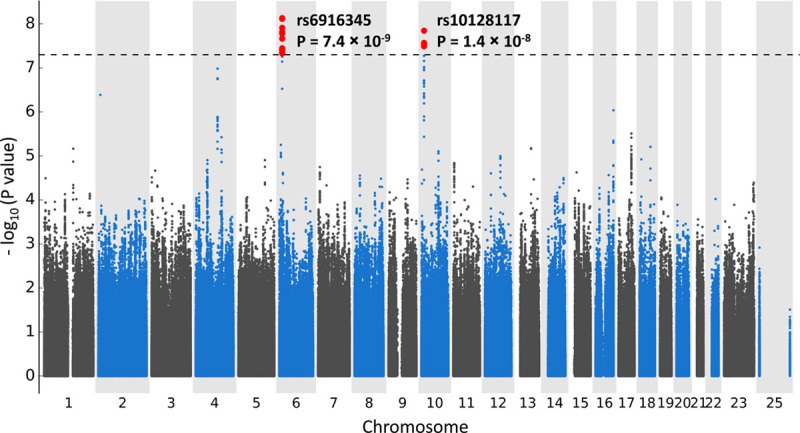
None of the genetic variants passed the genome-wide association study significance threshold for the primary cardiovascular end point conducted in 702 patients in the colchicine arm who were compliant to medication. The genome-wide association study for gastrointestinal events was conducted in all 767 patients in the colchicine arm and found 2 significant association signals, one with lead variant rs6916345 (hazard ratio, 1.89 [95% CI, 1.52-2.35], =7.41×10) in a locus which colocalizes with Crohn disease, and one with lead variant rs74795203 (hazard ratio, 2.51 [95% CI, 1.82-3.47]; =2.70×10), an intronic variant in gene . The interaction terms between the genetic variants and treatment with colchicine versus placebo were significant.
We found 2 genomic regions associated with gastrointestinal events in patients treated with colchicine. Those findings will benefit from replication to confirm that some patients may have genetic predispositions to lower tolerability of treatment with colchicine.
随机、安慰剂对照的 COLCOT(秋水仙碱心血管结局试验)已表明,每天服用 0.5 毫克秋水仙碱可降低近期心肌梗死后缺血性心血管事件的发生率。在这里,我们对 COLCOT 进行了一项事后药物基因组学研究,旨在确定秋水仙碱治疗效果和安全性的遗传预测因子。
COLCOT 试验中有 1522 名欧洲血统的参与者可用于 COLCOT 试验的药物基因组学研究。药物基因组学研究的主要心血管终点与主要试验相同,定义为首次发生心血管死亡、复苏性心脏骤停、心肌梗死、中风或因心绞痛需要冠状动脉血运重建而紧急住院的时间。安全终点是首次报告胃肠道事件的时间。使用 Illumina Global Screening 阵列对患者的 DNA 进行基因分型,然后进行推断。我们对秋水仙碱治疗患者进行了全基因组关联研究。
在遵守药物治疗的秋水仙碱组 702 名患者中进行的主要心血管终点的全基因组关联研究中,没有一个遗传变异通过全基因组关联研究的显著性阈值。对秋水仙碱组的所有 767 名患者进行了胃肠道事件的全基因组关联研究,发现了 2 个显著的关联信号,一个与位于克罗恩病的先导变异 rs6916345(危险比,1.89 [95% CI,1.52-2.35],=7.41×10)相关,另一个与位于基因中的先导变异 rs74795203(危险比,2.51 [95% CI,1.82-3.47];=2.70×10)相关,这是一个基因的内含子变异。遗传变异与秋水仙碱与安慰剂治疗之间的相互作用项具有显著性。
我们发现了 2 个与秋水仙碱治疗患者胃肠道事件相关的基因组区域。这些发现需要进一步复制以证实一些患者可能对秋水仙碱治疗的耐受性降低具有遗传易感性。