Departement of Medical Sciences, A.O.U. Città della Salute e della Scienza di Torino, University Cardiology, Corso Bramante 88, 10126, Turin, Italy.
Intern Emerg Med. 2021 Sep;16(6):1691-1700. doi: 10.1007/s11739-021-02654-7. Epub 2021 Mar 11.
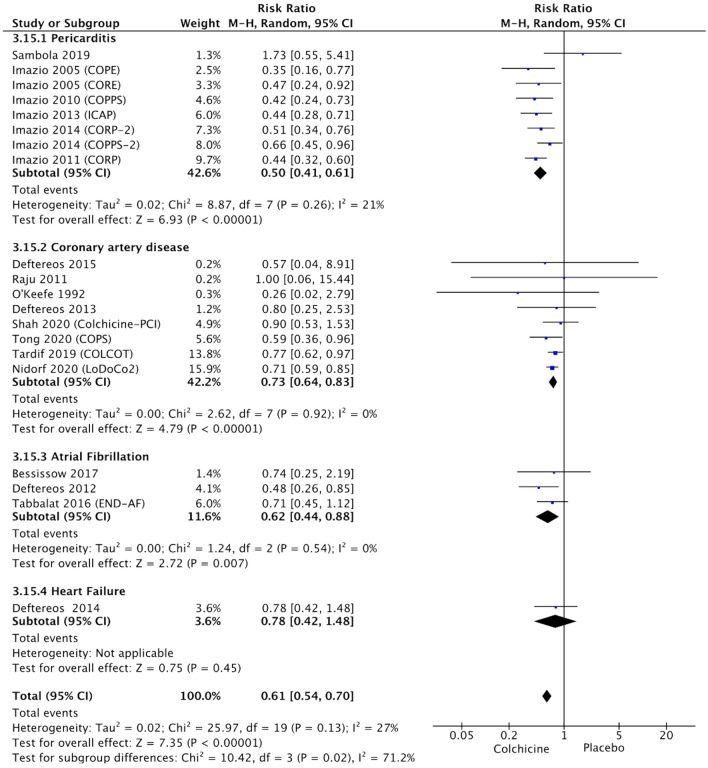
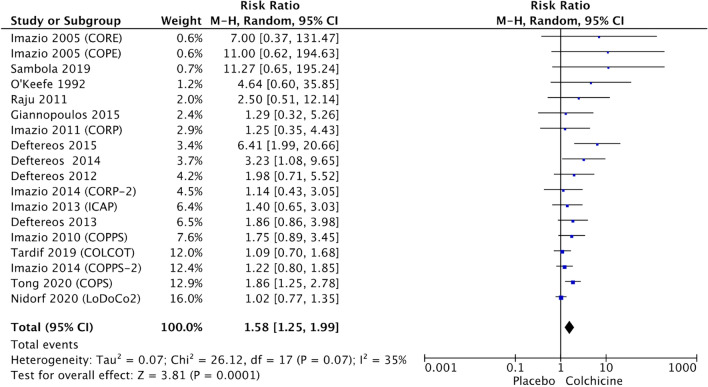
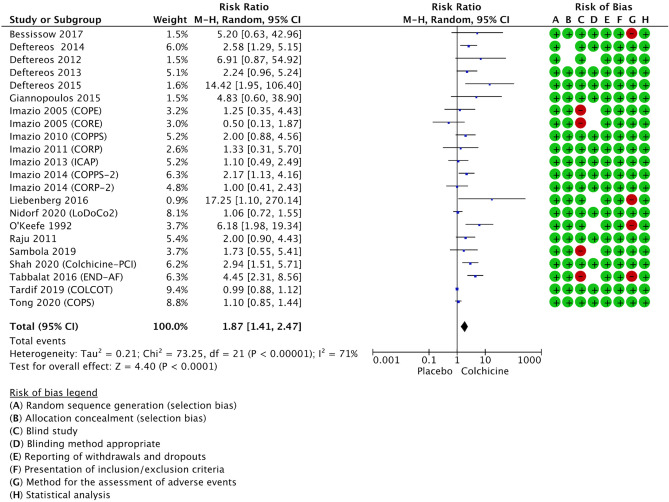
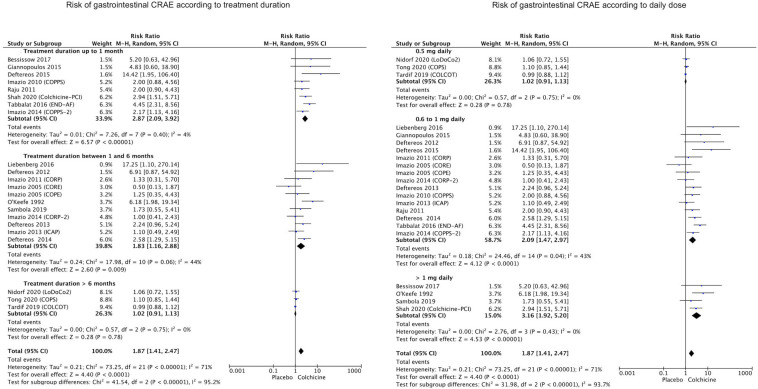
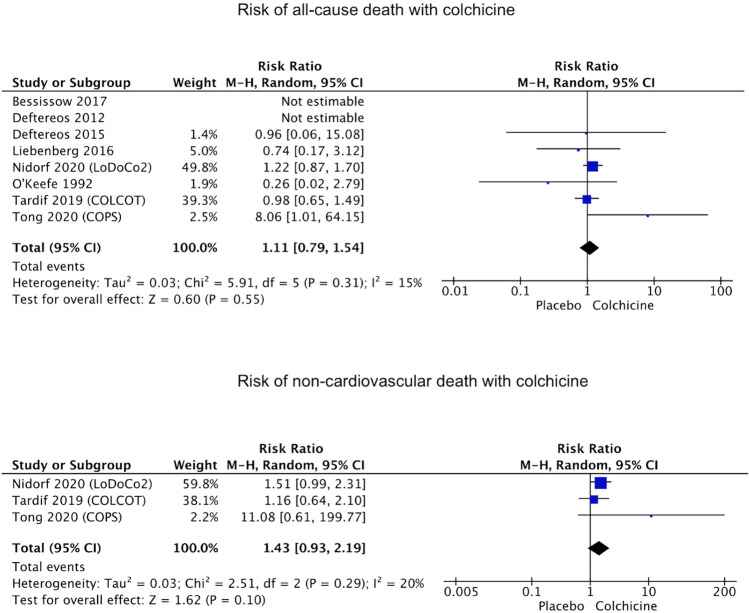
The emerging role of colchicine in the treatment of cardiovascular diseases is a strong demand for a comprehensive understanding of its efficacy and safety. This meta-analysis and systematic review aimed to study the efficacy in the reduction of adverse cardiovascular outcomes (CO), and the risk of colchicine-related adverse events (CRAEs). Fourteen thousand and nine eighty three patients from 22 randomized controlled trials (RCTs) were included, 9 in patients with coronary artery disease-CAD, 9 in patients with pericarditis, 4 in patients with atrial fibrillation-AF or heart failure. Colchicine was efficacious in the reduction of adverse CO across different settings: pericardial diseases (reduced risk of recurrent pericarditis, 17.6% vs. 35%, RR 0.50, 95% CI 0.41-0.61), CAD (reduced risk of cardiac death, myocardial infarction, stroke,coronary revascularization or hospitalization, 6.1% vs. 8.5%, RR 0.73, 95% CI 0.64-0.83), AF (reduced risk of arrhythmia recurrence, 14.2% vs. 22.7%, RR 0.62, 95% CI 0.44-0.88). Colchicine was associated with increased risk of gastrointestinal CRAEs (11.2% vs. 8.8%, RR 1.87, 95% CI 1.41-2.47) and drug discontinuation (5.4% vs. 3.7%, RR 1.58, 95% CI 1.25-1.99). In both cases, the risk was proportional to the daily dose or duration of treatment, possibly due to early drug discontinuation or tolerance. Other CRAEs (muscle-related, liver,hematologic,cutaneous, infections) were not increased by colchicine, as long as all-cause death (2.2% vs. 1.9%, RR 1.11, 95% CI 0.79-1.54) or non-cardiovascular death (1.5% vs. 1%, RR 1.43, 95% CI 0.93-2.19). Colchicine is efficacious and safe for the treatment of cardiovascular diseases. The risk of gastrointestinal CRAEs and drug discontinuation is not significant if colchicine is used at lower doses (0.5 mg daily) or for longer periods of time (> 6 months).
秋水仙碱在心血管疾病治疗中的新作用对其疗效和安全性的全面了解提出了强烈需求。本荟萃分析和系统评价旨在研究其降低不良心血管结局(CO)的疗效,以及秋水仙碱相关不良事件(CRAEs)的风险。共纳入 22 项随机对照试验(RCT)的 14093 名患者,其中 9 项为冠状动脉疾病(CAD)患者,9 项为心包炎患者,4 项为心房颤动(AF)或心力衰竭患者。秋水仙碱在不同疾病中均有效降低不良 CO:心包疾病(复发性心包炎风险降低,17.6% vs. 35%,RR 0.50,95%CI 0.41-0.61)、CAD(心脏死亡、心肌梗死、中风、冠状动脉血运重建或住院风险降低,6.1% vs. 8.5%,RR 0.73,95%CI 0.64-0.83)、AF(心律失常复发风险降低,14.2% vs. 22.7%,RR 0.62,95%CI 0.44-0.88)。秋水仙碱与胃肠道 CRAEs(11.2% vs. 8.8%,RR 1.87,95%CI 1.41-2.47)和药物停药(5.4% vs. 3.7%,RR 1.58,95%CI 1.25-1.99)风险增加相关,但这种风险与每日剂量或治疗时间呈比例关系,可能是由于早期药物停药或耐受。其他 CRAEs(肌肉相关、肝脏、血液学、皮肤、感染)不会因秋水仙碱而增加,只要全因死亡(2.2% vs. 1.9%,RR 1.11,95%CI 0.79-1.54)或非心血管死亡(1.5% vs. 1%,RR 1.43,95%CI 0.93-2.19)没有增加。秋水仙碱治疗心血管疾病既有效又安全。如果以较低剂量(每日 0.5 毫克)或更长时间(>6 个月)使用秋水仙碱,胃肠道 CRAEs 和药物停药的风险并不显著。