Institute for Global Health, University College London, London, UK
Clinical Research Department, Faculty of Infectious and Tropical Diseases, London School of Hygiene & Tropical Medicine, London, UK.
BMJ Open. 2021 Feb 9;11(2):e047110. doi: 10.1136/bmjopen-2020-047110.
To describe the characteristics and outcomes of patients with a clinical diagnosis of COVID-19 and false-negative SARS-CoV-2 reverse transcription-PCR (RT-PCR), and develop and internally validate a diagnostic risk score to predict risk of COVID-19 (including RT-PCR-negative COVID-19) among medical admissions.
Retrospective cohort study.
Two hospitals within an acute NHS Trust in London, UK.
All patients admitted to medical wards between 2 March and 3 May 2020.
Main outcomes were diagnosis of COVID-19, SARS-CoV-2 RT-PCR results, sensitivity of SARS-CoV-2 RT-PCR and mortality during hospital admission. For the diagnostic risk score, we report discrimination, calibration and diagnostic accuracy of the model and simplified risk score and internal validation.
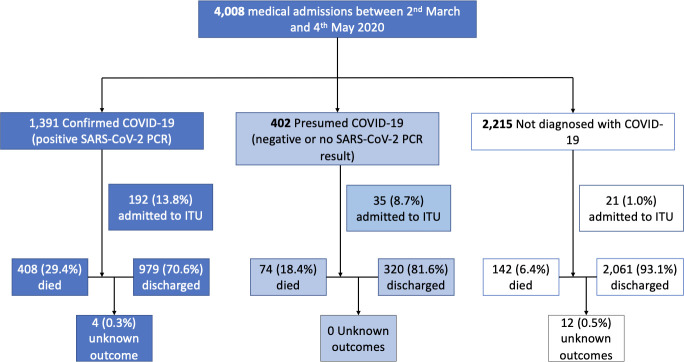
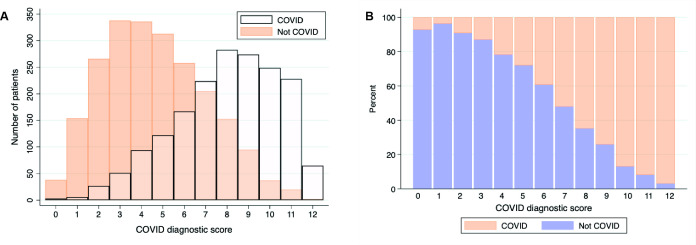
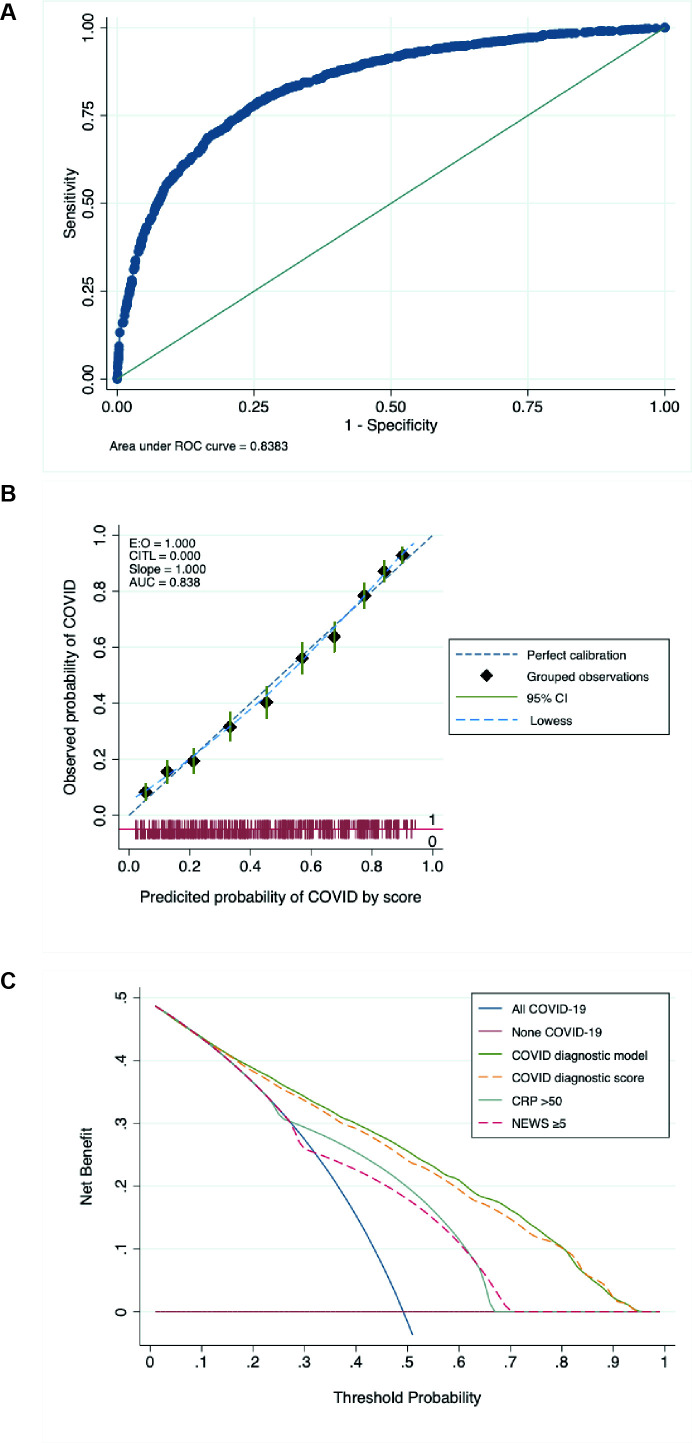
4008 patients were admitted between 2 March and 3 May 2020. 1792 patients (44.8%) were diagnosed with COVID-19, of whom 1391 were SARS-CoV-2 RT-PCR positive and 283 had only negative RT-PCRs. Compared with a clinical reference standard, sensitivity of RT-PCR in hospital patients was 83.1% (95% CI 81.2%-84.8%). Broadly, patients with false-negative RT-PCR COVID-19 and those confirmed by positive PCR had similar demographic and clinical characteristics but lower risk of intensive care unit admission and lower in-hospital mortality (adjusted OR 0.41, 95% CI 0.27-0.61). A simple diagnostic risk score comprising of age, sex, ethnicity, cough, fever or shortness of breath, National Early Warning Score 2, C reactive protein and chest radiograph appearance had moderate discrimination (area under the receiver-operator curve 0.83, 95% CI 0.82 to 0.85), good calibration and was internally validated.
RT-PCR-negative COVID-19 is common and is associated with lower mortality despite similar presentation. Diagnostic risk scores could potentially help triage patients requiring admission but need external validation.
描述临床诊断为 COVID-19 但 SARS-CoV-2 逆转录聚合酶链反应(RT-PCR)结果为阴性的患者的特征和结局,并建立和内部验证一个预测住院患者 COVID-19(包括 RT-PCR 阴性 COVID-19)风险的诊断风险评分。
回顾性队列研究。
英国伦敦一家急性国民保健服务信托基金会内的两家医院。
2020 年 3 月 2 日至 5 月 3 日期间入住内科病房的所有患者。
主要结局为 COVID-19 诊断、SARS-CoV-2 RT-PCR 结果、SARS-CoV-2 RT-PCR 的敏感性以及住院期间的死亡率。对于诊断风险评分,我们报告了模型和简化风险评分的区分度、校准度和诊断准确性以及内部验证。
2020 年 3 月 2 日至 5 月 3 日期间共收治 4008 例患者。其中 1792 例(44.8%)患者被诊断为 COVID-19,其中 1391 例患者 SARS-CoV-2 RT-PCR 阳性,283 例患者仅 RT-PCR 阴性。与临床参考标准相比,住院患者 RT-PCR 的敏感性为 83.1%(95%CI 81.2%-84.8%)。总体而言,RT-PCR 阴性 COVID-19 患者和通过阳性 PCR 确诊的患者具有相似的人口统计学和临床特征,但 ICU 入住率和院内死亡率较低(校正 OR 0.41,95%CI 0.27-0.61)。一个包含年龄、性别、种族、咳嗽、发热或呼吸急促、早期预警评分 2、C 反应蛋白和胸部 X 线表现的简单诊断风险评分具有中等的区分度(受试者工作特征曲线下面积 0.83,95%CI 0.82 至 0.85)、良好的校准度,并在内部得到验证。
RT-PCR 阴性 COVID-19 很常见,尽管临床表现相似,但死亡率较低。诊断风险评分可能有助于分诊需要住院的患者,但需要外部验证。