Cavazos Taylor B, Witte John S
Biological and Medical Informatics, University of California, San Francisco, San Francisco, CA 94158, USA.
Department of Epidemiology and Biostatistics, University of California, San Francisco, San Francisco, CA 94158, USA.
HGG Adv. 2021 Jan 14;2(1). doi: 10.1016/j.xhgg.2020.100017. Epub 2020 Dec 2.
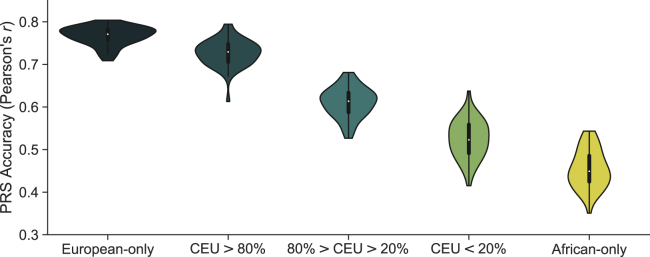
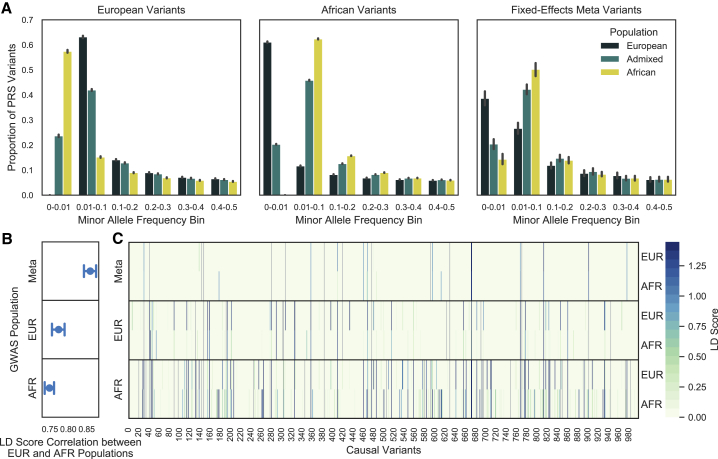
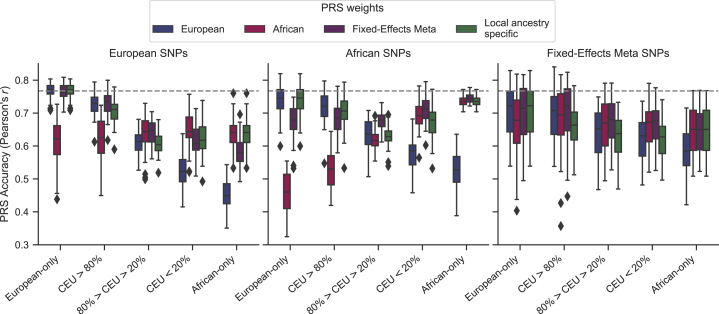
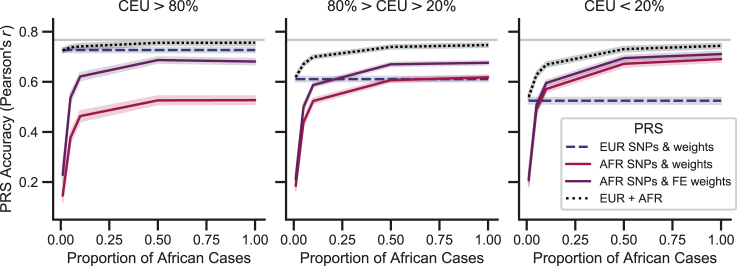
The majority of polygenic risk scores (PRSs) have been developed and optimized in individuals of European ancestry and may have limited generalizability across other ancestral populations. Understanding aspects of PRSs that contribute to this issue and determining solutions is complicated by disease-specific genetic architecture and limited knowledge of sharing of causal variants and effect sizes across populations. Motivated by these challenges, we undertook a simulation study to assess the relationship between ancestry and the potential bias in PRSs developed in European ancestry populations. Our simulations show that the magnitude of this bias increases with increasing divergence from European ancestry, and this is attributed to population differences in linkage disequilibrium and allele frequencies of European-discovered variants, likely as a result of genetic drift. Importantly, we find that including into the PRS variants discovered in African ancestry individuals has the potential to achieve unbiased estimates of genetic risk across global populations and admixed individuals. We confirm our simulation findings in an analysis of hemoglobin A1c (HbA1c), asthma, and prostate cancer in the UK Biobank. Given the demonstrated improvement in PRS prediction accuracy, recruiting larger diverse cohorts will be crucial-and potentially even necessary-for enabling accurate and equitable genetic risk prediction across populations.
大多数多基因风险评分(PRSs)是在欧洲血统个体中开发和优化的,在其他祖先群体中的通用性可能有限。由于特定疾病的遗传结构以及对不同人群间因果变异和效应大小共享情况的了解有限,理解导致这一问题的PRSs方面并确定解决方案变得很复杂。受这些挑战的推动,我们进行了一项模拟研究,以评估血统与在欧洲血统人群中开发的PRSs潜在偏差之间的关系。我们的模拟表明,这种偏差的程度随着与欧洲血统差异的增加而增大,这归因于连锁不平衡和欧洲发现的变异的等位基因频率在人群中的差异,这可能是遗传漂变的结果。重要的是,我们发现将在非洲血统个体中发现的变异纳入PRS有潜力在全球人群和混血个体中实现对遗传风险的无偏估计。我们在英国生物银行对糖化血红蛋白(HbA1c)、哮喘和前列腺癌的分析中证实了我们的模拟结果。鉴于已证明的PRS预测准确性的提高,招募更多样化的队列对于实现跨人群的准确和公平的遗传风险预测至关重要,甚至可能是必要的。