• 文献检索
  • 文档翻译
  • 深度研究
  • 学术资讯
  • Suppr Zotero 插件Zotero 插件
  • 邀请有礼
  • 套餐&价格
  • 历史记录
应用&插件
Suppr Zotero 插件Zotero 插件浏览器插件Mac 客户端Windows 客户端微信小程序
定价
高级版会员购买积分包购买API积分包
服务
文献检索文档翻译深度研究API 文档MCP 服务
关于我们
关于 Suppr公司介绍联系我们用户协议隐私条款
关注我们

Suppr 超能文献

核心技术专利:CN118964589B侵权必究
粤ICP备2023148730 号-1Suppr @ 2026

文献检索

告别复杂PubMed语法,用中文像聊天一样搜索,搜遍4000万医学文献。AI智能推荐,让科研检索更轻松。

立即免费搜索

文件翻译

保留排版,准确专业,支持PDF/Word/PPT等文件格式,支持 12+语言互译。

免费翻译文档

深度研究

AI帮你快速写综述,25分钟生成高质量综述,智能提取关键信息,辅助科研写作。

立即免费体验

跨人群的多基因预测受到血统、遗传结构和方法学的影响。

Polygenic prediction across populations is influenced by ancestry, genetic architecture, and methodology.

作者信息

Wang Ying, Kanai Masahiro, Tan Taotao, Kamariza Mireille, Tsuo Kristin, Yuan Kai, Zhou Wei, Okada Yukinori, Huang Hailiang, Turley Patrick, Atkinson Elizabeth G, Martin Alicia R

机构信息

Analytic and Translational Genetics Unit, Massachusetts General Hospital, Boston, MA 02114, USA.

Stanley Center for Psychiatric Research and Program in Medical and Population Genetics, Broad Institute of MIT and Harvard, Cambridge, MA 02142, USA.

出版信息

Cell Genom. 2023 Sep 14;3(10):100408. doi: 10.1016/j.xgen.2023.100408. eCollection 2023 Oct 11.

DOI:10.1016/j.xgen.2023.100408
PMID:37868036
原文链接:https://pmc.ncbi.nlm.nih.gov/articles/PMC10589629/
Abstract

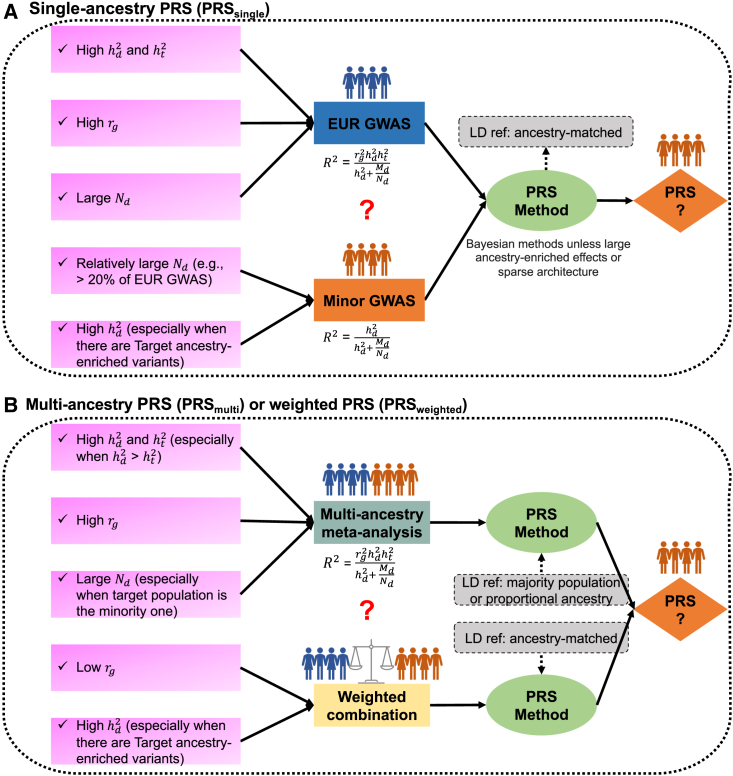
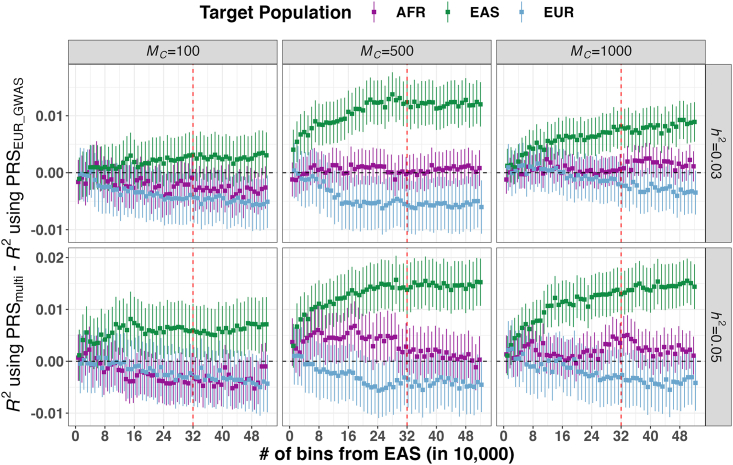
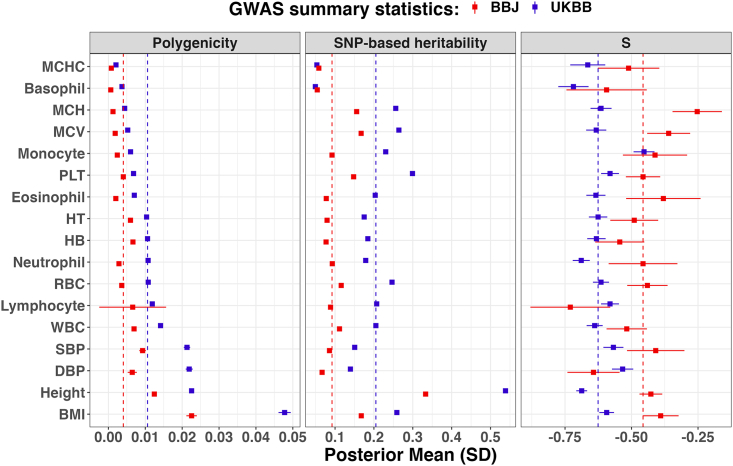
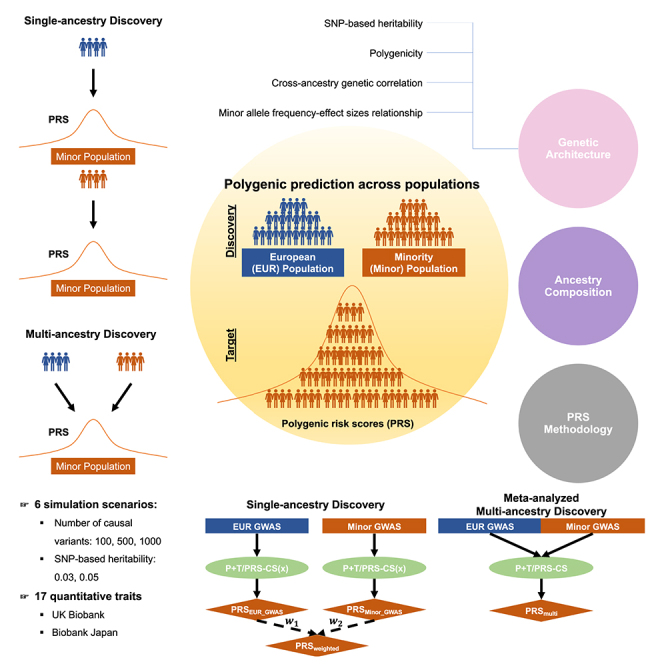
Polygenic risk scores (PRSs) developed from multi-ancestry genome-wide association studies (GWASs), PRS, hold promise for improving PRS accuracy and generalizability across populations. To establish best practices for leveraging the increasing diversity of genomic studies, we investigated how various factors affect the performance of PRS compared with PRSs constructed from single-ancestry GWASs (PRS). Through extensive simulations and empirical analyses, we showed that PRS overall outperformed PRS in understudied populations, except when the understudied population represented a small proportion of the multi-ancestry GWAS. Furthermore, integrating PRSs based on local ancestry-informed GWASs and large-scale, European-based PRSs improved predictive performance in understudied African populations, especially for less polygenic traits with large-effect ancestry-enriched variants. Our work highlights the importance of diversifying genomic studies to achieve equitable PRS performance across ancestral populations and provides guidance for developing PRSs from multiple studies.

摘要

从多血统全基因组关联研究(GWAS)中开发的多基因风险评分(PRS)有望提高PRS在不同人群中的准确性和通用性。为了确立利用基因组研究日益增长的多样性的最佳实践,我们研究了与从单血统GWAS构建的PRS相比,各种因素如何影响PRS的性能。通过广泛的模拟和实证分析,我们表明,除了研究不足的人群在多血统GWAS中所占比例较小时,PRS在研究不足的人群中总体表现优于PRS。此外,整合基于本地血统信息的GWAS和大规模欧洲血统PRS的PRS提高了在研究不足的非洲人群中的预测性能,特别是对于具有大效应血统富集变异的较少多基因性状。我们的工作强调了使基因组研究多样化以在不同祖先群体中实现公平的PRS性能的重要性,并为从多项研究中开发PRS提供了指导。
https://cdn.ncbi.nlm.nih.gov/pmc/blobs/99fe/10589629/935d08f20c1d/gr7.jpg
https://cdn.ncbi.nlm.nih.gov/pmc/blobs/99fe/10589629/d82c602c7002/fx1.jpg
https://cdn.ncbi.nlm.nih.gov/pmc/blobs/99fe/10589629/160dcbf98fa9/gr1.jpg
https://cdn.ncbi.nlm.nih.gov/pmc/blobs/99fe/10589629/46b54bbeb9cb/gr2.jpg
https://cdn.ncbi.nlm.nih.gov/pmc/blobs/99fe/10589629/8fac23a9431b/gr3.jpg
https://cdn.ncbi.nlm.nih.gov/pmc/blobs/99fe/10589629/8a51c2c094c3/gr4.jpg
https://cdn.ncbi.nlm.nih.gov/pmc/blobs/99fe/10589629/5eb997714c97/gr5.jpg
https://cdn.ncbi.nlm.nih.gov/pmc/blobs/99fe/10589629/85130bb905c7/gr6.jpg
https://cdn.ncbi.nlm.nih.gov/pmc/blobs/99fe/10589629/935d08f20c1d/gr7.jpg
https://cdn.ncbi.nlm.nih.gov/pmc/blobs/99fe/10589629/d82c602c7002/fx1.jpg
https://cdn.ncbi.nlm.nih.gov/pmc/blobs/99fe/10589629/160dcbf98fa9/gr1.jpg
https://cdn.ncbi.nlm.nih.gov/pmc/blobs/99fe/10589629/46b54bbeb9cb/gr2.jpg
https://cdn.ncbi.nlm.nih.gov/pmc/blobs/99fe/10589629/8fac23a9431b/gr3.jpg
https://cdn.ncbi.nlm.nih.gov/pmc/blobs/99fe/10589629/8a51c2c094c3/gr4.jpg
https://cdn.ncbi.nlm.nih.gov/pmc/blobs/99fe/10589629/5eb997714c97/gr5.jpg
https://cdn.ncbi.nlm.nih.gov/pmc/blobs/99fe/10589629/85130bb905c7/gr6.jpg
https://cdn.ncbi.nlm.nih.gov/pmc/blobs/99fe/10589629/935d08f20c1d/gr7.jpg

相似文献

1
Polygenic prediction across populations is influenced by ancestry, genetic architecture, and methodology.跨人群的多基因预测受到血统、遗传结构和方法学的影响。
Cell Genom. 2023 Sep 14;3(10):100408. doi: 10.1016/j.xgen.2023.100408. eCollection 2023 Oct 11.
2
All of Us diversity and scale improve polygenic prediction contextually with greatest improvements for under-represented populations.“我们所有人”项目的多样性和规模在情境中改善了多基因预测,对代表性不足的人群改善最大。
bioRxiv. 2024 Aug 6:2024.08.06.606846. doi: 10.1101/2024.08.06.606846.
3
Evaluating polygenic risk score prediction performance for Alzheimer's disease in a population-based Hispanic cohort using single- and multi-ancestry models.在一个基于人群的西班牙裔队列中,使用单祖先和多祖先模型评估阿尔茨海默病的多基因风险评分预测性能。
Lancet Reg Health Am. 2025 Jul 25;49:101198. doi: 10.1016/j.lana.2025.101198. eCollection 2025 Sep.
4
Multi-ancestry polygenic risk scores for venous thromboembolism.多血统多基因静脉血栓栓塞症风险评分。
Hum Mol Genet. 2024 Sep 3;33(18):1584-1591. doi: 10.1093/hmg/ddae097.
5
Leveraging local ancestry and cross-ancestry genetic architecture to improve genetic prediction of complex traits in admixed populations.利用本地祖先和跨祖先遗传结构改善混合人群复杂性状的遗传预测。
Am J Hum Genet. 2025 Jul 3. doi: 10.1016/j.ajhg.2025.06.010.
6
Performance of Polygenic Risk Scores for Primary Open-Angle Glaucoma in Populations of African Descent.非洲裔人群中原发性开角型青光眼多基因风险评分的表现
JAMA Ophthalmol. 2025 Jan 1;143(1):7-14. doi: 10.1001/jamaophthalmol.2024.4784.
7
Polygenic Scores of Cardiometabolic Risk Factors in American Indian Adults.美国印第安成年人心脏代谢风险因素的多基因评分
JAMA Netw Open. 2025 Mar 3;8(3):e250535. doi: 10.1001/jamanetworkopen.2025.0535.
8
Multi-ancestry polygenic risk scores for the prediction of type 2 diabetes and complications in diverse ancestries.用于预测不同血统人群2型糖尿病及其并发症的多血统多基因风险评分。
medRxiv. 2025 Jul 23:2025.07.21.25331778. doi: 10.1101/2025.07.21.25331778.
9
MUSSEL: Enhanced Bayesian polygenic risk prediction leveraging information across multiple ancestry groups.基于多祖先群体信息的贝类增强贝叶斯多基因风险预测
Cell Genom. 2024 Apr 10;4(4):100539. doi: 10.1016/j.xgen.2024.100539.
10
Insights into Ancestral Diversity in Parkinsons Disease Risk: A Comparative Assessment of Polygenic Risk Scores.帕金森病风险中祖先多样性的见解:多基因风险评分的比较评估
medRxiv. 2024 May 9:2023.11.28.23299090. doi: 10.1101/2023.11.28.23299090.

引用本文的文献

1
Consortium profile: the methylation, imaging and NeuroDevelopment (MIND) consortium.联盟简介:甲基化、成像与神经发育(MIND)联盟
Mol Psychiatry. 2025 Sep 6. doi: 10.1038/s41380-025-03203-w.
2
Leveraging local ancestry and cross-ancestry genetic architecture to improve genetic prediction of complex traits in admixed populations.利用本地祖先和跨祖先遗传结构改善混合人群复杂性状的遗传预测。
Am J Hum Genet. 2025 Jul 3. doi: 10.1016/j.ajhg.2025.06.010.
3
Development and Validation of a Type 1 Diabetes Multi-Ancestry Polygenic Score.

本文引用的文献

1
Optimal strategies for learning multi-ancestry polygenic scores vary across traits.学习多血统多基因评分的最佳策略因性状而异。
Nat Commun. 2023 Jul 7;14(1):4023. doi: 10.1038/s41467-023-38930-7.
2
Polygenic scoring accuracy varies across the genetic ancestry continuum.多基因评分准确性在遗传祖先连续体上有所差异。
Nature. 2023 Jun;618(7966):774-781. doi: 10.1038/s41586-023-06079-4. Epub 2023 May 17.
3
Causal effects on complex traits are similar for common variants across segments of different continental ancestries within admixed individuals.
1型糖尿病多血统多基因风险评分的开发与验证
medRxiv. 2025 Jun 22:2025.06.20.25329522. doi: 10.1101/2025.06.20.25329522.
4
Ancestry Calibration of Polygenic Risk Scores Improves Risk Stratification and Effect Estimation in African American Adults.多基因风险评分的血统校准改善了非裔美国成年人的风险分层和效应估计。
medRxiv. 2025 Jun 18:2025.06.18.25329573. doi: 10.1101/2025.06.18.25329573.
5
Extending Genome-Wide Association Studies to admixed cohorts with high degrees of relatedness.将全基因组关联研究扩展至具有高度亲缘关系的混合队列。
medRxiv. 2025 Jun 9:2025.05.27.25328444. doi: 10.1101/2025.05.27.25328444.
6
Transferability of European-derived Alzheimer's disease polygenic risk scores across multiancestry populations.源自欧洲的阿尔茨海默病多基因风险评分在多祖先人群中的可转移性。
Nat Genet. 2025 Jun 18. doi: 10.1038/s41588-025-02227-w.
7
Putting Polygenic Scores in Context: How Intersectional Factors Affect Relative and Absolute Genetic Risk.将多基因评分置于背景中:交叉因素如何影响相对和绝对遗传风险。
medRxiv. 2025 Jun 5:2025.06.04.25328987. doi: 10.1101/2025.06.04.25328987.
8
Robust inference and widespread genetic correlates from a large-scale genetic association study of human personality.一项关于人类个性的大规模基因关联研究的稳健推断和广泛的基因相关性
bioRxiv. 2025 May 19:2025.05.16.648988. doi: 10.1101/2025.05.16.648988.
9
Diabetes mellitus polygenic risk scores: heterogeneity and clinical translation.糖尿病多基因风险评分:异质性与临床转化。
Nat Rev Endocrinol. 2025 Jun 4. doi: 10.1038/s41574-025-01132-w.
10
Development and Validation of Polygenic Risk Scores for Blood Pressure Traits in Continental African Populations.非洲大陆人群血压性状多基因风险评分的开发与验证
Circ Genom Precis Med. 2025 Jun;18(3):e005048. doi: 10.1161/CIRCGEN.124.005048. Epub 2025 May 27.
在混合个体中,不同大陆血统片段上的常见变异对复杂性状的因果效应相似。
Nat Genet. 2023 Apr;55(4):549-558. doi: 10.1038/s41588-023-01338-6. Epub 2023 Mar 20.
4
Low and differential polygenic score generalizability among African populations due largely to genetic diversity.由于遗传多样性,非洲人群中的低和差异多基因评分普遍适用性在很大程度上受到影响。
HGG Adv. 2023 Feb 13;4(2):100184. doi: 10.1016/j.xhgg.2023.100184. eCollection 2023 Apr 13.
5
Global Biobank analyses provide lessons for developing polygenic risk scores across diverse cohorts.全球生物样本库分析为在不同队列中开发多基因风险评分提供了经验教训。
Cell Genom. 2023 Jan 4;3(1):100241. doi: 10.1016/j.xgen.2022.100241. eCollection 2023 Jan 11.
6
Meta-analysis fine-mapping is often miscalibrated at single-variant resolution.荟萃分析精细定位在单变异分辨率下常常校准不当。
Cell Genom. 2022 Dec 14;2(12). doi: 10.1016/j.xgen.2022.100210. Epub 2022 Nov 4.
7
The Research Program: Data quality, utility, and diversity.研究计划:数据质量、效用和多样性。
Patterns (N Y). 2022 Aug 12;3(8):100570. doi: 10.1016/j.patter.2022.100570.
8
Improving polygenic prediction in ancestrally diverse populations.提高在祖源多样化人群中的多基因预测能力。
Nat Genet. 2022 May;54(5):573-580. doi: 10.1038/s41588-022-01054-7. Epub 2022 May 5.
9
Leveraging fine-mapping and multipopulation training data to improve cross-population polygenic risk scores.利用精细映射和多人群训练数据提高跨人群多基因风险评分。
Nat Genet. 2022 Apr;54(4):450-458. doi: 10.1038/s41588-022-01036-9. Epub 2022 Apr 7.
10
A roadmap to increase diversity in genomic studies.增加基因组研究多样性的路线图。
Nat Med. 2022 Feb;28(2):243-250. doi: 10.1038/s41591-021-01672-4. Epub 2022 Feb 10.