Discipline of Natural Sciences, Indian Institute of Information Technology, Design, and Manufacturing, Jabalpur, Madhya Pradesh, India.
Department of Pharmacoinformatics, National Institute of Pharmaceutical Education and Research, Kolkata, West Bengal, India.
J Biomol Struct Dyn. 2022 Sep;40(14):6381-6397. doi: 10.1080/07391102.2021.1883112. Epub 2021 Feb 10.
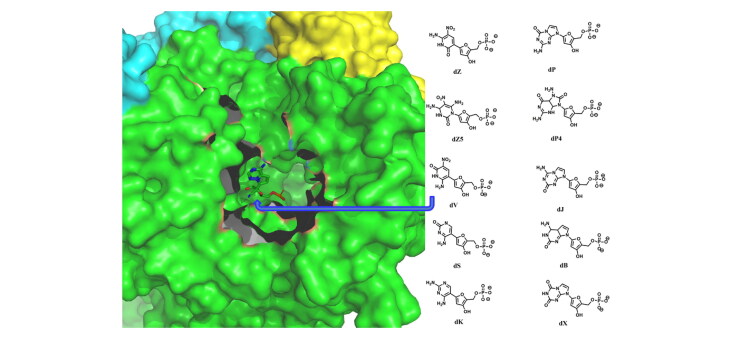
The recent outbreak of the SARS-CoV-2 infection has affected the lives and economy of more than 200 countries. The unavailability of virus-specific drugs has created an opportunity to identify potential therapeutic agents that can control the rapid transmission of this pandemic. Here, the mechanisms of the inhibition of the RNA-dependent RNA polymerase (RdRp), responsible for the replication of the virus in host cells, are examined by different ligands, such as Remdesivir (RDV), Remdesivir monophosphate (RMP), and several artificially expanded genetic information systems (AEGISs) including their different sequences by employing molecular docking, MD simulations, and MM/GBSA techniques. It is found that the binding of RDV to RdRp may block the RNA binding site. However, RMP would acquire a partially flipped conformation and may allow the viral RNA to enter into the binding site. The internal dynamics of RNA and RdRp may help RMP to regain its original position, where it may inhibit the RNA-chain elongation reaction. Remarkably, AEGISs are found to obstruct the binding site of RNA. It is shown that dPdZ, a two-nucleotide sequence containing P and Z would bind to RdRp very strongly and may occupy the positions of two nucleotides in the RNA strand, thereby denying access of the substrate-binding site to the viral RNA. Thus, it is proposed that the AEGISs may act as novel therapeutic candidates against the SARS-CoV-2. However, evaluations of their potencies and toxicities are needed before using them against COVID-19.Communicated by Ramaswamy H. Sarma.
最近爆发的严重急性呼吸系统综合征冠状病毒 2 型(SARS-CoV-2)感染已经影响了 200 多个国家的生活和经济。由于缺乏病毒特异性药物,因此有机会确定可以控制这种大流行快速传播的潜在治疗剂。在这里,通过不同的配体(例如瑞德西韦(RDV)、瑞德西韦单磷酸酯(RMP)和几种人工扩展遗传信息系统(AEGIS))检查了负责病毒在宿主细胞中复制的 RNA 依赖性 RNA 聚合酶(RdRp)的抑制机制,包括它们的不同序列。通过分子对接,MD 模拟和 MM / GBSA 技术对其进行了研究。结果发现,RDV 与 RdRp 的结合可能会阻止 RNA 的结合位点。但是,RMP 将获得部分翻转构象,并可能允许病毒 RNA 进入结合位点。RNA 和 RdRp 的内部动力学可能有助于 RMP 恢复其原始位置,在该位置它可能会抑制 RNA 链延伸反应。值得注意的是,AEGIS 被发现会阻碍 RNA 的结合位点。结果表明,含有 P 和 Z 的两个核苷酸序列 dPdZ 与 RdRp 结合非常牢固,并且可能占据 RNA 链中两个核苷酸的位置,从而使底物结合位点无法与病毒 RNA 结合。因此,提出 AEGIS 可能是针对 SARS-CoV-2 的新型治疗候选物。但是,在将其用于治疗 COVID-19 之前,需要对它们的效力和毒性进行评估。Ramaswamy H. Sarma 通讯。