Professor Philipe de Souto Barreto, Gérontopôle de Toulouse, Institut du Vieillissement, 37 Allées Jules Guesde, F-31000 Toulouse, France, Phone: (+33) 561 145 668, Fax: (+33) 561 145 640, e-mail:
J Prev Alzheimers Dis. 2021;8(2):142-150. doi: 10.14283/jpad.2020.70.
Importance/Objective: To describe the feasibility and acceptability of a 6-month web-based multidomain lifestyle training intervention for community-dwelling older people and to test the effects of the intervention on both function- and lifestyle-related outcomes.
6-month, parallel-group, randomized controlled trial (RCT).
Toulouse area, South-West, France.
Community-dwelling men and women, ≥ 65 years-old, presenting subjective memory complaint, without dementia.
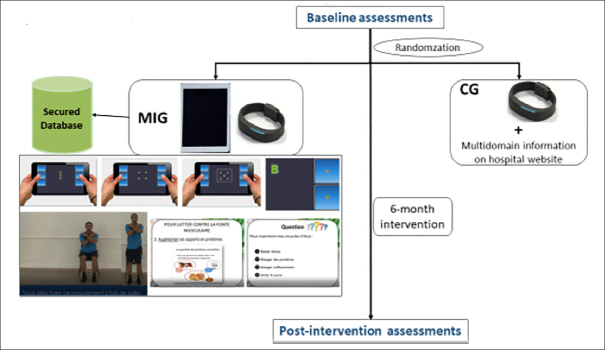
The web-based multidomain intervention group (MIG) received a tablet to access the multidomain platform and a wrist-worn accelerometer measuring step counts; the control group (CG) received only the wrist-worn accelerometer. The multidomain platform was composed of nutritional advices, personalized exercise training, and cognitive training. Main outcomes and measures: Feasibility, defined as the proportion of people connecting to ≥75% of the prescribed sessions, and acceptability, investigated through content analysis from recorded semi-structured interviews. Secondary outcomes included clinical (eg, cognitive function, mobility, health-related quality of life (HRQOL)) and lifestyle (eg, step count, food intake) measurements.
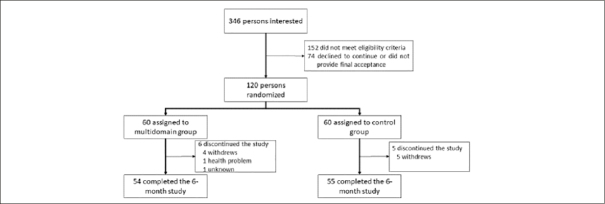
Among the 120 subjects (74.2 ±5.6 years-old; 57.5% women), 109 completed the study (n=54, MIG; n=55, CG). 58 MIG subjects connected to the multidomain platform at least once; among them, adherers of ≥75% of sessions varied across multidomain components: 37 people (63.8% of 58 participants) for cognitive training, 35 (60.3%) for nutrition, and three (5.2%) for exercise; these three persons adhered to all multidomain components. Participants considered study procedures and multidomain content in a positive way; the most cited weaknesses were related to exercise: too easy, repetitive, and slow progression. Compared to controls, the intervention had a positive effect on HRQOL; no significant effects were observed across the other clinical and lifestyle outcomes.
Providing multidomain lifestyle training through a web-platform is feasible and well-accepted, but the training should be challenging enough and adequately progress according to participants' capabilities to increase adherence. Recommendations for a larger on-line multidomain lifestyle training RCT are provided.
背景:目的:描述一种针对社区居住老年人的基于网络的多领域生活方式训练干预措施的可行性和可接受性,并测试该干预措施对功能和生活方式相关结果的影响。
设计:6 个月、平行组、随机对照试验(RCT)。
地点:法国西南部图卢兹地区。
参与者:社区居住的≥65 岁男性和女性,有主观记忆抱怨,但没有痴呆。
干预措施:基于网络的多领域干预组(MIG)接受了一个平板电脑来访问多领域平台和一个测量步数的腕戴式加速度计;对照组(CG)仅接受腕戴式加速度计。多领域平台由营养建议、个性化运动训练和认知训练组成。
主要结果和措施:可行性定义为连接到≥75%规定课程的人数比例,通过记录的半结构化访谈的内容分析来调查可接受性。次要结果包括临床(如认知功能、移动性、健康相关生活质量(HRQOL))和生活方式(如步数、食物摄入量)测量。
结果:在 120 名受试者中(74.2±5.6 岁;57.5%女性),109 名完成了研究(n=54,MIG;n=55,CG)。58 名 MIG 受试者至少一次连接到多领域平台;其中,≥75%课程的坚持者在多领域成分上有所不同:37 人(58 名参与者中的 63.8%)参加认知训练,35 人(60.3%)参加营养,三人(5.2%)参加运动;这三个人坚持了所有多领域的组成部分。参与者以积极的方式看待研究程序和多领域内容;最常提到的弱点与运动有关:太容易、重复和进展缓慢。与对照组相比,干预对 HRQOL 有积极影响;在其他临床和生活方式结果方面没有观察到显著影响。
结论:通过网络平台提供多领域生活方式训练是可行且可接受的,但培训应具有足够的挑战性,并根据参与者的能力适当进展,以提高依从性。提供了关于更大规模在线多领域生活方式训练 RCT 的建议。