Department of Medical Virology, Faculty of Health Sciences, University of Pretoria, Pretoria 0001, South Africa.
Immunology Laboratory, Ampath, Pretoria 0001, South Africa.
Viruses. 2021 Jan 30;13(2):215. doi: 10.3390/v13020215.
Viral gastroenteritis remains a major cause of hospitalisation in young children. This study aimed to determine the distribution and diversity of enteric viruses in children ≤5 years, hospitalised with gastroenteritis at Kalafong Provincial Tertiary Hospital, Pretoria, South Africa, between July 2016 and December 2017.
Stool specimens ( = 205) were screened for norovirus GI and GII, rotavirus, sapovirus, astrovirus and adenovirus by multiplex RT-PCR. HIV exposure and secretor status were evaluated. Secretor status was determined by genotyping.
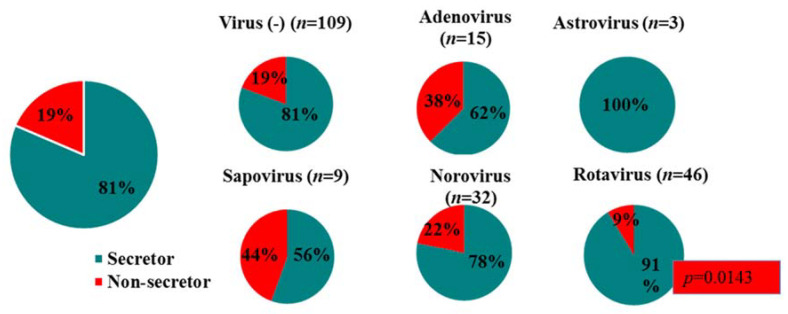
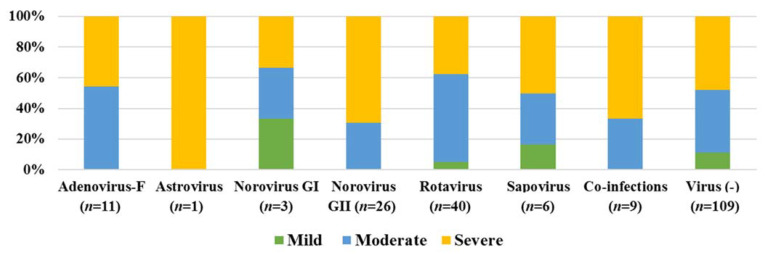
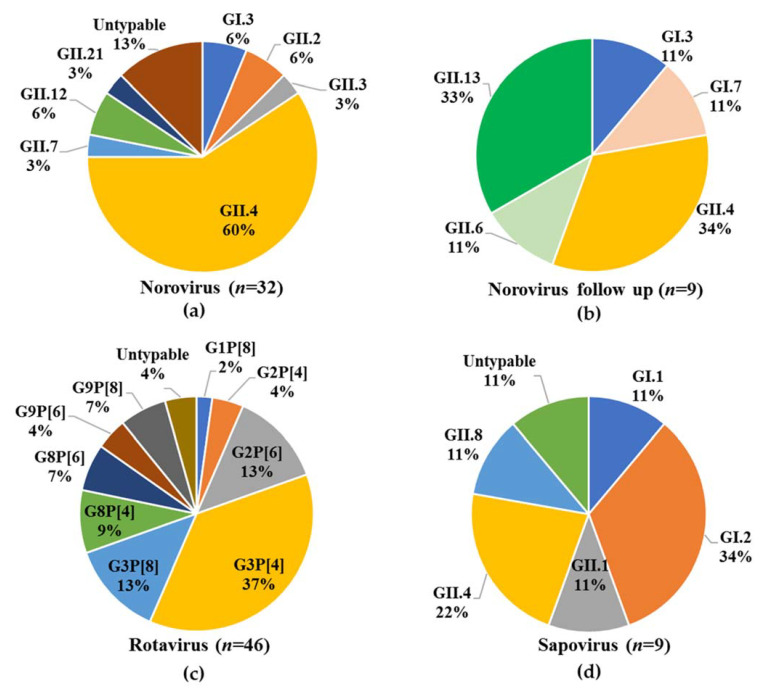
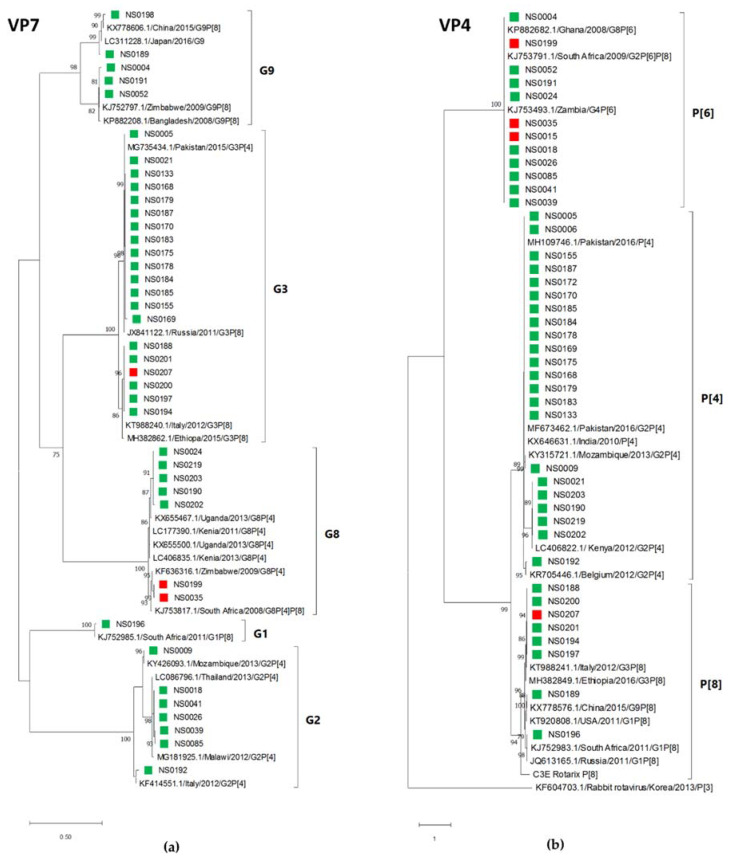
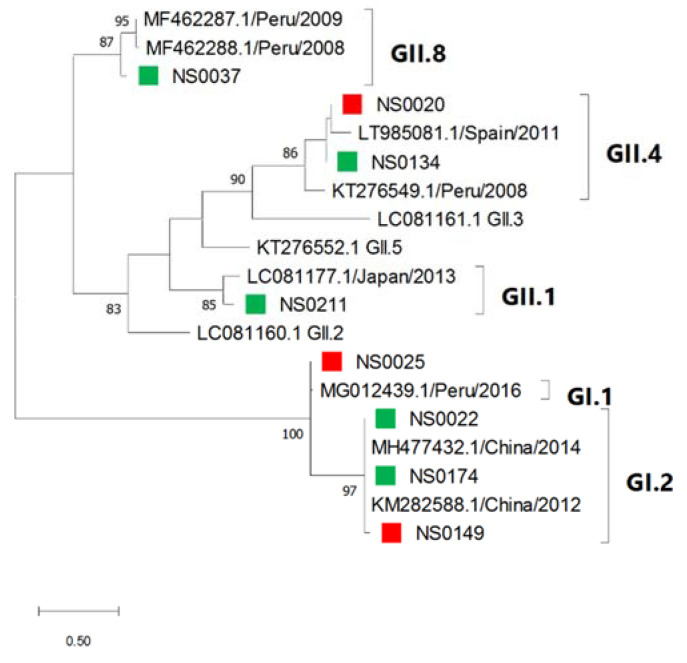
At least one gastroenteritis virus was detected in 47% (96/205) of children. Rotavirus predominated (46/205), followed by norovirus (32/205), adenovirus (15/205), sapovirus (9/205) and astrovirus (3/205). Norovirus genotypes GI.3, GII.2, GII.3, GII.4, GII.7, GII.12, GII.21, and rotavirus strains G1P[8], G2P[4], G2P[6], G3P[4], G3P[8], G8P[4], G8P[6], G9P[6], G9P[8] and sapovirus genotypes GI.1, GI.2, GII.1, GII.4, GII.8 were detected; norovirus GII.4[P31] and rotavirus G3P[4] predominated. Asymptomatic norovirus infection (GI.3, GI.7, GII.4, GII.6, GII.13) was detected in 22% of 46 six-week follow up stools. HIV exposure (30%) was not associated with more frequent or severe viral gastroenteritis hospitalisations compared to unexposed children. Rotavirus preferentially infected secretor children ( = 0.143) and norovirus infected 78% secretors and 22% non-secretors.
Rotavirus was still the leading cause of gastroenteritis hospitalisations, but norovirus caused more severe symptoms.
病毒性肠胃炎仍然是导致幼儿住院的主要原因。本研究旨在确定 2016 年 7 月至 2017 年 12 月在南非比勒陀利亚卡拉丰省级三级医院因肠胃炎住院的≤5 岁儿童中肠病毒的分布和多样性。
采用多重 RT-PCR 方法检测 205 份粪便标本中的诺如病毒 GI 和 GII、轮状病毒、星状病毒、肠道病毒和腺病毒。评估 HIV 暴露和分泌状态。分泌状态通过基因分型确定。
在 96/205 名儿童中至少检测到一种肠胃炎病毒。轮状病毒(46/205)为主,其次是诺如病毒(32/205)、腺病毒(15/205)、星状病毒(9/205)和星状病毒(3/205)。诺如病毒基因型 GI.3、GII.2、GII.3、GII.4、GII.7、GII.12、GII.21 和轮状病毒株 G1P[8]、G2P[4]、G2P[6]、G3P[4]、G3P[8]、G8P[4]、G8P[6]、G9P[6]、G9P[8]和星状病毒基因型 GI.1、GI.2、GII.1、GII.4、GII.8 均有检测到;诺如病毒 GII.4[P31]和轮状病毒 G3P[4]占优势。46 份为期 6 周的随访粪便中,检测到无症状诺如病毒感染(GI.3、GI.7、GII.4、GII.6、GII.13)占 22%。与未暴露的儿童相比,HIV 暴露(30%)与更频繁或更严重的病毒性肠胃炎住院无关。轮状病毒优先感染分泌者( = 0.143),而诺如病毒感染 78%的分泌者和 22%的非分泌者。
轮状病毒仍然是肠胃炎住院的主要原因,但诺如病毒引起的症状更严重。