Health and Well-Being Promotion Unit, Public Health and Welfare Department, Finnish Institute for Health and Welfare, P.O. Box 30, 00271, Helsinki, Finland.
Department of Government Services, Finnish Institute for Health and Welfare, Helsinki, Finland.
Sci Rep. 2021 Feb 11;11(1):3627. doi: 10.1038/s41598-021-82200-9.
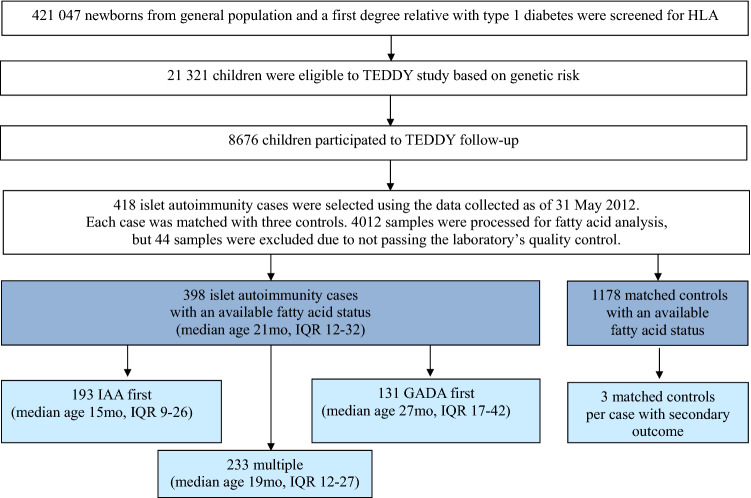
Our aim was to investigate the associations between erythrocyte fatty acids and the risk of islet autoimmunity in children. The Environmental Determinants of Diabetes in the Young Study (TEDDY) is a longitudinal cohort study of children at high genetic risk for type 1 diabetes (n = 8676) born between 2004 and 2010 in the U.S., Finland, Sweden, and Germany. A nested case-control design comprised 398 cases with islet autoimmunity and 1178 sero-negative controls matched for clinical site, family history, and gender. Fatty acids composition was measured in erythrocytes collected at the age of 3, 6, and 12 months and then annually up to 6 years of age. Conditional logistic regression models were adjusted for HLA risk genotype, ancestry, and weight z-score. Higher eicosapentaenoic and docosapentaenoic acid (n - 3 polyunsaturated fatty acids) levels during infancy and conjugated linoleic acid after infancy were associated with a lower risk of islet autoimmunity. Furthermore, higher levels of some even-chain saturated (SFA) and monounsaturated fatty acids (MUFA) were associated with increased risk. Fatty acid status in early life may signal the risk for islet autoimmunity, especially n - 3 fatty acids may be protective, while increased levels of some SFAs and MUFAs may precede islet autoimmunity.
我们的目的是研究红细胞脂肪酸与儿童胰岛自身免疫风险之间的关联。糖尿病的环境决定因素在年轻人研究(TEDDY)是一个纵向队列研究的儿童在高遗传风险 1 型糖尿病(n = 8676)出生于 2004 年至 2010 年在美国、芬兰、瑞典和德国。一个嵌套的病例对照设计组成 398 例与胰岛自身免疫和 1178 血清阴性对照匹配的临床部位、家族史和性别。脂肪酸组成在红细胞中测量收集在 3 岁、6 岁和 12 个月,然后每年达 6 年的年龄。条件逻辑回归模型调整 HLA 风险基因型、祖先和体重 z 分数。较高的二十碳五烯酸和二十二碳五烯酸(n-3 多不饱和脂肪酸)水平在婴儿期和共轭亚油酸在婴儿期后与较低的胰岛自身免疫风险相关。此外,较高水平的一些偶数链饱和(SFA)和单不饱和脂肪酸(MUFA)与增加的风险相关。生命早期的脂肪酸状态可能预示着胰岛自身免疫的风险,尤其是 n-3 脂肪酸可能具有保护作用,而一些 SFA 和 MUFA 的水平升高可能先于胰岛自身免疫。