• 文献检索
  • 文档翻译
  • 深度研究
  • 学术资讯
  • Suppr Zotero 插件Zotero 插件
  • 邀请有礼
  • 套餐&价格
  • 历史记录
应用&插件
Suppr Zotero 插件Zotero 插件浏览器插件Mac 客户端Windows 客户端微信小程序
定价
高级版会员购买积分包购买API积分包
服务
文献检索文档翻译深度研究API 文档MCP 服务
关于我们
关于 Suppr公司介绍联系我们用户协议隐私条款
关注我们

Suppr 超能文献

核心技术专利:CN118964589B侵权必究
粤ICP备2023148730 号-1Suppr @ 2026

文献检索

告别复杂PubMed语法,用中文像聊天一样搜索,搜遍4000万医学文献。AI智能推荐,让科研检索更轻松。

立即免费搜索

文件翻译

保留排版,准确专业,支持PDF/Word/PPT等文件格式,支持 12+语言互译。

免费翻译文档

深度研究

AI帮你快速写综述,25分钟生成高质量综述,智能提取关键信息,辅助科研写作。

立即免费体验

深度卷积神经网络和人类在处理面部时与实现无关的表示。

Implementation-Independent Representation for Deep Convolutional Neural Networks and Humans in Processing Faces.

作者信息

Song Yiying, Qu Yukun, Xu Shan, Liu Jia

机构信息

Beijing Key Laboratory of Applied Experimental Psychology, Faculty of Psychology, Beijing Normal University, Beijing, China.

State Key Laboratory of Cognitive Neuroscience and Learning, Beijing Normal University, Beijing, China.

出版信息

Front Comput Neurosci. 2021 Jan 26;14:601314. doi: 10.3389/fncom.2020.601314. eCollection 2020.

DOI:10.3389/fncom.2020.601314
PMID:33574746
原文链接:https://pmc.ncbi.nlm.nih.gov/articles/PMC7870475/
Abstract

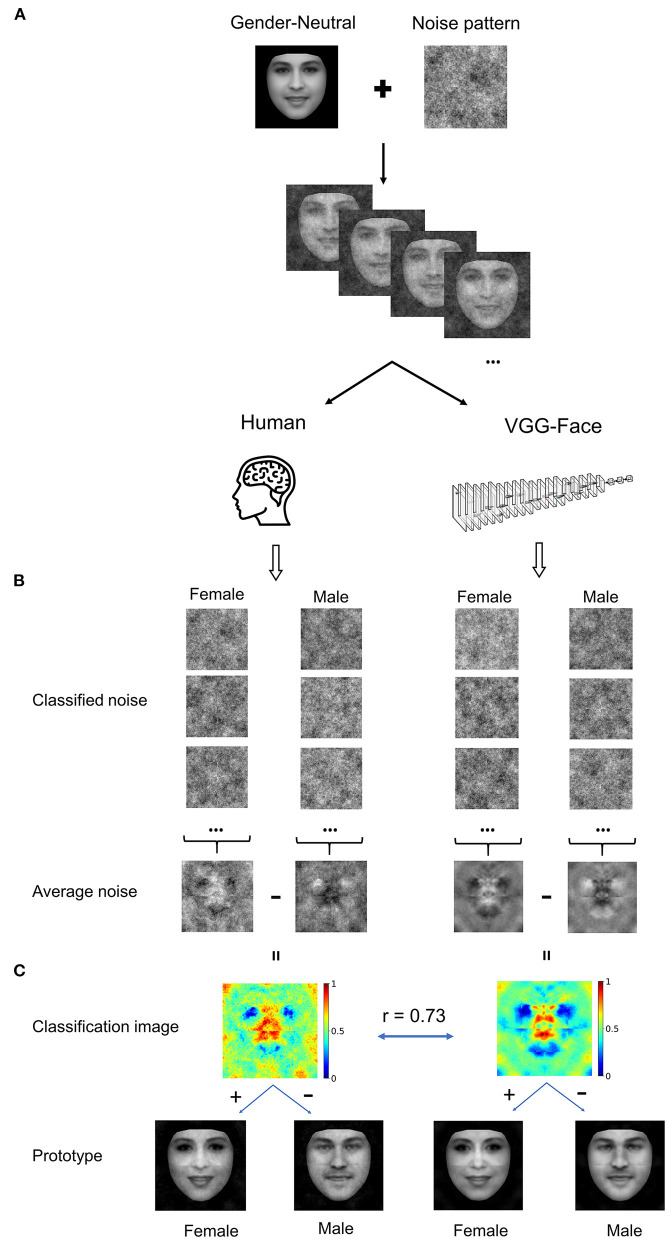
Deep convolutional neural networks (DCNN) nowadays can match human performance in challenging complex tasks, but it remains unknown whether DCNNs achieve human-like performance through human-like processes. Here we applied a reverse-correlation method to make explicit representations of DCNNs and humans when performing face gender classification. We found that humans and a typical DCNN, VGG-Face, used similar critical information for this task, which mainly resided at low spatial frequencies. Importantly, the prior task experience, which the VGG-Face was pre-trained to process faces at the subordinate level (i.e., identification) as humans do, seemed necessary for such representational similarity, because AlexNet, a DCNN pre-trained to process objects at the basic level (i.e., categorization), succeeded in gender classification but relied on a completely different representation. In sum, although DCNNs and humans rely on different sets of hardware to process faces, they can use a similar and implementation-independent representation to achieve the same computation goal.

摘要

如今,深度卷积神经网络(DCNN)在具有挑战性的复杂任务中能够达到人类的表现水平,但DCNN是否通过类似人类的过程实现类似人类的表现仍不明确。在此,我们应用了一种反向相关方法,以便在进行面部性别分类时,明确DCNN和人类的表征。我们发现,人类和典型的DCNN(VGG-Face)在执行此任务时使用了类似的关键信息,这些信息主要位于低空间频率处。重要的是,VGG-Face像人类一样在从属级别(即识别)对处理面部进行了预训练,这种先前的任务经验对于这种表征相似性似乎是必要的,因为AlexNet是一个在基本级别(即分类)对处理物体进行预训练的DCNN,它成功地进行了性别分类,但依赖的是完全不同的表征。总之,虽然DCNN和人类依靠不同的硬件集来处理面部,但它们可以使用类似且与实现无关的表征来实现相同的计算目标。
https://cdn.ncbi.nlm.nih.gov/pmc/blobs/0451/7870475/fb4082d33328/fncom-14-601314-g0005.jpg
https://cdn.ncbi.nlm.nih.gov/pmc/blobs/0451/7870475/45c977ced1ad/fncom-14-601314-g0001.jpg
https://cdn.ncbi.nlm.nih.gov/pmc/blobs/0451/7870475/bebf557880a9/fncom-14-601314-g0002.jpg
https://cdn.ncbi.nlm.nih.gov/pmc/blobs/0451/7870475/472dcca1afa1/fncom-14-601314-g0003.jpg
https://cdn.ncbi.nlm.nih.gov/pmc/blobs/0451/7870475/90c01cb565fe/fncom-14-601314-g0004.jpg
https://cdn.ncbi.nlm.nih.gov/pmc/blobs/0451/7870475/fb4082d33328/fncom-14-601314-g0005.jpg
https://cdn.ncbi.nlm.nih.gov/pmc/blobs/0451/7870475/45c977ced1ad/fncom-14-601314-g0001.jpg
https://cdn.ncbi.nlm.nih.gov/pmc/blobs/0451/7870475/bebf557880a9/fncom-14-601314-g0002.jpg
https://cdn.ncbi.nlm.nih.gov/pmc/blobs/0451/7870475/472dcca1afa1/fncom-14-601314-g0003.jpg
https://cdn.ncbi.nlm.nih.gov/pmc/blobs/0451/7870475/90c01cb565fe/fncom-14-601314-g0004.jpg
https://cdn.ncbi.nlm.nih.gov/pmc/blobs/0451/7870475/fb4082d33328/fncom-14-601314-g0005.jpg

相似文献

1
Implementation-Independent Representation for Deep Convolutional Neural Networks and Humans in Processing Faces.深度卷积神经网络和人类在处理面部时与实现无关的表示。
Front Comput Neurosci. 2021 Jan 26;14:601314. doi: 10.3389/fncom.2020.601314. eCollection 2020.
2
Multidimensional Face Representation in a Deep Convolutional Neural Network Reveals the Mechanism Underlying AI Racism.深度卷积神经网络中的多维面部表征揭示了人工智能种族主义背后的机制。
Front Comput Neurosci. 2021 Mar 10;15:620281. doi: 10.3389/fncom.2021.620281. eCollection 2021.
3
Face Recognition Depends on Specialized Mechanisms Tuned to View-Invariant Facial Features: Insights from Deep Neural Networks Optimized for Face or Object Recognition.人脸识别依赖于专门的机制,这些机制针对的是不变的面部特征:来自专门针对人脸或物体识别进行优化的深度神经网络的见解。
Cogn Sci. 2021 Sep;45(9):e13031. doi: 10.1111/cogs.13031.
4
The Face Inversion Effect in Deep Convolutional Neural Networks.深度卷积神经网络中的面部倒置效应
Front Comput Neurosci. 2022 May 9;16:854218. doi: 10.3389/fncom.2022.854218. eCollection 2022.
5
Modeling naturalistic face processing in humans with deep convolutional neural networks.用深度卷积神经网络对人类自然主义面孔处理进行建模。
Proc Natl Acad Sci U S A. 2023 Oct 24;120(43):e2304085120. doi: 10.1073/pnas.2304085120. Epub 2023 Oct 17.
6
Social Trait Information in Deep Convolutional Neural Networks Trained for Face Identification.深度卷积神经网络在人脸识别训练中所获取的社交特质信息。
Cogn Sci. 2019 Jun;43(6):e12729. doi: 10.1111/cogs.12729.
7
Emerged human-like facial expression representation in a deep convolutional neural network.深度卷积神经网络中出现的类人面部表情表征。
Sci Adv. 2022 Mar 25;8(12):eabj4383. doi: 10.1126/sciadv.abj4383. Epub 2022 Mar 23.
8
Semantic Relatedness Emerges in Deep Convolutional Neural Networks Designed for Object Recognition.语义相关性在为目标识别设计的深度卷积神经网络中显现。
Front Comput Neurosci. 2021 Feb 22;15:625804. doi: 10.3389/fncom.2021.625804. eCollection 2021.
9
Intracranial Electroencephalography and Deep Neural Networks Reveal Shared Substrates for Representations of Face Identity and Expressions.颅内脑电图和深度神经网络揭示了面部身份和表情表示的共享基础。
J Neurosci. 2023 Jun 7;43(23):4291-4303. doi: 10.1523/JNEUROSCI.1277-22.2023. Epub 2023 May 4.
10
Seeing through disguise: Getting to know you with a deep convolutional neural network.透过伪装看本质:用深度卷积神经网络了解你。
Cognition. 2021 Jun;211:104611. doi: 10.1016/j.cognition.2021.104611. Epub 2021 Feb 13.

引用本文的文献

1
Using deep neural networks to disentangle visual and semantic information in human perception and memory.利用深度神经网络分离人类感知和记忆中的视觉和语义信息。
Nat Hum Behav. 2024 Apr;8(4):702-717. doi: 10.1038/s41562-024-01816-9. Epub 2024 Feb 8.
2
Disrupted visual input unveils the computational details of artificial neural networks for face perception.视觉输入的中断揭示了用于面部感知的人工神经网络的计算细节。
Front Comput Neurosci. 2022 Nov 29;16:1054421. doi: 10.3389/fncom.2022.1054421. eCollection 2022.
3
Real-world size of objects serves as an axis of object space.

本文引用的文献

1
DNNBrain: A Unifying Toolbox for Mapping Deep Neural Networks and Brains.DNNBrain:用于映射深度神经网络与大脑的统一工具箱。
Front Comput Neurosci. 2020 Nov 30;14:580632. doi: 10.3389/fncom.2020.580632. eCollection 2020.
2
PsychoPy2: Experiments in behavior made easy.心理物理学 2 版:简单易用的行为实验。
Behav Res Methods. 2019 Feb;51(1):195-203. doi: 10.3758/s13428-018-01193-y.
3
Cognitive computational neuroscience.认知计算神经科学
现实世界中物体的大小充当了物体空间的一个轴。
Commun Biol. 2022 Jul 27;5(1):749. doi: 10.1038/s42003-022-03711-3.
4
The Face Inversion Effect in Deep Convolutional Neural Networks.深度卷积神经网络中的面部倒置效应
Front Comput Neurosci. 2022 May 9;16:854218. doi: 10.3389/fncom.2022.854218. eCollection 2022.
5
The Face Module Emerged in a Deep Convolutional Neural Network Selectively Deprived of Face Experience.面部模块出现在一个深度卷积神经网络中,该网络被选择性地剥夺了面部体验。
Front Comput Neurosci. 2021 May 20;15:626259. doi: 10.3389/fncom.2021.626259. eCollection 2021.
6
Semantic Relatedness Emerges in Deep Convolutional Neural Networks Designed for Object Recognition.语义相关性在为目标识别设计的深度卷积神经网络中显现。
Front Comput Neurosci. 2021 Feb 22;15:625804. doi: 10.3389/fncom.2021.625804. eCollection 2021.
Nat Neurosci. 2018 Sep;21(9):1148-1160. doi: 10.1038/s41593-018-0210-5. Epub 2018 Aug 20.
4
Subcortical human face processing? Evidence from masked priming.皮层下的人脸加工?掩蔽启动的证据。
J Exp Psychol Hum Percept Perform. 2013 Aug;39(4):989-1002. doi: 10.1037/a0030867. Epub 2012 Dec 17.
5
Effects of band-pass spatial frequency filtering of face and object images on the amplitude of N170.面部和物体图像的带通空间频率滤波对N170波幅的影响。
Perception. 2012;41(6):717-32. doi: 10.1068/p7056.
6
Do humans and baboons use the same information when categorizing human and baboon faces?人类和狒狒在对人类和狒狒的面孔进行分类时使用的信息相同吗?
Psychol Sci. 2006 Jul;17(7):599-607. doi: 10.1111/j.1467-9280.2006.01751.x.
7
Spatial-frequency thresholds for object categorisation at basic and subordinate levels.基础和从属层级上物体分类的空间频率阈值。
Perception. 2006;35(1):41-52. doi: 10.1068/p5445.
8
Spatial scale contribution to early visual differences between face and object processing.空间尺度对人脸与物体加工早期视觉差异的作用
Brain Res Cogn Brain Res. 2003 May;16(3):416-24. doi: 10.1016/s0926-6410(03)00056-9.
9
Deriving behavioural receptive fields for visually completed contours.推导视觉上完整轮廓的行为感受野。
Curr Biol. 2000 Jun 1;10(11):663-6. doi: 10.1016/s0960-9822(00)00523-6.
10
Neurocomputational bases of object and face recognition.物体与面部识别的神经计算基础
Philos Trans R Soc Lond B Biol Sci. 1997 Aug 29;352(1358):1203-19. doi: 10.1098/rstb.1997.0103.