Mo Xiao-Cong, Zhang Zi-Tong, Song Meng-Jia, Zhou Zi-Qi, Zeng Jian-Xiong, Du Yu-Fei, Sun Feng-Ze, Yang Jie-Ying, He Jun-Yi, Huang Yue, Xia Jian-Chuan, Weng De-Sheng
State Key Laboratory of Oncology in South China, Collaborative Innovation Centre for Cancer Medicine, Guangzhou, Guangdong 510060, P.R. China.
Department of Biotherapy, Sun Yat-Sen University Cancer Center, Guangzhou, Guangdong 510060, P.R. China.
Oncol Lett. 2021 Mar;21(3):205. doi: 10.3892/ol.2021.12466. Epub 2021 Jan 14.
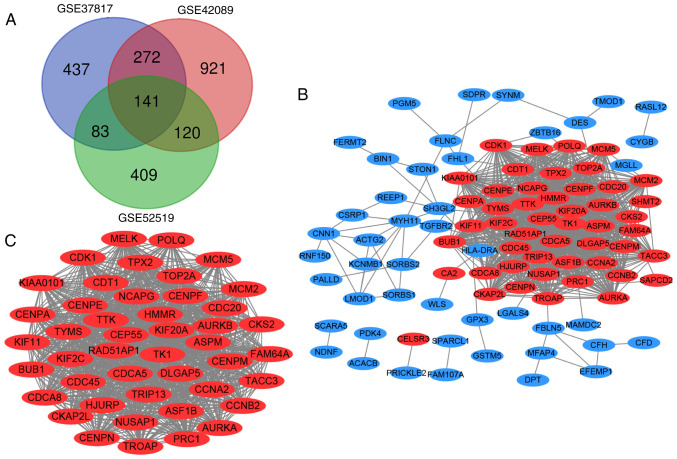
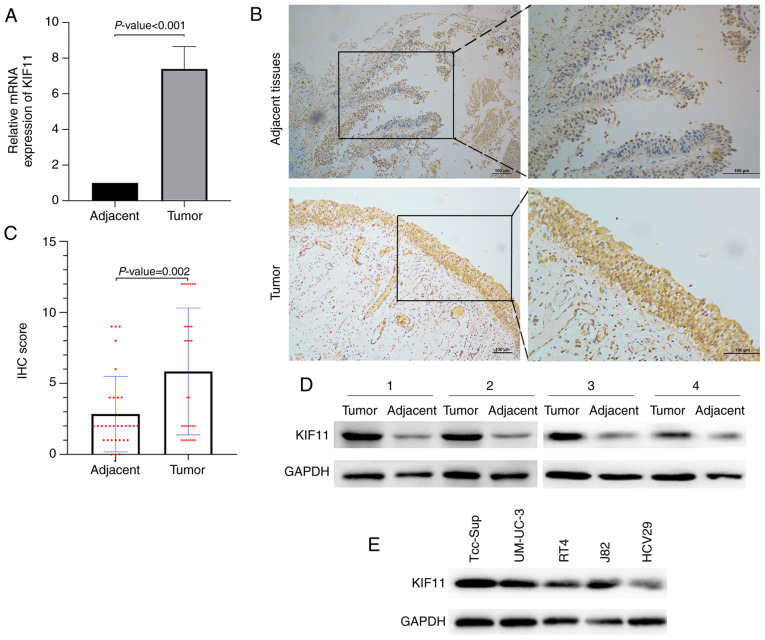
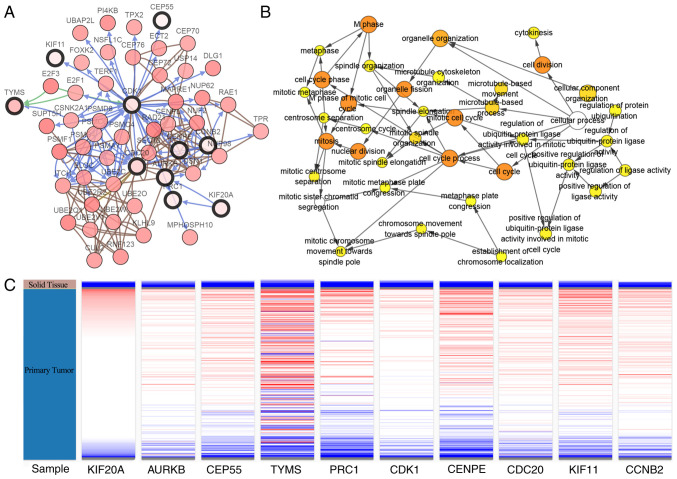
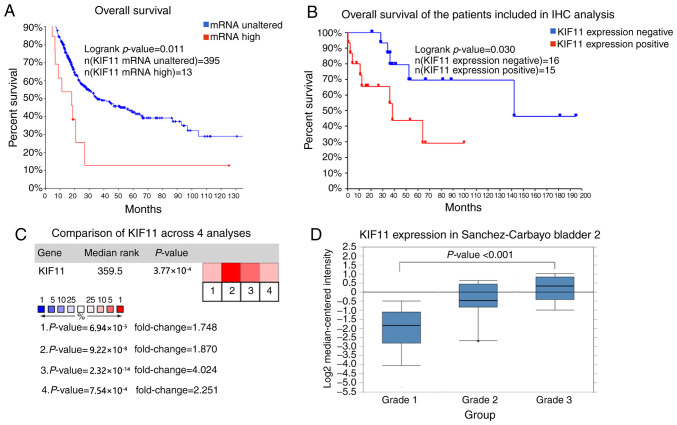
Bladder cancer (BC) is the ninth most common lethal malignancy worldwide. Great efforts have been devoted to clarify the pathogenesis of BC, but the underlying molecular mechanisms remain unclear. To screen for the genes associated with the progression and carcinogenesis of BC, three datasets were obtained from the Gene Expression Omnibus. A total of 37 tumor and 16 non-cancerous samples were analyzed to identify differentially expressed genes (DEGs). Subsequently, 141 genes were identified, including 55 upregulated and 86 downregulated genes. The protein-protein interaction network was established using the Search Tool for Retrieval of Interacting Genes database. Hub gene identification and module analysis were performed using Cytoscape software. Hierarchical clustering of hub genes was conducted using the University of California, Santa Cruz Cancer Genomics Browser. Among the hub genes, kinesin family member 11 (KIF11) was identified as one of the most significant prognostic biomarkers among all the candidates. The Kaplan Meier Plotter database was used for survival analysis of KIF11. The expression profile of KIF11 was analyzed using the ONCOMINE database. The expression levels of KIF11 in BC samples and bladder cells were measured using reverse transcription-quantitative pCR, immunohistochemistry and western blotting. In summary, KIF11 was significantly upregulated in BC and might act as a potential prognostic biomarker. The present identification of DEGs and hub genes in BC may provide novel insight for investigating the molecular mechanisms of BC.
膀胱癌(BC)是全球第九大常见致命恶性肿瘤。人们已付出巨大努力来阐明膀胱癌的发病机制,但潜在的分子机制仍不清楚。为筛选与膀胱癌进展和致癌作用相关的基因,从基因表达综合数据库(Gene Expression Omnibus)获取了三个数据集。共分析了37个肿瘤样本和16个非癌样本,以鉴定差异表达基因(DEGs)。随后,鉴定出141个基因,包括55个上调基因和86个下调基因。使用检索相互作用基因的搜索工具(Search Tool for Retrieval of Interacting Genes)数据库建立了蛋白质-蛋白质相互作用网络。使用Cytoscape软件进行枢纽基因鉴定和模块分析。使用加利福尼亚大学圣克鲁兹分校癌症基因组浏览器(University of California, Santa Cruz Cancer Genomics Browser)对枢纽基因进行层次聚类。在所有候选枢纽基因中,驱动蛋白家族成员11(KIF11)被鉴定为最重要的预后生物标志物之一。使用Kaplan Meier Plotter数据库对KIF11进行生存分析。使用ONCOMINE数据库分析KIF11的表达谱。使用逆转录定量聚合酶链反应、免疫组织化学和蛋白质印迹法检测BC样本和膀胱细胞中KIF11的表达水平。总之,KIF11在膀胱癌中显著上调,可能作为一种潜在的预后生物标志物。目前对膀胱癌中差异表达基因和枢纽基因的鉴定可能为研究膀胱癌的分子机制提供新的见解。