Cai Qiliang, Chen Yegang, Xin Shuhui, Zhang Dingrong, Pan Jiancheng, Xie Zunke, Xu Chenjie, Li Shu, Zhang Xinyu, Gao Ying, Hou Jie, Guo Xuemei, Zhou Xiaodong, Zhang Baoshuai, Ma Fei, Zhang Wei, Lin Guiting, Xin Zhongcheng, Niu Yuanjie, Wang Yaogang
Department of Urology, the Second Hospital of Tianjin Medical University, Tianjin Institute of Urology, Tianjin 300211, China.
School of Public Health, Tianjin Medical University, Tianjin 300070, China.
Transl Androl Urol. 2020 Apr;9(2):153-165. doi: 10.21037/tau.2020.02.24.
Bladder cancer is a leading cause of cancer-related deaths all over the world. Epidemiological studies of bladder cancer are therefore crucial for policy making. This study was carried out to describe the characteristics of changes in the incidence and mortality of bladder cancer from 1990 to 2016 by age group, gender, geographical region, and sociodemographic index (SDI) and to simultaneously project future trends up to 2030.
Incidence and mortality trends in bladder cancer from 1990 to 2016 were described based on data and methodologies from the Global Burden of Disease (GBD) Study. The data also allowed the future trends of bladder cancer incidence and mortality to be predicted by ARIMA model. Trends were analyzed by age group, gender, and SDI. Projections to 2030 were sub-analyzed by SDI countries. R software (x64 version 3.5.1), SAS (version 9.3), and SPSS (version 22.0) were used throughout the process.
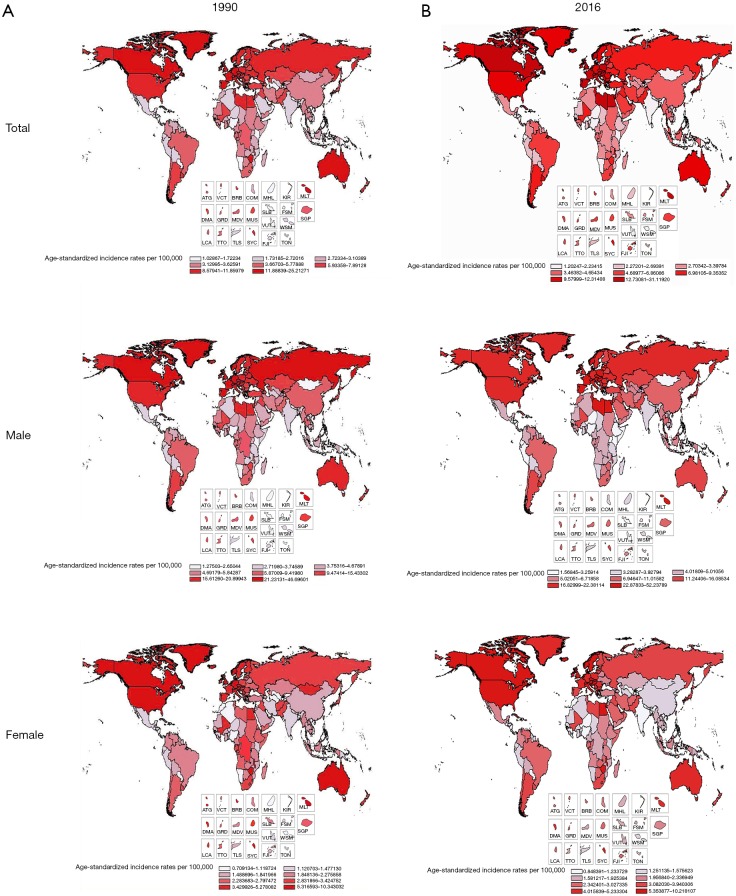
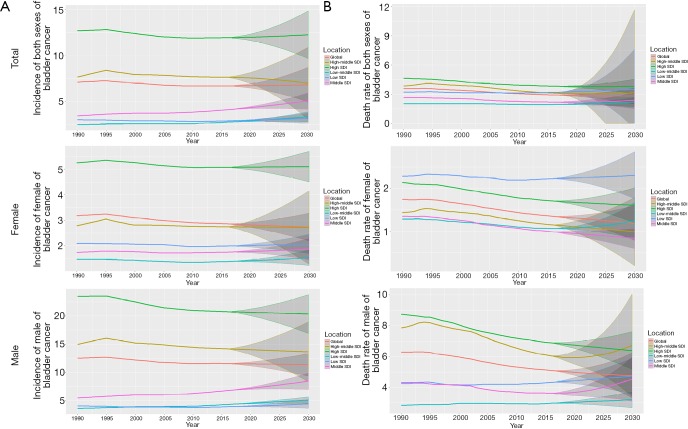
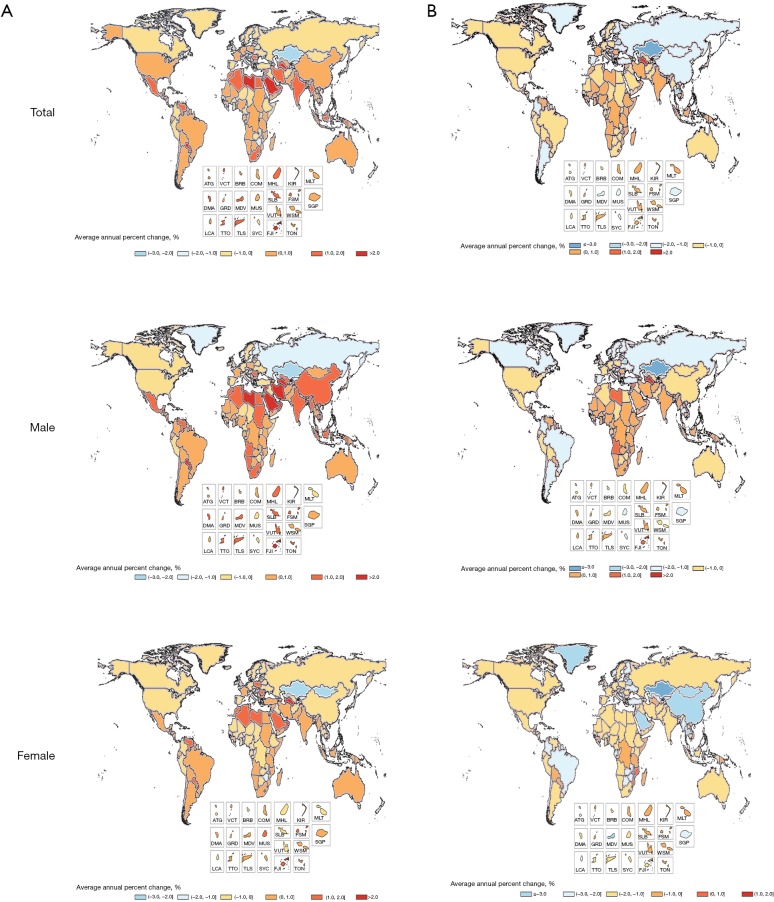
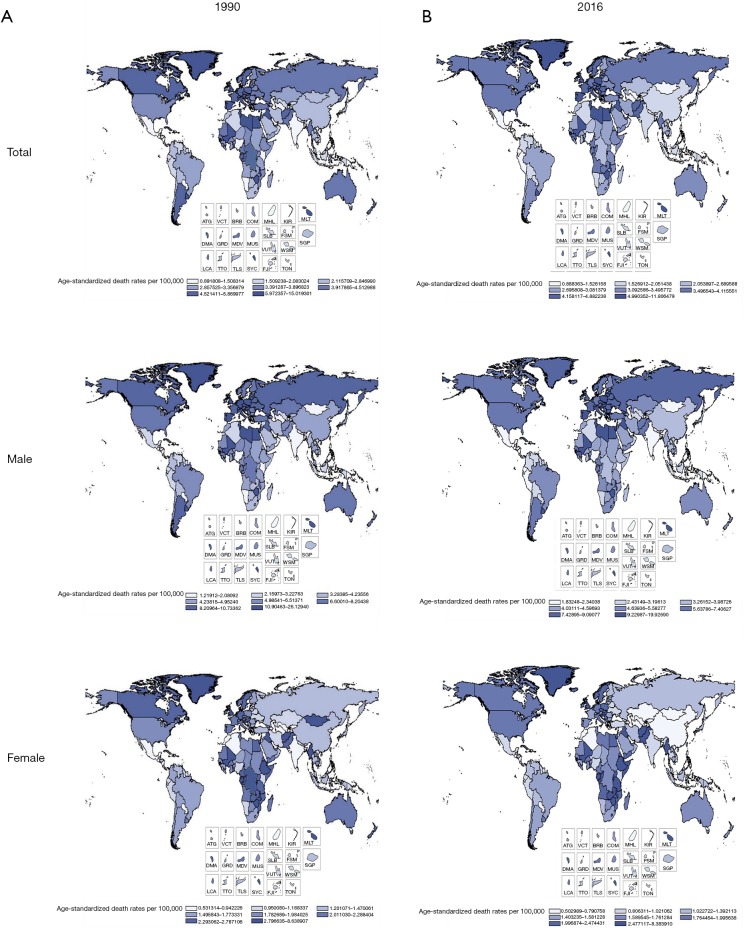
Globally, in 2016, there were 437,442 [95% uncertainty interval (UI), 426,709-447,912] new bladder cancer cases and 186,199 (95% UI, 180,453-191,686) bladder cancer-associated deaths. Between 1990 and 2016, changes in the age-standardized incidence rate (ASIR) of bladder cancer decreased by 5.91% from 7.11 (95% UI, 6.93-7.27) in 1990 to 6.69 (95% UI, 6.52-6.85) in 2016. The age-standardized death rate (ASDR) decreased from 3.58 (95% UI, 3.49-3.68) to 2.94 (95% UI, 2.85-3.03) over the same period of time. In future, the greatest occurrence of bladder cancer will be in high SDI countries, followed by high-middle SDI countries. Moreover, bladder cancer incidence rates may increase substantially in middle SDI countries, while the incidence rates will remain relatively stable for men and women in other SDI countries. From 2017 to 2030, bladder cancer deaths will continue to increase in low SDI countries, while deaths in other SDI countries will continue to decrease.
There was a regional difference in the incidence and mortality trends of bladder cancer between 1990 and 2016. Overall, the situation is not optimistic. From 2017 to 2030, the incidence of bladder cancer will continue to rise, especially in high and high-middle SDI countries, where decision-makers should propose appropriate policies on the screening and prevention of bladder cancer.
膀胱癌是全球癌症相关死亡的主要原因之一。因此,膀胱癌的流行病学研究对于政策制定至关重要。本研究旨在描述1990年至2016年间按年龄组、性别、地理区域和社会人口学指数(SDI)划分的膀胱癌发病率和死亡率变化特征,并同时预测至2030年的未来趋势。
基于全球疾病负担(GBD)研究的数据和方法,描述了1990年至2016年间膀胱癌的发病率和死亡率趋势。这些数据还使我们能够通过自回归积分移动平均(ARIMA)模型预测膀胱癌发病率和死亡率的未来趋势。按年龄组、性别和SDI分析趋势。到2030年的预测按SDI国家进行亚组分析。整个过程使用了R软件(x64版本3.5.1)、SAS(9.3版本)和SPSS(22.0版本)。
在全球范围内,2016年有437,442例[95%不确定区间(UI),426,709 - 447,912]新发膀胱癌病例和186,199例(95% UI,180,453 - 191,686)与膀胱癌相关的死亡病例。1990年至2016年间,膀胱癌的年龄标准化发病率(ASIR)从1990年的7.11(95% UI,6.93 - 7.27)下降了5.9%,降至2016年的6.69(95% UI,6.52 - 6.85)。同期,年龄标准化死亡率(ASDR)从3.58(95% UI,3.49 - 3.68)降至2.94(95% UI,2.85 - 3.03)。未来,膀胱癌的最大发病数将出现在高SDI国家,其次是高中等SDI国家。此外,中等SDI国家的膀胱癌发病率可能大幅上升,而其他SDI国家的男性和女性发病率将保持相对稳定。2017年至2030年,低SDI国家的膀胱癌死亡人数将继续增加,而其他SDI国家的死亡人数将继续减少。
1990年至2016年间,膀胱癌的发病率和死亡率趋势存在地区差异。总体而言,情况不容乐观。2017年至2030年,膀胱癌发病率将持续上升,尤其是在高和高中等SDI国家,决策者应针对膀胱癌的筛查和预防提出适当政策。