Zhao Junyu, Li Hong, Lin Rong, Xie Minzhi, Wang Yinzhou, Chen Huiying
School of Nursing, Fujian Medical University, Fuzhou, China.
Department of Nursing, Fujian Provincial Hospital, Fuzhou, China.
Int J Nurs Sci. 2020 Dec 14;8(1):38-42. doi: 10.1016/j.ijnss.2020.12.005. eCollection 2021 Jan 10.
This study aimed to evaluate the effects of a 16-week creative expression intervention program (CrExp) on the event-related potential (ERP) and task reaction time in older individuals with mild cognitive impairment (MCI).
This study is a randomized controlled clinical trial conducted in the Memory Center of Fujian Provincial hospital. Thirty-six MCI patients were randomly distributed into two groups. One group underwent a 16-week creative expression program (CrExp, = 18) and the other performed as a control group (CG, = 18) by general social activities. The amplitude and latency of ERP-P300 from the central (Cz), parietal (Pz), frontal (Fz) cortices and task reaction time (RT) were assessed at baseline, post-interventi on, and 24-week follow-up.
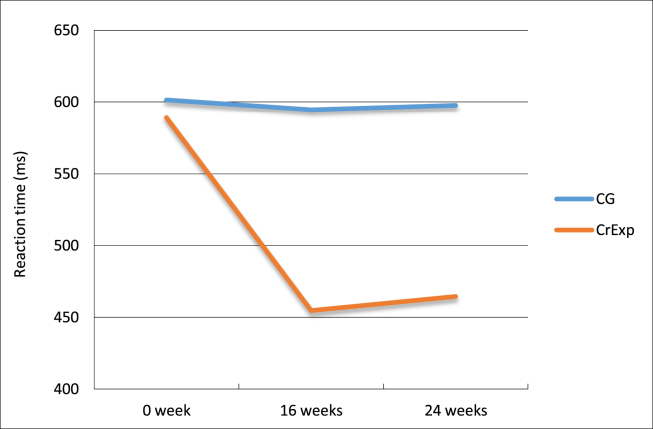
The CrExp group showed greater differences than CG of P300 latency in Cz ( = 4.37, = 0.015), Pz ( = 2.78, = 0.009), Fz ( = 6.45, = 0.031) brain area after 16 weeks of intervention and in Fz ( = 3.23, = 0.028), Cz ( = 3.79, = 0.024), and Pz ( = 5.60, = 0.036) at 24 weeks follow-up. Also, we analyzed the task reaction time between two groups and found that a shorten reaction time at post-intervention ( = 4.47, = 0.011) and 24 weeks follow-up ( = 3.12, = 0.007) in the CrExp group. However, there was no difference in P300 amplitude in either brain area between the two groups.
The electrophysiological results of the creative expression cognitive therapy group were more obvious than those of the general cognitive therapy group, and the latency and task reaction time may be considered as supported parameters in diagnosing the effects during non-drug therapy intervention in clinical practice.
本研究旨在评估一项为期16周的创造性表达干预计划(CrExp)对轻度认知障碍(MCI)老年人事件相关电位(ERP)和任务反应时间的影响。
本研究是在福建省立医院记忆中心进行的一项随机对照临床试验。36例MCI患者被随机分为两组。一组接受为期16周的创造性表达计划(CrExp,n = 18),另一组作为对照组(CG,n = 18)进行一般社交活动。在基线、干预后和24周随访时评估中央(Cz)、顶叶(Pz)、额叶(Fz)皮质的ERP-P300波幅和潜伏期以及任务反应时间(RT)。
干预16周后,CrExp组在Cz(t = 4.37,p = 0.015)、Pz(t = 2.78,p = 0.009)、Fz(t = 6.45,p = 0.031)脑区的P300潜伏期差异比CG组更大,在24周随访时,Fz(t = 3.23,p = 0.028)、Cz(t = 3.79,p = 0.024)和Pz(t = 5.60,p = 0.036)脑区也是如此。此外,我们分析了两组之间的任务反应时间,发现CrExp组在干预后(t = 4.47,p = 0.011)和24周随访时(t = 3.12,p = 0.007)反应时间缩短。然而,两组在任一脑区的P300波幅均无差异。
创造性表达认知治疗组的电生理结果比一般认知治疗组更明显,潜伏期和任务反应时间可被视为临床实践中非药物治疗干预效果诊断的支持参数。