Department of Basic Sciences, Faculty of Paramedical Sciences, Shahid Beheshti University of Medical Sciences, Tehran, Iran.
Proteomics Research Center, Faculty of Paramedical Sciences, Shahid Beheshti University of Medical Sciences, Tehran, Iran.
Stem Cell Res Ther. 2021 Feb 12;12(1):126. doi: 10.1186/s13287-021-02196-x.
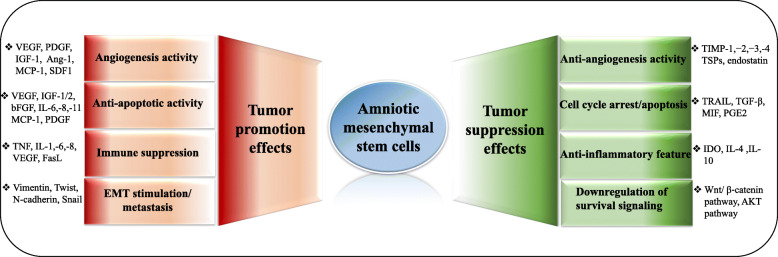
Cancer is a leading cause of death in both developed and developing countries, and because of population growth and aging, it is a growing medical burden worldwide. With robust development in medicine, the use of stem cells has opened new treatment modalities in cancer therapy. In adult stem cells, mesenchymal stem cells (MSCs) are showing rising promise in cancer treatment due to their unique properties. Among different sources of MSCs, human amniotic fluid/membrane is an attractive and suitable reservoir. There are conflicting opinions about the role of human amniotic membrane/fluid mesenchymal stem cells (hAMSCS/hAFMSCs) in cancer, as some studies demonstrating the anticancer effects of these cells and others suggesting their progressive effects on cancer. This review focuses on recent findings about the role of hAMSCs/hAFMSCs in cancer treatment and summarizes the suppressing as well as promoting effects of these cells on cancer progression and underling mechanisms.
癌症是发达国家和发展中国家的主要死亡原因之一,由于人口增长和老龄化,癌症在全球范围内的医疗负担也在不断增加。随着医学的蓬勃发展,干细胞的应用为癌症治疗开辟了新的治疗模式。在成体干细胞中,间充质干细胞(MSCs)因其独特的特性在癌症治疗中显示出越来越大的潜力。在不同来源的 MSCs 中,人羊膜/膜间充质干细胞(hAMSCS/hAFMSCs)是一种有吸引力和合适的来源。关于人羊膜/膜间充质干细胞(hAMSCS/hAFMSCs)在癌症中的作用存在争议,一些研究表明这些细胞具有抗癌作用,而另一些研究则表明它们对癌症具有进展作用。本综述重点介绍了 hAMSCs/hAFMSCs 在癌症治疗中的作用的最新发现,并总结了这些细胞对癌症进展的抑制和促进作用及其潜在机制。