Program of Genetics & Genome Biology, The Hospital for Sick Children, The Peter Gilgan Centre for Research and Learning, Toronto, Ontario, Canada.
Institute of Molecular Cancer Research, University of Zurich, Zurich, Switzerland.
J Huntingtons Dis. 2021;10(1):95-122. doi: 10.3233/JHD-200448.
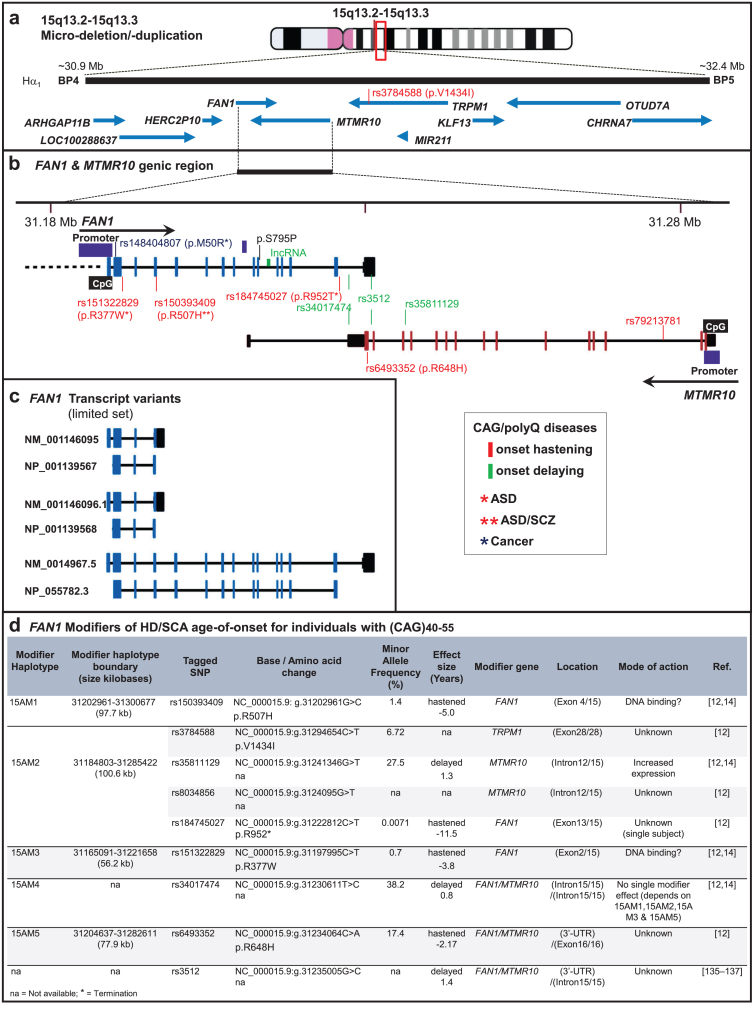
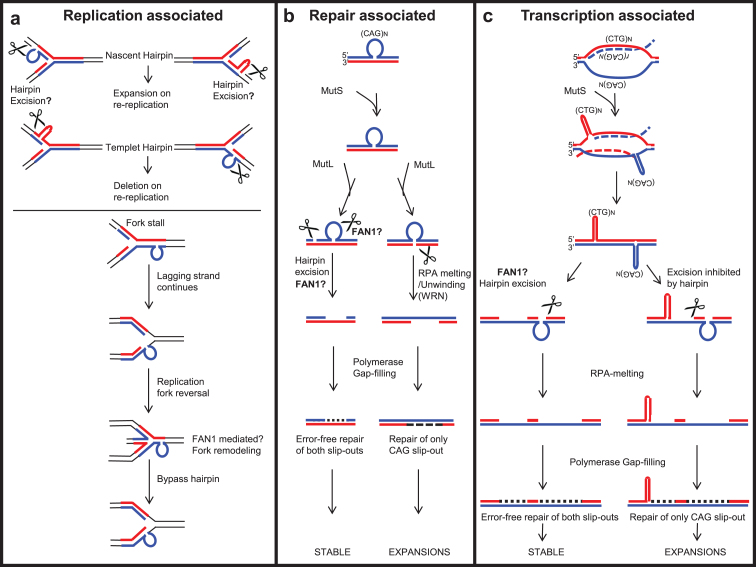
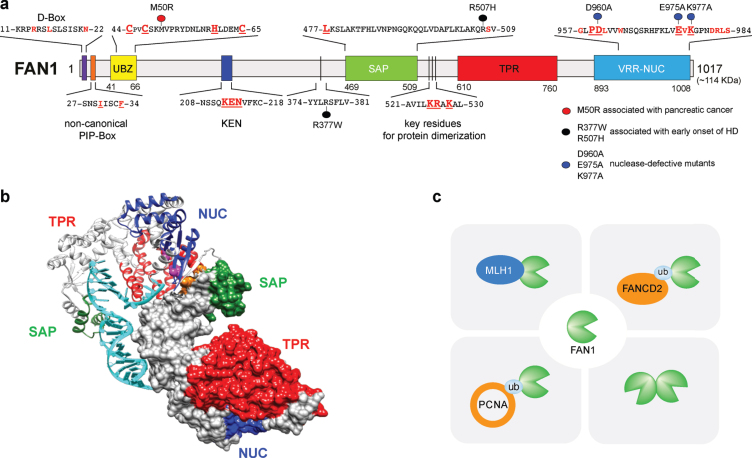
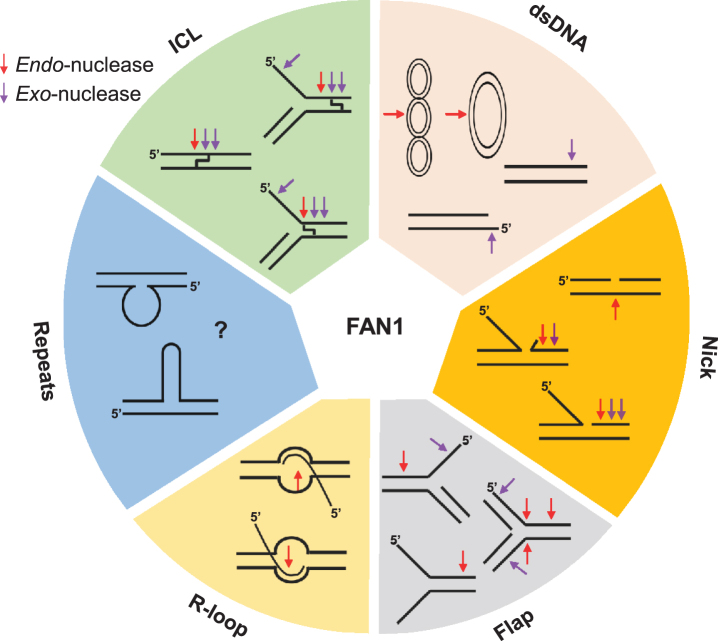
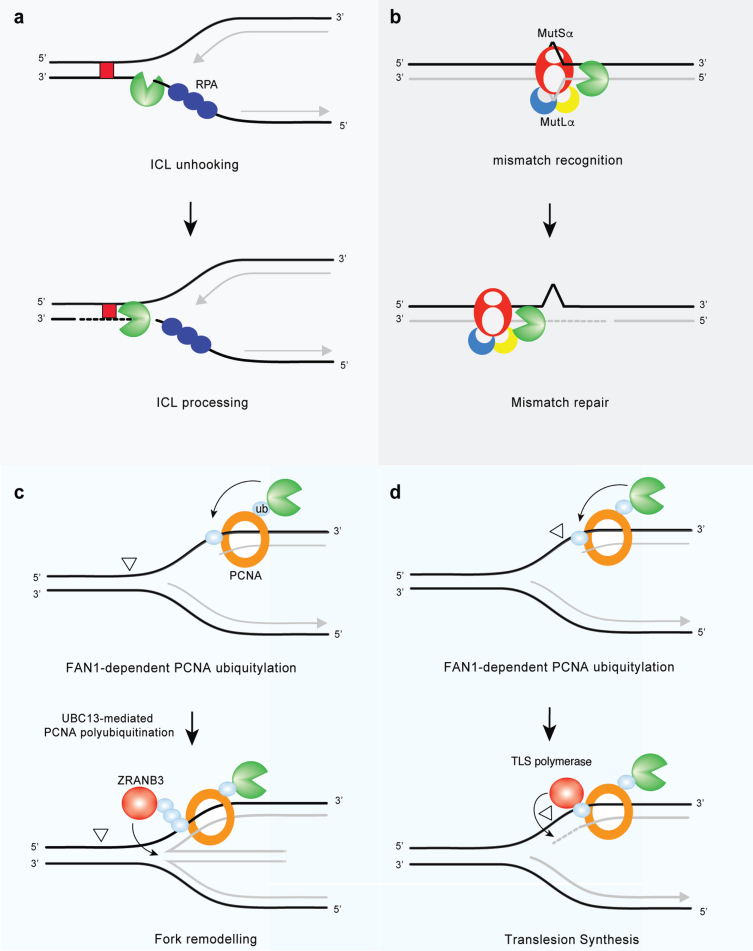
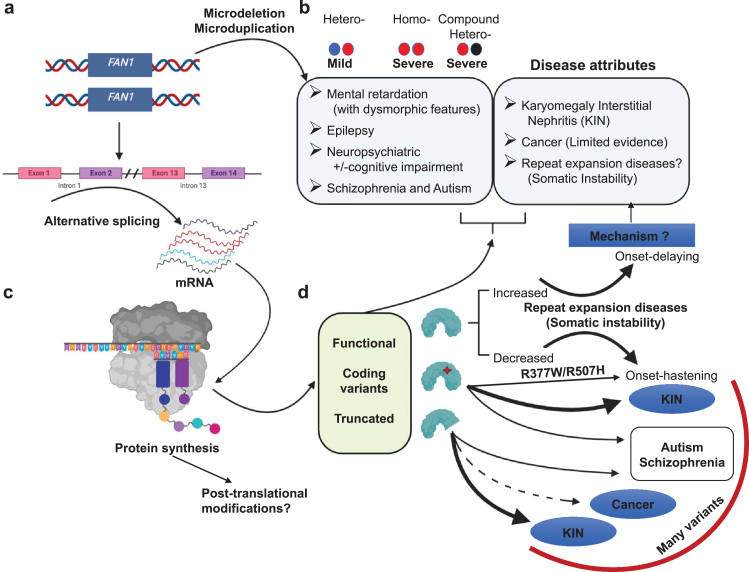
FAN1 encodes a DNA repair nuclease. Genetic deficiencies, copy number variants, and single nucleotide variants of FAN1 have been linked to karyomegalic interstitial nephritis, 15q13.3 microdeletion/microduplication syndrome (autism, schizophrenia, and epilepsy), cancer, and most recently repeat expansion diseases. For seven CAG repeat expansion diseases (Huntington's disease (HD) and certain spinocerebellar ataxias), modification of age of onset is linked to variants of specific DNA repair proteins. FAN1 variants are the strongest modifiers. Non-coding disease-delaying FAN1 variants and coding disease-hastening variants (p.R507H and p.R377W) are known, where the former may lead to increased FAN1 levels and the latter have unknown effects upon FAN1 functions. Current thoughts are that ongoing repeat expansions in disease-vulnerable tissues, as individuals age, promote disease onset. Fan1 is required to suppress against high levels of ongoing somatic CAG and CGG repeat expansions in tissues of HD and FMR1 transgenic mice respectively, in addition to participating in DNA interstrand crosslink repair. FAN1 is also a modifier of autism, schizophrenia, and epilepsy. Coupled with the association of these diseases with repeat expansions, this suggests a common mechanism, by which FAN1 modifies repeat diseases. Yet how any of the FAN1 variants modify disease is unknown. Here, we review FAN1 variants, associated clinical effects, protein structure, and the enzyme's attributed functional roles. We highlight how variants may alter its activities in DNA damage response and/or repeat instability. A thorough awareness of the FAN1 gene and FAN1 protein functions will reveal if and how it may be targeted for clinical benefit.
FAN1 编码一种 DNA 修复核酸内切酶。FAN1 的遗传缺陷、拷贝数变异和单核苷酸变异与巨染色体间肾炎、15q13.3 微缺失/微重复综合征(自闭症、精神分裂症和癫痫)、癌症以及最近的重复扩展疾病有关。对于七种 CAG 重复扩展疾病(亨廷顿病 (HD) 和某些脊髓小脑共济失调),发病年龄的改变与特定 DNA 修复蛋白的变异有关。FAN1 变异是最强的修饰物。已知非编码疾病延迟 FAN1 变异和编码疾病加速变异(p.R507H 和 p.R377W),前者可能导致 FAN1 水平增加,后者对 FAN1 功能的影响未知。目前的想法是,随着个体年龄的增长,疾病易感组织中持续的重复扩展会促进疾病的发生。Fan1 是必需的,以抑制 HD 和 FMR1 转基因小鼠组织中高水平的持续体细胞 CAG 和 CGG 重复扩展,除了参与 DNA 链间交联修复。FAN1 也是自闭症、精神分裂症和癫痫的修饰物。鉴于这些疾病与重复扩展有关,这表明 FAN1 通过一种共同机制修饰重复疾病。然而,任何 FAN1 变异如何修饰疾病尚不清楚。在这里,我们回顾了 FAN1 变异体、相关的临床影响、蛋白质结构以及该酶的归因功能作用。我们强调了变异体如何改变其在 DNA 损伤反应和/或重复不稳定性中的活性。对 FAN1 基因和 FAN1 蛋白功能的全面了解将揭示它是否以及如何可能成为临床获益的目标。