Department of Psychiatry, Washington University School of Medicine, Mailstop 8134-29-2100, 660 S. Euclid Ave., St. Louis, MO 63110, USA.
Department of Psychiatry and Behavioral Sciences, Stanford University School of Medicine, Stanford, CA, USA; Center for m(2)Health, Palo Alto University, Palo Alto, CA, USA.
Contemp Clin Trials. 2021 Apr;103:106320. doi: 10.1016/j.cct.2021.106320. Epub 2021 Feb 11.
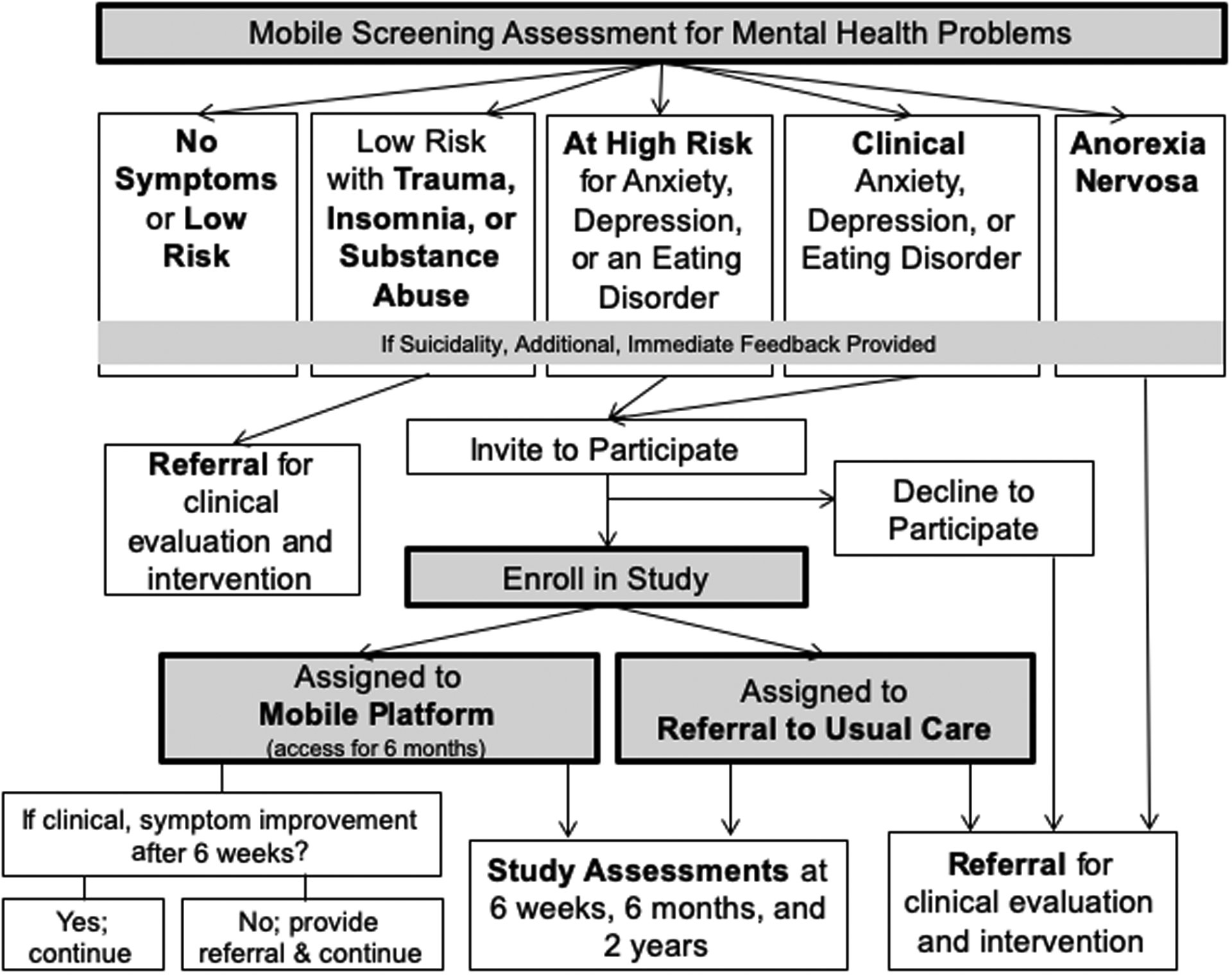
About a third of college students struggle with anxiety, depression, or an eating disorder, and only 20-40% of college students with mental disorders receive treatment. Inadequacies in mental health care delivery result in prolonged illness, disease progression, poorer prognosis, and greater likelihood of relapse, highlighting the need for a new approach to detect mental health problems and engage college students in services. We have developed a transdiagnostic, low-cost mobile mental health targeted prevention and intervention platform that uses population-level screening to engage college students in tailored services that address common mental health problems. We will test the impact of this mobile mental health platform for service delivery in a large-scale trial across 20+ colleges. Students who screen positive or at high-risk for clinical anxiety, depression, or an eating disorder and who are not currently engaged in mental health services (N = 7884) will be randomly assigned to: 1) intervention via the mobile mental health platform; or 2) referral to usual care (i.e., campus health or counseling center). We will test whether the mobile mental health platform, compared to referral, is associated with improved uptake, reduced clinical cases, disorder-specific symptoms, and improved quality of life and functioning. We will also test mediators, predictors, and moderators of improved mental health outcomes, as well as stakeholder-relevant outcomes, including cost-effectiveness and academic performance. This population-level approach to service engagement has the potential to improve mental health outcomes for the millions of students enrolled in U.S. colleges and universities.
大约三分之一的大学生患有焦虑症、抑郁症或饮食失调症,但只有 20-40%的有精神障碍的大学生接受治疗。精神卫生保健服务提供不足导致疾病持续时间延长、病情恶化、预后较差以及复发可能性增加,这突显了需要采用新方法来发现精神健康问题并让大学生参与服务。我们开发了一种针对多种精神障碍的、低成本的移动心理健康靶向预防和干预平台,该平台使用人群水平筛查让大学生参与解决常见心理健康问题的定制服务。我们将在 20 多所大学进行的大规模试验中测试这种移动心理健康服务提供平台的效果。筛查呈阳性或有临床焦虑、抑郁或饮食失调高风险但目前未参与心理健康服务的学生(N=7884)将被随机分配到以下两组:1)通过移动心理健康平台进行干预;或 2)转介至常规护理(即校园健康或咨询中心)。我们将测试与转介相比,移动心理健康平台是否与提高参与度、减少临床病例、特定障碍症状以及改善生活质量和功能有关。我们还将测试改善心理健康结果的中介因素、预测因素和调节因素,以及与利益相关者相关的结果,包括成本效益和学业成绩。这种针对人群的服务参与方法有可能改善在美国高校注册的数百万学生的心理健康结果。