• 文献检索
  • 文档翻译
  • 深度研究
  • 学术资讯
  • Suppr Zotero 插件Zotero 插件
  • 邀请有礼
  • 套餐&价格
  • 历史记录
应用&插件
Suppr Zotero 插件Zotero 插件浏览器插件Mac 客户端Windows 客户端微信小程序
定价
高级版会员购买积分包购买API积分包
服务
文献检索文档翻译深度研究API 文档MCP 服务
关于我们
关于 Suppr公司介绍联系我们用户协议隐私条款
关注我们

Suppr 超能文献

核心技术专利:CN118964589B侵权必究
粤ICP备2023148730 号-1Suppr @ 2026

文献检索

告别复杂PubMed语法,用中文像聊天一样搜索,搜遍4000万医学文献。AI智能推荐,让科研检索更轻松。

立即免费搜索

文件翻译

保留排版,准确专业,支持PDF/Word/PPT等文件格式,支持 12+语言互译。

免费翻译文档

深度研究

AI帮你快速写综述,25分钟生成高质量综述,智能提取关键信息,辅助科研写作。

立即免费体验

针对大学生心理健康的基于技术的干预措施:系统评价

Technology-based interventions for mental health in tertiary students: systematic review.

作者信息

Farrer Louise, Gulliver Amelia, Chan Jade K Y, Batterham Philip J, Reynolds Julia, Calear Alison, Tait Robert, Bennett Kylie, Griffiths Kathleen M

机构信息

Centre for Mental Health Research, The Australian National University, Canberra ACT, Australia.

出版信息

J Med Internet Res. 2013 May 27;15(5):e101. doi: 10.2196/jmir.2639.

DOI:10.2196/jmir.2639
PMID:23711740
原文链接:https://pmc.ncbi.nlm.nih.gov/articles/PMC3668609/
Abstract

BACKGROUND

Mental disorders are responsible for a high level of disability burden in students attending university. However, many universities have limited resources available to support student mental health. Technology-based interventions may be highly relevant to university populations. Previous reviews have targeted substance use and eating disorders in tertiary students. However, the effectiveness of technology-based interventions for other mental disorders and related issues has not been reviewed.

OBJECTIVE

To systematically review published randomized trials of technology-based interventions evaluated in a university setting for disorders other than substance use and eating disorders.

METHODS

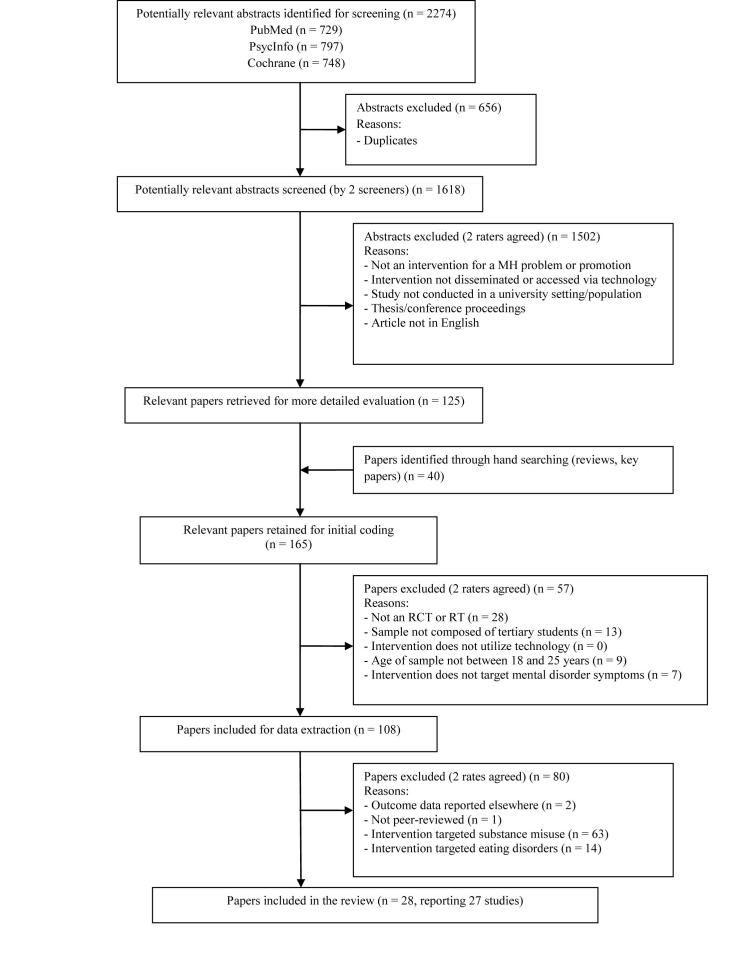
The PubMed, PsycInfo, and Cochrane Central Register of Controlled Trials databases were searched using keywords, phrases, and MeSH terms. Retrieved abstracts (n=1618) were double screened and coded. Included studies met the following criteria: (1) the study was a randomized trial or a randomized controlled trial, (2) the sample was composed of students attending a tertiary institution, (3) the intervention was delivered by or accessed using a technological device or process, (4) the age range of the sample was between 18 and 25 years, and (5) the intervention was designed to improve, reduce, or change symptoms relating to a mental disorder.

RESULTS

A total of 27 studies met inclusion criteria for the present review. Most of the studies (24/27, 89%) employed interventions targeting anxiety symptoms or disorders or stress, although almost one-third (7/24, 29%) targeted both depression and anxiety. There were a total of 51 technology-based interventions employed across the 27 studies. Overall, approximately half (24/51, 47%) were associated with at least 1 significant positive outcome compared with the control at postintervention. However, 29% (15/51) failed to find a significant effect. Effect sizes were calculated for the 18 of 51 interventions that provided sufficient data. Median effect size was 0.54 (range -0.07 to 3.04) for 8 interventions targeting depression and anxiety symptoms and 0.84 (range -0.07 to 2.66) for 10 interventions targeting anxiety symptoms and disorders. Internet-based technology (typically involving cognitive behavioral therapy) was the most commonly employed medium, being employed in 16 of 27 studies and approximately half of the 51 technology-based interventions (25/51, 49%). Distal and universal preventive interventions were the most common type of intervention. Some methodological problems were evident in the studies, with randomization methods either inadequate or inadequately described, few studies specifying a primary outcome, and most of the studies failing to undertake or report appropriate intent-to-treat analyses.

CONCLUSIONS

The findings of this review indicate that although technological interventions targeting certain mental health and related problems offer promise for students in university settings, more high quality trials that fully report randomization methods, outcome data, and data analysis methods are needed.
https://cdn.ncbi.nlm.nih.gov/pmc/blobs/1013/3668609/15bd2c360d81/jmir_v15i5e101_fig1.jpg
摘要

背景

精神障碍在大学生群体中造成了很高的残疾负担。然而,许多大学用于支持学生心理健康的资源有限。基于技术的干预措施可能与大学生群体高度相关。以往的综述主要针对大学生的物质使用和饮食失调问题。然而,基于技术的干预措施对其他精神障碍及相关问题的有效性尚未得到综述。

目的

系统综述在大学环境中针对物质使用和饮食失调以外的精神障碍所开展的已发表的基于技术的干预措施的随机试验。

方法

使用关键词、短语和医学主题词检索PubMed、PsycInfo和Cochrane对照试验中心注册库数据库。对检索到的1618篇摘要进行了双重筛选和编码。纳入的研究符合以下标准:(1)该研究为随机试验或随机对照试验;(2)样本由高等院校的学生组成;(3)干预措施通过技术设备或流程实施或获取;(4)样本年龄范围在18至25岁之间;(5)干预措施旨在改善、减轻或改变与精神障碍相关的症状。

结果

共有27项研究符合本综述的纳入标准。大多数研究(24/27,89%)采用针对焦虑症状或障碍或压力的干预措施,尽管近三分之一(7/24,29%)的研究同时针对抑郁和焦虑。27项研究共采用了51种基于技术的干预措施。总体而言,与干预后对照组相比,约一半(24/51,47%)的干预措施至少有1项显著的积极结果。然而,29%(15/51)的干预措施未发现显著效果。对51项干预措施中的18项提供了充分数据的干预措施计算了效应量。针对抑郁和焦虑症状的8项干预措施的效应量中位数为0.54(范围为-0.07至3.04),针对焦虑症状和障碍的10项干预措施的效应量中位数为0.84(范围为-0.07至2.66)。基于互联网的技术(通常涉及认知行为疗法)是最常用的媒介,在27项研究中的16项以及51种基于技术的干预措施中的约一半(25/51,49%)中被采用。远程和普遍预防性干预是最常见的干预类型。研究中存在一些方法学问题,随机化方法要么不充分,要么描述不充分,很少有研究指定主要结局,并且大多数研究未进行或报告适当的意向性分析。

结论

本综述的结果表明,尽管针对某些心理健康及相关问题的技术干预措施对大学环境中的学生有前景,但需要更多高质量的试验,全面报告随机化方法、结局数据和数据分析方法。

相似文献

1
Technology-based interventions for mental health in tertiary students: systematic review.针对大学生心理健康的基于技术的干预措施:系统评价
J Med Internet Res. 2013 May 27;15(5):e101. doi: 10.2196/jmir.2639.
2
Technology-based interventions for tobacco and other drug use in university and college students: a systematic review and meta-analysis.基于技术的针对大学生烟草及其他药物使用的干预措施:一项系统评价与荟萃分析
Addict Sci Clin Pract. 2015 Feb 24;10(1):5. doi: 10.1186/s13722-015-0027-4.
3
Psychological and/or educational interventions for the prevention of depression in children and adolescents.预防儿童和青少年抑郁症的心理和/或教育干预措施。
Cochrane Database Syst Rev. 2004(1):CD003380. doi: 10.1002/14651858.CD003380.pub2.
4
The clinical effectiveness and cost-effectiveness of low-intensity psychological interventions for the secondary prevention of relapse after depression: a systematic review.低强度心理干预在预防抑郁复发中的临床效果和成本效益:系统评价。
Health Technol Assess. 2012 May;16(28):1-130. doi: 10.3310/hta16280.
5
Systemic pharmacological treatments for chronic plaque psoriasis: a network meta-analysis.慢性斑块状银屑病的全身药理学治疗:一项网状Meta分析。
Cochrane Database Syst Rev. 2020 Jan 9;1(1):CD011535. doi: 10.1002/14651858.CD011535.pub3.
6
Systemic pharmacological treatments for chronic plaque psoriasis: a network meta-analysis.系统性药理学治疗慢性斑块状银屑病:网络荟萃分析。
Cochrane Database Syst Rev. 2021 Apr 19;4(4):CD011535. doi: 10.1002/14651858.CD011535.pub4.
7
Falls prevention interventions for community-dwelling older adults: systematic review and meta-analysis of benefits, harms, and patient values and preferences.社区居住的老年人跌倒预防干预措施:系统评价和荟萃分析的益处、危害以及患者的价值观和偏好。
Syst Rev. 2024 Nov 26;13(1):289. doi: 10.1186/s13643-024-02681-3.
8
Technological aids for the rehabilitation of memory and executive functioning in children and adolescents with acquired brain injury.脑损伤儿童和青少年记忆与执行功能康复的技术辅助手段。
Cochrane Database Syst Rev. 2016 Jul 1;7(7):CD011020. doi: 10.1002/14651858.CD011020.pub2.
9
E-Health interventions for anxiety and depression in children and adolescents with long-term physical conditions.针对患有长期身体疾病的儿童和青少年焦虑与抑郁的电子健康干预措施。
Cochrane Database Syst Rev. 2018 Aug 15;8(8):CD012489. doi: 10.1002/14651858.CD012489.pub2.
10
Pharmacotherapy for anxiety and comorbid alcohol use disorders.焦虑症合并酒精使用障碍的药物治疗
Cochrane Database Syst Rev. 2015 Jan 20;1(1):CD007505. doi: 10.1002/14651858.CD007505.pub2.

引用本文的文献

1
How do we know that they actually use it? Exploring measures of adherence to stress management strategies in university students: A systematic review.我们如何知道他们真的使用了它?探索大学生对压力管理策略的依从性测量:一项系统综述。
Internet Interv. 2025 Aug 12;41:100868. doi: 10.1016/j.invent.2025.100868. eCollection 2025 Sep.
2
Designing Digital Mental Health Interventions to Meet the Needs of Older Adolescents: Qualitative Interview and Group Discussion Study.设计满足大龄青少年需求的数字心理健康干预措施:定性访谈与小组讨论研究
JMIR Form Res. 2025 Aug 29;9:e68950. doi: 10.2196/68950.
3
Long-Term Outcomes and Cost-Effectiveness of an Internet-Based Self-Help Intervention for Social Anxiety Disorder in University Students: Results of a Randomized Controlled Trial.

本文引用的文献

1
Evaluating the translation process of an Internet-based self-help intervention for prevention of depression: a cost-effectiveness analysis.评估基于互联网的预防抑郁症自助干预措施的翻译过程:一项成本效益分析。
J Med Internet Res. 2013 Jan 23;15(1):e18. doi: 10.2196/jmir.2422.
2
Campus suicide prevention: bridging paradigms and forging partnerships.校园自杀预防:跨越范式,建立伙伴关系。
Harv Rev Psychiatry. 2012 Jul-Aug;20(4):209-21. doi: 10.3109/10673229.2012.712841.
3
Prevention of depression in the college student population: a review of the literature.
一项针对大学生社交焦虑障碍的基于互联网自助干预的长期结果与成本效益:一项随机对照试验的结果
Depress Anxiety. 2023 Nov 17;2023:7912017. doi: 10.1155/2023/7912017. eCollection 2023.
4
Overcoming mental health challenges in higher education: a narrative review.应对高等教育中的心理健康挑战:一项叙述性综述。
Front Psychol. 2024 Dec 11;15:1466060. doi: 10.3389/fpsyg.2024.1466060. eCollection 2024.
5
Effectiveness of Digital Health Interventions in Promoting Physical Activity Among College Students: Systematic Review and Meta-Analysis.数字健康干预措施在促进大学生身体活动方面的有效性:系统评价和荟萃分析。
J Med Internet Res. 2024 Nov 20;26:e51714. doi: 10.2196/51714.
6
The association of diet quality with the mental health of students during their transition to university.饮食质量与大学生过渡到大学期间心理健康的关系。
PLoS One. 2024 Oct 15;19(10):e0312123. doi: 10.1371/journal.pone.0312123. eCollection 2024.
7
Effectiveness of digital health interventions in improving mental health of older adults with mild cognitive impairment: A systematic review and meta-analysis protocol.数字健康干预对改善轻度认知障碍老年人心理健康的有效性:一项系统评价和荟萃分析方案
Digit Health. 2024 Oct 13;10:20552076241288651. doi: 10.1177/20552076241288651. eCollection 2024 Jan-Dec.
8
Exploring student preferences for implementing a digital mental health intervention in a university setting: Qualitative study within a randomised controlled trial.探索学生对在大学环境中实施数字心理健康干预措施的偏好:随机对照试验中的定性研究
Digit Health. 2024 Aug 30;10:20552076241277175. doi: 10.1177/20552076241277175. eCollection 2024 Jan-Dec.
9
Skill Enactment Among University Students Using a Brief Video-Based Mental Health Intervention: Mixed Methods Study Within a Randomized Controlled Trial.大学生使用基于简短视频的心理健康干预措施的技能实施情况:一项随机对照试验中的混合方法研究。
JMIR Ment Health. 2024 Aug 21;11:e53794. doi: 10.2196/53794.
10
A Transdiagnostic Video-Based Internet Intervention (Uni Virtual Clinic-Lite) to Improve the Mental Health of University Students: Randomized Controlled Trial.基于视频的跨诊断互联网干预(Uni 虚拟诊所-Lite)改善大学生心理健康的随机对照试验。
J Med Internet Res. 2024 Aug 13;26:e53598. doi: 10.2196/53598.
大学生群体的抑郁预防:文献综述。
Arch Psychiatr Nurs. 2012 Feb;26(1):21-42. doi: 10.1016/j.apnu.2011.03.003. Epub 2011 Jun 11.
4
CONSORT-EHEALTH: improving and standardizing evaluation reports of Web-based and mobile health interventions.CONSORT-EHEALTH:改进并规范基于网络和移动健康干预措施的评估报告。
J Med Internet Res. 2011 Dec 31;13(4):e126. doi: 10.2196/jmir.1923.
5
The use of virtual reality in the study, assessment, and treatment of body image in eating disorders and nonclinical samples: a review of the literature.虚拟现实在进食障碍和非临床样本的身体意象研究、评估和治疗中的应用:文献综述。
Body Image. 2012 Jan;9(1):1-11. doi: 10.1016/j.bodyim.2011.10.001. Epub 2011 Nov 25.
6
Effects of an Internet-based prevention programme for eating disorders in the USA and Germany--a meta-analytic review.基于互联网的饮食障碍预防项目对美国和德国的影响——一项荟萃分析评价。
Eur Eat Disord Rev. 2012 Jan;20(1):1-8. doi: 10.1002/erv.1130. Epub 2011 Jul 27.
7
New technologies to manage exam anxiety.应对考试焦虑的新技术。
Stud Health Technol Inform. 2011;167:57-62.
8
A systematic review of randomized controlled trials: Web-based interventions for smoking cessation among adolescents, college students, and adults.一项系统评价的随机对照试验:基于网络的干预措施在青少年、大学生和成年人中的戒烟效果。
Nicotine Tob Res. 2011 Apr;13(4):227-38. doi: 10.1093/ntr/ntq252. Epub 2011 Feb 24.
9
Internet-based intervention for the treatment of online addiction for college students in China: a pilot study of the Healthy Online Self-helping Center.基于互联网的干预治疗中国大学生网络成瘾:大学生健康在线自助中心的初步研究。
Cyberpsychol Behav Soc Netw. 2011 Sep;14(9):497-503. doi: 10.1089/cyber.2010.0167. Epub 2011 Feb 5.
10
Online alcohol interventions: a systematic review.在线酒精干预:一项系统综述。
J Med Internet Res. 2010 Dec 19;12(5):e62. doi: 10.2196/jmir.1479.