Trammell Janet P, Aguilar Shaya C
Social Science Department, Seaver College, Pepperdine University, Malibu, CA, United States.
Front Psychol. 2021 Jan 11;11:575245. doi: 10.3389/fpsyg.2020.575245. eCollection 2020.
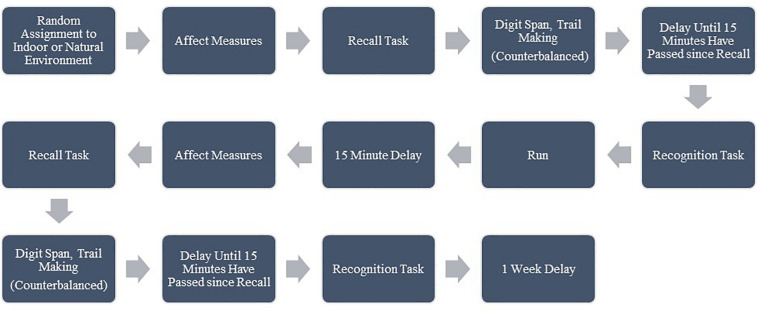
The Attention Restoration Theory (ART) has been widely cited to account for beneficial effects of natural environments on affect and attention. However, the effects of environment and exercise are not consistent. In a within-subjects design, participants completed affective and cognitive measures that varied in attentional demands (memory, working memory, and executive function) both before and after exercise in a natural and indoor environment. Contrary to the hypotheses, a natural environment resulted in lower positive affect and no difference in negative affect compared to an indoor environment. A natural environment resulted in the most improvement for cognitive tasks that required moderate attentional demand: Trail Making Test A and Digit Span Forwards. As predicted, exercise resulted in improved affect and improved executive function (Trail Making Test B). There were no interactions between environment and exercise. These results suggest that ART cannot fully explain the influence of environment on affect and cognition.
注意力恢复理论(ART)已被广泛引用,以解释自然环境对情感和注意力的有益影响。然而,环境和运动的影响并不一致。在一项被试内设计中,参与者在自然环境和室内环境中运动前后,完成了在注意力要求方面有所不同的情感和认知测量(记忆、工作记忆和执行功能)。与假设相反,与室内环境相比,自然环境导致积极情感降低,消极情感没有差异。自然环境对需要适度注意力要求的认知任务(连线测验A和数字广度顺背)的改善最为明显。正如预测的那样,运动导致情感改善和执行功能改善(连线测验B)。环境和运动之间没有交互作用。这些结果表明,注意力恢复理论不能完全解释环境对情感和认知的影响。