Association of Dutch Burn Centres, Zeestraat 29, 1941 AJ, Beverwijk, The Netherlands.
Burn Center, Red Cross Hospital, Beverwijk, The Netherlands.
Appl Microbiol Biotechnol. 2021 Mar;105(5):2057-2070. doi: 10.1007/s00253-021-11166-5. Epub 2021 Feb 15.
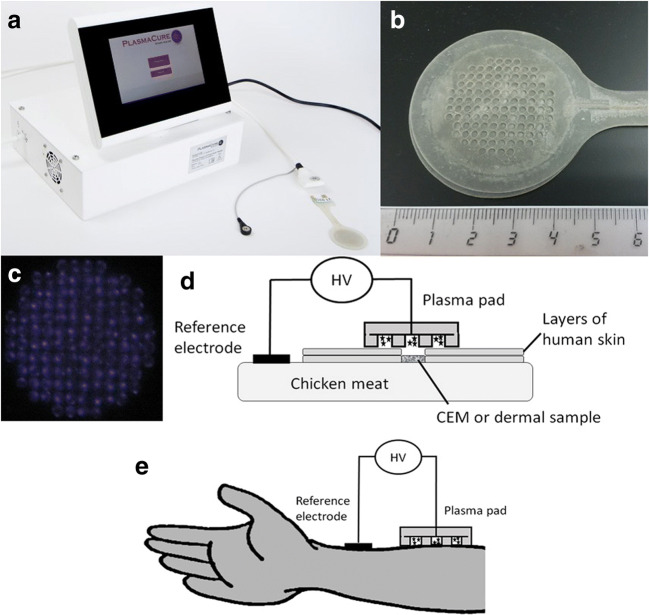
Cold atmospheric plasma (CAP) devices generate an ionized gas with highly reactive species and electric fields at ambient air pressure and temperature. A flexible dielectric barrier discharge (DBD) was developed as an alternative antimicrobial treatment for chronic wounds. Treatment of Staphylococcus aureus in collagen-elastin matrices with CAP for 2 min resulted in a 4 log reduction. CAP treatment was less effective on S. aureus on dermal samples. CAP did not affect cellular activity or DNA integrity of human dermal samples when used for up to 2 min. Repeated daily CAP treatments for 2 min lowered cellular activity of dermal samples to 80% after 2 to 4 days, but this was not significant. Repeated treatment of ex vivo human burn wound models with CAP for 2 min did not affect re-epithelialization. Intact skin of 25 healthy volunteers was treated with CAP for 3× 20" to determine safety. Although participants reported moderate pain scores (numerical rating scale 3.3), all volunteers considered the procedure to be acceptable. Severe adverse events did not occur. CAP treatment resulted in a temporarily increased local skin temperature (≈3.4°C) and increased erythema. Lowering the plasma power resulted in a significantly lower erythema increase. Good log reduction (2.9) of bacterial load was reached in 14/15 volunteers artificially contaminated with Pseudomonas aeruginosa. This study demonstrated the in vitro and in vivo safety and efficacy in bacterial reduction of a flexible cold plasma device. Trial registration number NCT03007264, January 2, 2017 KEY POINTS: • CAP strongly reduced bacterial numbers both in vitro and in vivo. • Re-epithelialization of burn wound models was not affected by repeated CAP. • CAP treatment of intact skin was well tolerated in volunteers.
冷等离子体(CAP)设备在环境空气压力和温度下产生具有高反应性的离子化气体和电场。柔性介电阻挡放电(DBD)被开发为慢性伤口的替代抗菌处理方法。用 CAP 处理 2 分钟可使胶原蛋白弹性蛋白基质中的金黄色葡萄球菌减少 4 对数。CAP 处理对真皮样本上的金黄色葡萄球菌的效果较差。当 CAP 用于真皮样本时,最长 2 分钟不会影响其细胞活性或 DNA 完整性。重复每日 CAP 处理 2 分钟,在 2 至 4 天后将真皮样本的细胞活性降低至 80%,但无统计学意义。重复 2 分钟的 CAP 处理对体外人烧伤模型不会影响再上皮化。对 25 名健康志愿者的完整皮肤进行了 CAP 处理 3×20",以确定安全性。尽管参与者报告了中度疼痛评分(数字评分量表 3.3),但所有志愿者都认为该过程是可以接受的。没有发生严重不良事件。CAP 处理导致局部皮肤温度暂时升高(≈3.4°C)和红斑增加。降低等离子体功率会导致红斑增加明显降低。在 14/15 名志愿者中人工污染铜绿假单胞菌的情况下,达到了良好的对数减少(2.9)。这项研究证明了一种灵活的冷等离子体设备在体外和体内的安全性和减少细菌数量的功效。注册号 NCT03007264,2017 年 1 月 2 日 主要观点:•CAP 可强烈减少体外和体内的细菌数量。•反复 CAP 处理不会影响烧伤模型的再上皮化。•志愿者对 CAP 处理完整皮肤的耐受性良好。