Universidad de Castilla-La Mancha, Health and Social Research Center, Cuenca, Spain.
Institute of Applied Health Research, University of Birmingham, Birmingham, United Kingdom.
PLoS Med. 2021 Feb 16;18(2):e1003543. doi: 10.1371/journal.pmed.1003543. eCollection 2021 Feb.
The comparative analysis of the effect of several doses of statins against different intensities of physical exercise on arterial stiffness (a measure of cardiovascular risk) could shed light for clinicians on which method is most effective in preventing cardiovascular disease (CVD) and be used to inform shared decision-making between doctors and patients. This study was aimed at analyzing the effect, in high cardiometabolic risk patients, of different statins doses and exercise intensities on arterial stiffness (a measure of cardiovascular risk) by integrating all available direct and indirect evidence in network meta-analyses.
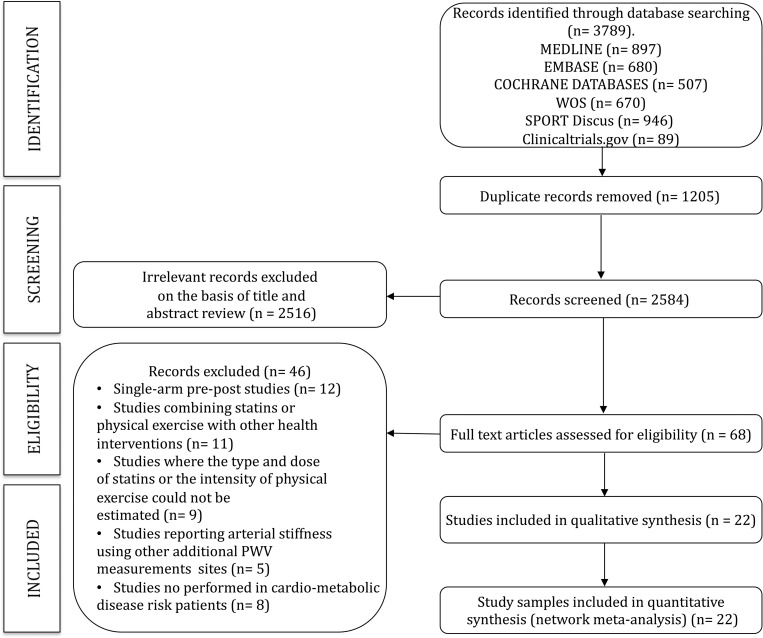
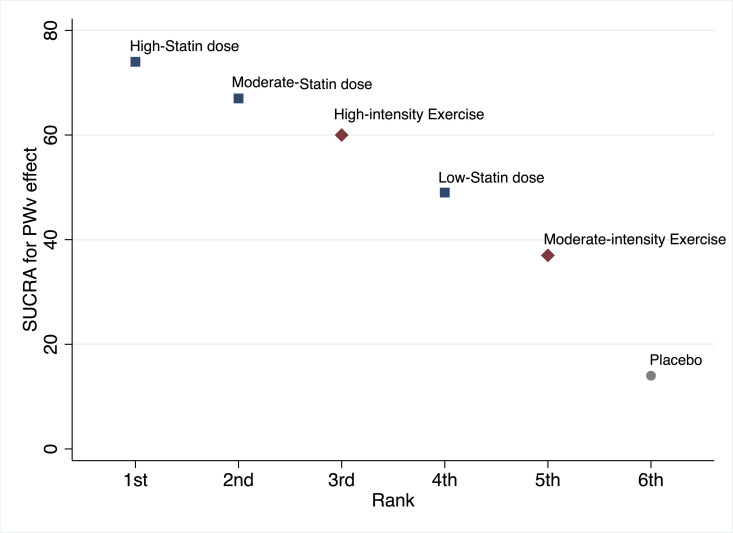
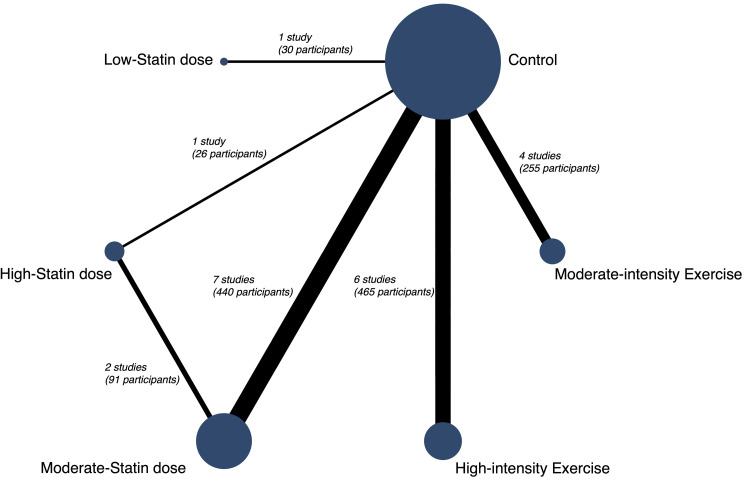
We systematically searched MEDLINE, Embase, SPORTDiscus, Cochrane Central Register of Controlled Trials, Cochrane Database of Systematic Reviews, and Web of Science databases from their inception to February 28, 2020; for unpublished trials, we also searched ClinicalTrials.gov. We searched for studies concerning the effect of statins or physical exercise on arterial stiffness, measured by pulse wave velocity (PWV). For methodological quality assessment, Cochrane Collaboration's tool for assessing risk of bias (RoB2) was used. A network geometry graph was used to assess the strength of the evidence. Comparative evaluation of the interventions effect was performed by conducting a standard pairwise meta-analysis and a network meta-analysis (NMA) for direct and indirect comparisons between interventions and control/nonintervention. A total of 22 studies were included in the analyses (18 randomized controlled trials (RCTs) and 4 nonrandomized experimental studies), including 1,307 patients with high cardiometabolic risk from Asia (3 studies), Oceania (2 studies), Europe (10 studies), North America (5 studies), and South America (2 studies). The overall risk of bias assessed with RoB2 was high in all included studies. For standard pairwise meta-analysis and NMA, high-intensity exercise versus control (mean difference (MD) -0.56; 95% CI: -1.01, -0.11; p = 0.015 and -0.62; 95% CI: -1.20, -0.04; p = 0.038, respectively) and moderate statin dose versus control (MD -0.80, 95% CI: -1.59, -0.01; p = 0.048 and -0.73, 95% CI: -1.30, -0.15; p = 0.014, respectively) showed significant MDs. When nonrandomized experimental studies were excluded, the effect on high-intensity exercise versus control and moderate statin dose versus was slightly modified. The main limitation of this study was that the magnitude of the effect of the exercise interventions could be underestimated due to regression toward the mean bias because the baseline cardiometabolic risk profile of patients in the physical exercise intervention trials was healthier than those in the statins ones; consequently, more modest improvements in physical exercise interventions compared to statins interventions can be expected. Additionally, we might consider as limitations the small study sizes, the heterogeneous patient groups, the focus on a proxy endpoint (PWV), and the high risk of bias.
In this NMA, we found that although many patients could benefit from statins for reducing CVD risk, our results support that, considering the beneficial effects of high-intensity exercise on arterial stiffness, it would be worthwhile to refocus our attention on this type of exercise as an effective tool for the prevention of CVD.
PROSPERO CRD42019123120.
对几种他汀类药物剂量与不同强度的体育锻炼对动脉僵硬度(心血管风险的衡量标准)的效果进行比较分析,可以为临床医生提供哪种方法在预防心血管疾病(CVD)方面最有效,并用于医生和患者之间的共同决策。本研究旨在通过网络荟萃分析整合所有现有直接和间接证据,分析高代谢风险患者中不同他汀类药物剂量和运动强度对动脉僵硬度(心血管风险的衡量标准)的影响。
我们系统地检索了 MEDLINE、Embase、SPORTDiscus、Cochrane 对照试验中心注册库、Cochrane 系统评价数据库和 Web of Science 数据库,检索时间从成立到 2020 年 2 月 28 日;对于未发表的试验,我们还在 ClinicalTrials.gov 上进行了检索。我们检索了关于他汀类药物或体育锻炼对脉搏波速度(PWV)测量的动脉僵硬度影响的研究。为了评估方法学质量,我们使用了 Cochrane 协作工具评估偏倚风险(RoB2)。网络几何图用于评估证据的强度。通过对干预效果进行标准的两两荟萃分析和网络荟萃分析(NMA),对直接和间接比较干预与对照/非干预的效果进行了比较评估。共纳入了 22 项研究(18 项随机对照试验(RCT)和 4 项非随机实验研究),包括来自亚洲(3 项研究)、大洋洲(2 项研究)、欧洲(10 项研究)、北美(5 项研究)和南美(2 项研究)的 1307 名高代谢风险患者。所有纳入研究的 RoB2 整体风险评估均较高。对于标准的两两荟萃分析和 NMA,高强度运动与对照相比(平均差异(MD)-0.56;95%置信区间:-1.01,-0.11;p = 0.015 和-0.62;95%置信区间:-1.20,-0.04;p = 0.038)和中等他汀类药物剂量与对照相比(MD-0.80,95%置信区间:-1.59,-0.01;p = 0.048 和-0.73,95%置信区间:-1.30,-0.15;p = 0.014)均显示出显著的 MD。当排除非随机实验研究时,高强度运动与对照和中等他汀类药物剂量与对照相比的效果略有改变。本研究的主要局限性是,由于向均数回归的偏倚,运动干预效果的幅度可能被低估,因为物理运动干预试验中患者的初始代谢风险特征比他汀类药物试验中的更健康;因此,与他汀类药物干预相比,物理运动干预可能会产生更适度的改善。此外,我们可能会考虑到研究规模较小、患者群体异质性、关注替代终点(PWV)以及高偏倚风险等作为局限性。
在本 NMA 中,我们发现,尽管许多患者可以从他汀类药物降低 CVD 风险中受益,但我们的结果支持这样的观点,即考虑到高强度运动对动脉僵硬度的有益影响,重新关注这种类型的运动作为预防 CVD 的有效工具是值得的。
PROSPERO CRD42019123120。