Dyrdak Robert, Hodcroft Emma B, Wahlund Martina, Neher Richard A, Albert Jan
Department of Clinical Microbiology, Karolinska University Hospital, Stockholm, Sweden; Department of Microbiology, Tumor and Cell Biology, Karolinska Institutet, Stockholm, Sweden.
Biozentrum, University of Basel, Basel, Switzerland; Swiss Institute of Bioinformatics, Basel, Switzerland.
J Clin Virol. 2021 Mar;136:104754. doi: 10.1016/j.jcv.2021.104754. Epub 2021 Feb 8.
The four seasonal coronaviruses 229E, NL63, OC43, and HKU1 are frequent causes of respiratory infections and show annual and seasonal variation. Increased understanding about these patterns could be informative about the epidemiology of SARS-CoV-2.
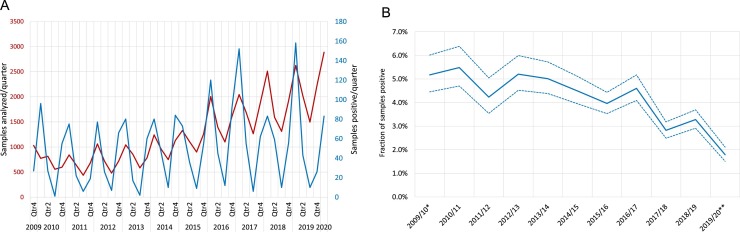
Results from PCR diagnostics for the seasonal coronaviruses, and other respiratory viruses, were obtained for 55,190 clinical samples analyzed at the Karolinska University Hospital, Stockholm, Sweden, between 14 September 2009 and 2 April 2020.
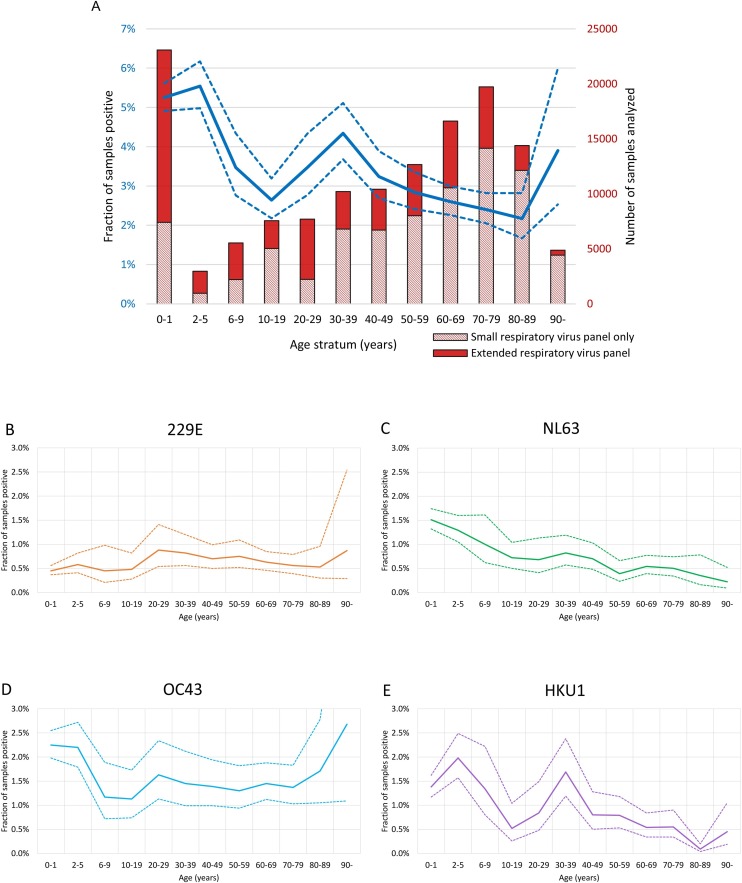
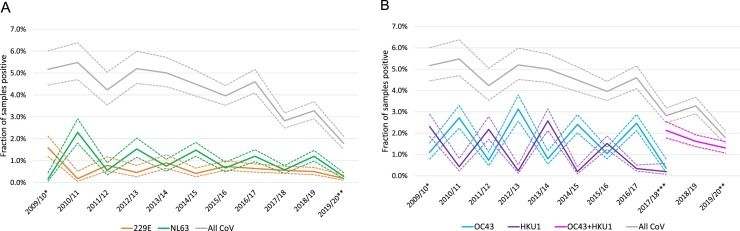
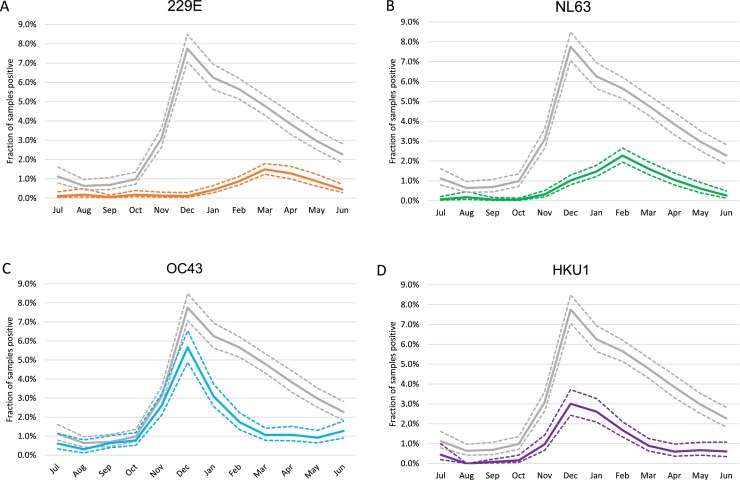
Seasonal coronaviruses were detected in 2130 samples (3.9 %) and constituted 8.1 % of all virus detections. OC43 was most commonly detected (28.4 % of detections), followed by NL63 (24.0 %), HKU1 (17.6 %), and 229E (15.3 %). The overall fraction of positive samples was similar between seasons, but at species level there were distinct biennial alternating peak seasons for the Alphacoronaviruses, 229E and NL63, and the Betacoronaviruses, OC43 and HKU1, respectively. The Betacoronaviruses peaked earlier in the winter season (Dec-Jan) than the Alphacoronaviruses (Feb-Mar). Coronaviruses were detected across all ages, but diagnostics were more frequently requested for paediatric patients than adults and the elderly. OC43 and 229E incidence was relatively constant across age strata, while that of NL63 and HKU1 decreased with age.
Both the Alphacoronaviruses and Betacoronaviruses showed alternating biennial winter incidence peaks, which suggests some type of immune mediated interaction. Symptomatic reinfections in adults and the elderly appear relatively common. Both findings may be of relevance for the epidemiology of SARS-CoV-2.
四种季节性冠状病毒229E、NL63、OC43和HKU1是呼吸道感染的常见病因,并呈现年度和季节性变化。深入了解这些模式可能有助于了解严重急性呼吸综合征冠状病毒2(SARS-CoV-2)的流行病学。
2009年9月14日至2020年4月2日期间,在瑞典斯德哥尔摩卡罗林斯卡大学医院对55190份临床样本进行了季节性冠状病毒及其他呼吸道病毒的聚合酶链反应(PCR)诊断检测。
在2130份样本(3.9%)中检测到季节性冠状病毒,占所有病毒检测的8.1%。最常检测到的是OC43(占检测的28.4%),其次是NL63(24.0%)、HKU1(17.6%)和229E(15.3%)。各季节阳性样本的总体比例相似,但在种属水平上,α冠状病毒229E和NL63以及β冠状病毒OC43和HKU1分别有明显的两年交替高峰季节。β冠状病毒在冬季(12月至1月)的高峰出现时间早于α冠状病毒(2月至3月)。各年龄段均检测到冠状病毒,但儿科患者进行诊断检测的频率高于成人和老年人。OC43和229E的发病率在各年龄层相对恒定,而NL63和HKU1的发病率随年龄增长而下降。
α冠状病毒和β冠状病毒均呈现两年交替的冬季发病高峰,这表明存在某种免疫介导的相互作用。成人和老年人出现有症状的再次感染似乎较为常见。这两个发现可能与SARS-CoV-2的流行病学有关。