Nyamwaya Doris K, Otiende Mark, Omuoyo Donwilliams O, Githinji George, Karanja Henry K, Gitonga John N, R de Laurent Zaydah, Otieno James R, Sang Rosemary, Kamau Everlyn, Cheruiyot Stanley, Otieno Edward, Agoti Charles N, Bejon Philip, Thumbi Samuel M, Warimwe George M
KEMRI-Wellcome Trust Research Programme, P.O. Box 230-80108, Kilifi, Kenya.
KEMRI-Centre for Virus Research, Nairobi, Kenya.
BMC Infect Dis. 2021 Feb 18;21(1):186. doi: 10.1186/s12879-021-05875-5.
Chikungunya fever (CHIKF) was first described in Tanzania in 1952. Several epidemics including East Africa have occurred, but there are no descriptions of longitudinal surveillance of endemic disease. Here, we estimate the incidence of CHIKF in coastal Kenya and describe the associated viral phylogeny.
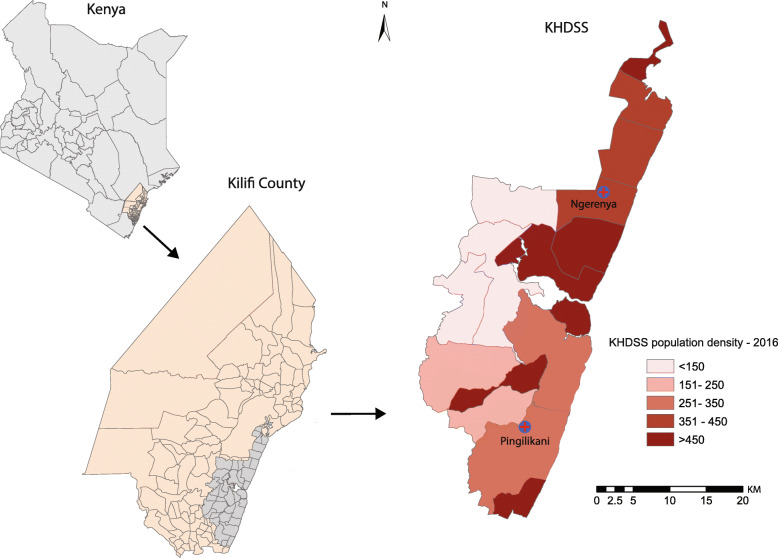
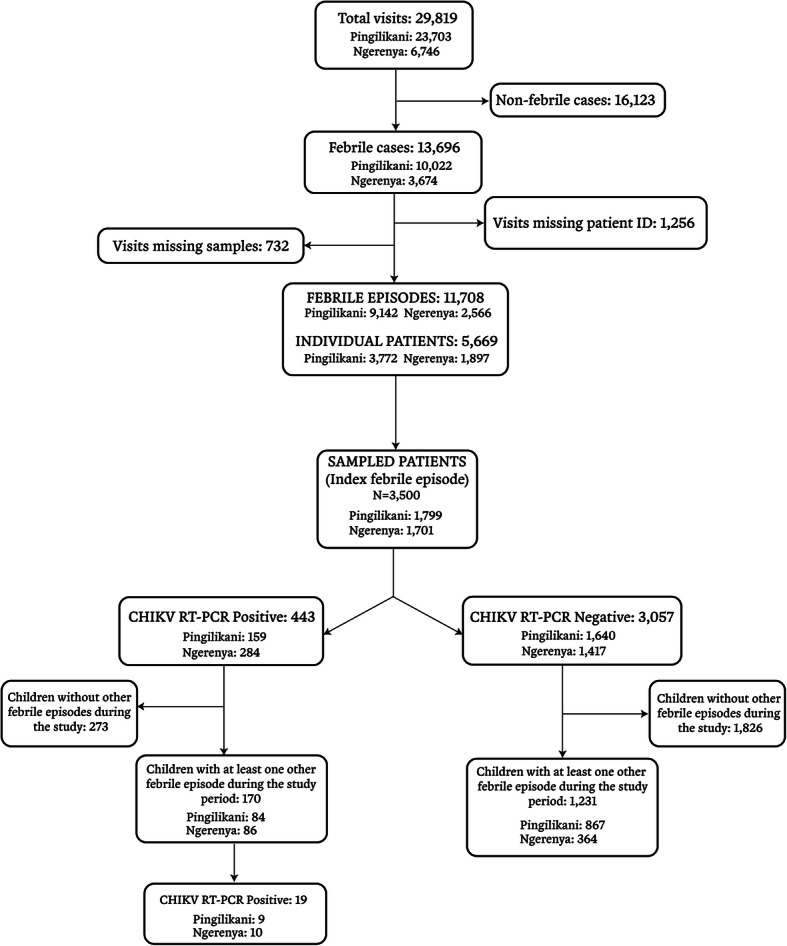
We monitored acute febrile illnesses among 3500 children visiting two primary healthcare facilities in coastal Kenya over a 5-year period (2014-2018). Episodes were linked to a demographic surveillance system and blood samples obtained. Cross-sectional sampling in a community survey of a different group of 435 asymptomatic children in the same study location was done in 2016. Reverse-transcriptase PCR was used for chikungunya virus (CHIKV) screening, and viral genomes sequenced for phylogenetic analyses.
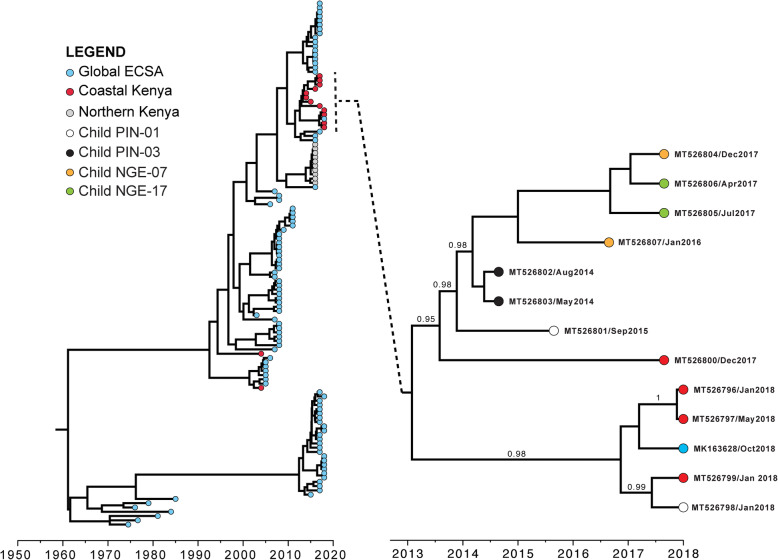
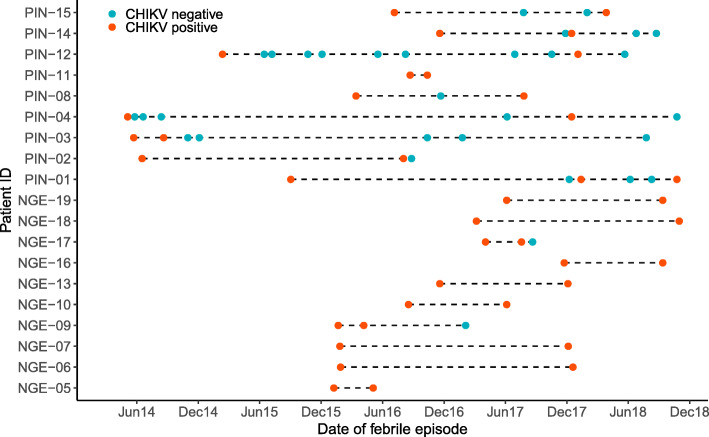
We found CHIKF to be endemic in this setting, associated with 12.7% (95% CI 11.60, 13.80) of all febrile presentations to primary healthcare. The prevalence of CHIKV infections among asymptomatic children in the community survey was 0.7% (95% CI 0.22, 2.12). CHIKF incidence among children < 1 year of age was 1190 cases/100,000-person years and 63 cases/100,000-person years among children aged ≥10 years. Recurrent CHIKF episodes, associated with fever and viraemia, were observed among 19 of 170 children with multiple febrile episodes during the study period. All sequenced viral genomes mapped to the ECSA genotype albeit distinct from CHIKV strains associated with the 2004 East African epidemic.
CHIKF may be a substantial public health burden in primary healthcare on the East African coast outside epidemic years, and recurrent infections are common.
基孔肯雅热(CHIKF)于1952年在坦桑尼亚首次被描述。包括东非在内已发生多起疫情,但尚无关于地方病纵向监测的描述。在此,我们估计了肯尼亚沿海地区基孔肯雅热的发病率,并描述了相关的病毒系统发育情况。
我们在5年期间(2014 - 2018年)对肯尼亚沿海地区两家基层医疗保健机构的3500名儿童的急性发热疾病进行了监测。发病情况与人口监测系统相关联,并采集了血样。2016年在同一研究地点对另一组435名无症状儿童进行了社区横断面抽样调查。采用逆转录聚合酶链反应(RT-PCR)进行基孔肯雅病毒(CHIKV)筛查,并对病毒基因组进行测序以进行系统发育分析。
我们发现基孔肯雅热在该地区为地方病,在基层医疗保健机构所有发热病例中占12.7%(9