Nyamwaya Doris K, Otiende Mark, Mwango Lilian, Kariuki Symon M, Otieno Berrick, Omuoyo Donwilliams O, Githinji George, Kitsao Barnes S, Karanja Henry K, Gitonga John N, de Laurent Zaydah R, Davies Alun, Mwarumba Salim, Agoti Charles N, Thumbi Samuel M, Hamaluba Mainga M, Newton Charles R, Bejon Philip, Warimwe George M
KEMRI-Wellcome Trust Research Programme, Nairobi, Kenya.
Paul G Allen School for Global Animal Health, Washington State University, Washington, United States of America.
PLoS Med. 2022 May 12;19(5):e1003994. doi: 10.1371/journal.pmed.1003994. eCollection 2022 May.
Neurological complications due to chikungunya virus (CHIKV) infection have been described in different parts of the world, with children being disproportionately affected. However, the burden of CHIKV-associated neurological disease in Africa is currently unknown and given the lack of diagnostic facilities in routine care it is possible that CHIKV is an unrecognized etiology among children with encephalitis or other neurological illness.
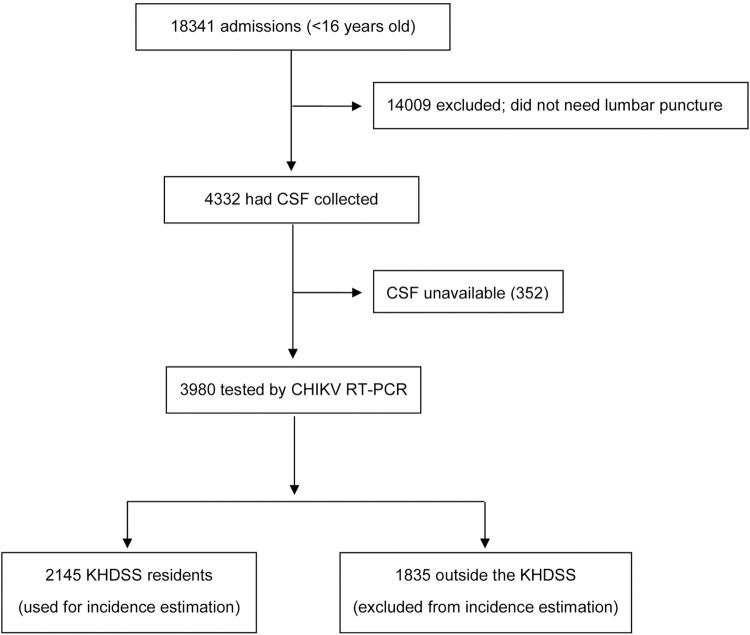
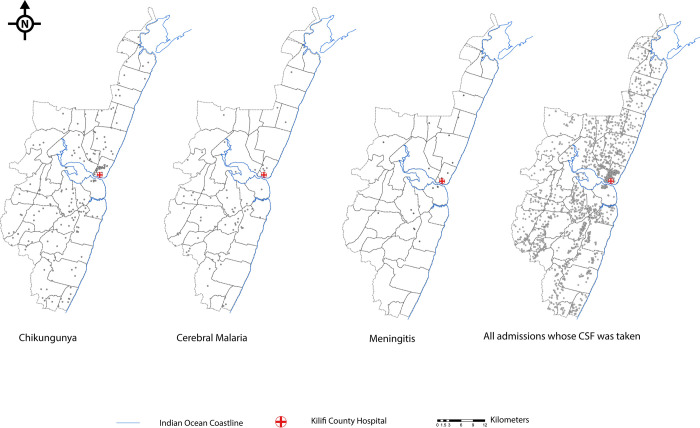
We estimated the incidence of CHIKV infection among children hospitalized with neurological disease in Kilifi County, coastal Kenya. We used reverse transcriptase polymerase chain reaction (RT-PCR) to systematically test for CHIKV in cerebrospinal fluid (CSF) samples from children aged <16 years hospitalized with symptoms of neurological disease at Kilifi County Hospital between January 2014 and December 2018. Clinical records were linked to the Kilifi Health and Demographic Surveillance System and population incidence rates of CHIKV infection estimated. There were 18,341 pediatric admissions for any reason during the 5-year study period, of which 4,332 (24%) had CSF collected. The most common clinical reasons for CSF collection were impaired consciousness, seizures, and coma (47%, 22%, and 21% of all collections, respectively). After acute investigations done for immediate clinical care, CSF samples were available for 3,980 admissions, of which 367 (9.2%) were CHIKV RT-PCR positive. Case fatality among CHIKV-positive children was 1.4% (95% CI 0.4, 3.2). The annual incidence of CHIKV-associated neurological disease varied between 13 to 58 episodes per 100,000 person-years among all children <16 years old. Among children aged <5 years, the incidence of CHIKV-associated neurological disease was 77 per 100,000 person-years, compared with 20 per 100,000 for cerebral malaria and 7 per 100,000 for bacterial meningitis during the study period. Because of incomplete case ascertainment due to children not presenting to hospital, or not having CSF collected, these are likely minimum estimates. Study limitations include reliance on hospital-based surveillance and limited CSF sampling in children in coma or other contraindications to lumbar puncture, both of which lead to under-ascertainment of incidence and of case fatality.
In this study, we observed that CHIKV infections are relatively more common than cerebral malaria and bacterial meningitis among children hospitalized with neurological disease in coastal Kenya. Given the wide distribution of CHIKV mosquito vectors, studies to determine the geographic extent of CHIKV-associated neurological disease in Africa are essential.
基孔肯雅病毒(CHIKV)感染所致的神经系统并发症在世界不同地区均有报道,儿童受影响的比例尤其高。然而,目前非洲CHIKV相关神经系统疾病的负担尚不清楚,而且由于常规医疗中缺乏诊断设施,CHIKV有可能是脑炎或其他神经系统疾病患儿中未被认识的病因。
我们估计了肯尼亚沿海基利菲县因神经系统疾病住院儿童中CHIKV感染的发病率。我们使用逆转录聚合酶链反应(RT-PCR)对2014年1月至2018年12月期间在基利菲县医院因神经系统疾病症状住院的16岁以下儿童的脑脊液(CSF)样本进行系统的CHIKV检测。临床记录与基利菲健康与人口监测系统相关联,并估计CHIKV感染的人群发病率。在为期5年的研究期间,共有18341名儿童因任何原因入院,其中4332名(24%)采集了脑脊液。采集脑脊液最常见的临床原因是意识障碍、癫痫发作和昏迷(分别占所有采集病例的47%、22%和21%)。在为立即进行临床护理而进行的急性检查后,有3980例入院病例可获得脑脊液样本,其中367例(9.2%)CHIKV RT-PCR呈阳性。CHIKV阳性儿童的病死率为1.4%(95%CI 0.4,3.2)。在所有16岁以下儿童中,CHIKV相关神经系统疾病的年发病率在每10万人年13至58例之间。在5岁以下儿童中,CHIKV相关神经系统疾病的发病率为每10万人年77例,而在研究期间,脑型疟疾的发病率为每10万人年20例,细菌性脑膜炎的发病率为每10万人年7例。由于儿童未到医院就诊或未采集脑脊液导致病例确定不完全,这些可能是最低估计值。研究的局限性包括依赖基于医院的监测以及昏迷儿童或有腰椎穿刺其他禁忌证的儿童脑脊液采样有限,这两者都会导致发病率和病死率的确定不足。
在本研究中,我们观察到在肯尼亚沿海因神经系统疾病住院的儿童中,CHIKV感染比脑型疟疾和细菌性脑膜炎相对更常见。鉴于CHIKV蚊媒分布广泛,开展研究以确定非洲CHIKV相关神经系统疾病的地理范围至关重要。