Sangath, New Delhi, India.
Centre for Brain and Cognitive Development, Birkbeck, University of London, London, United Kingdom.
PLoS One. 2021 Feb 19;16(2):e0247223. doi: 10.1371/journal.pone.0247223. eCollection 2021.
Early identification of preschool children who are at risk of faltering in their development is essential to ensuring that all children attain their full potential. Electroencephalography (EEG) has been used to measure neural correlates of cognitive and social development in children for decades. Effective portable and low-cost EEG devices increase the potential of its use to assess neurodevelopment in children at scale and particularly in low-resource settings. We conducted a systematic review aimed to synthesise EEG measures of cognitive and social development in 2-5-year old children. Our secondary aim was to identify how these measures differ across a) the course of development within this age range, b) gender and c) socioeconomic status (SES).
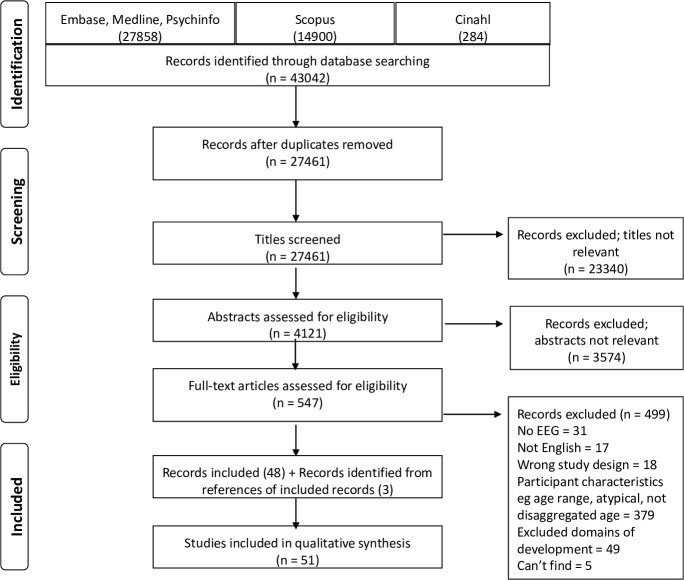
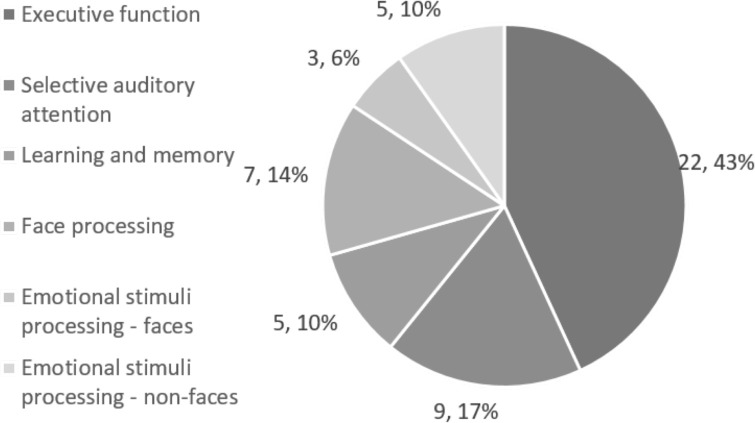
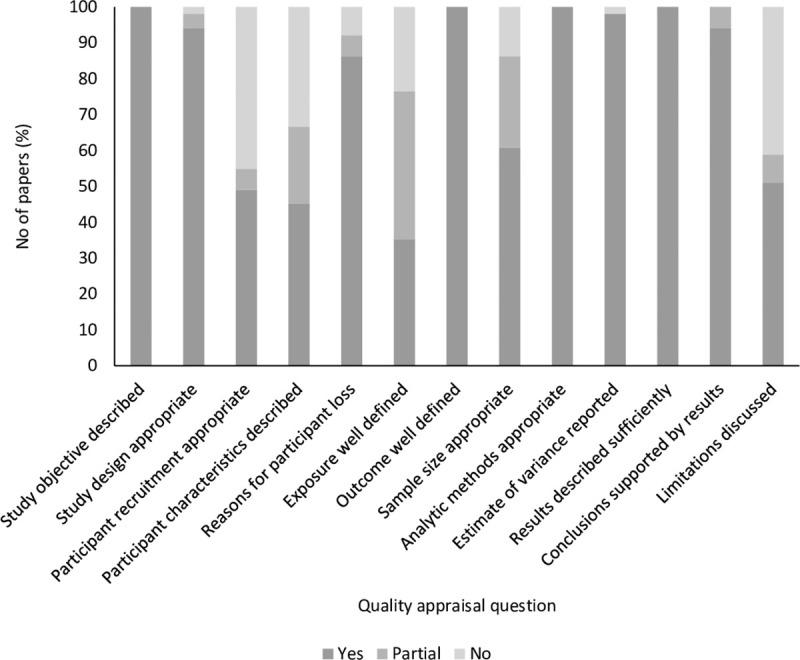
A systematic literature search identified 51 studies for inclusion in this review. Data relevant to the primary and secondary aims was extracted from these studies and an assessment for risk of bias was done, which highlighted the need for harmonisation of EEG data collection and analysis methods across research groups and more detailed reporting of participant characteristics. Studies reported on the domains of executive function (n = 22 papers), selective auditory attention (n = 9), learning and memory (n = 5), processing of faces (n = 7) and emotional stimuli (n = 8). For papers investigating executive function and selective auditory attention, the most commonly reported measures were alpha power and the amplitude and latency of positive (P1, P2, P3) and negative (N1, N2) deflections of event related potential (ERPs) components. The N170 and P1 ERP components were the most commonly reported neural responses to face and emotional faces stimuli. A mid-latency negative component and positive slow wave were used to index learning and memory, and late positive potential in response to emotional non-face stimuli. While almost half the studies described changes in EEG measures across age, only eight studies disaggregated results based on gender, and six included children from low income households to assess the impact of SES on neurodevelopment. No studies were conducted in low- and middle-income countries.
This review has identified power across the EEG spectrum and ERP components to be the measures most commonly reported in studies in which preschool children engage in tasks indexing cognitive and social development. It has also highlighted the need for additional research into their changes across age and based on gender and SES.
早期识别发展迟缓的学龄前儿童对于确保所有儿童充分发挥潜力至关重要。脑电图 (EEG) 已被用于测量儿童认知和社会发展的神经相关性数十年。有效的便携式和低成本 EEG 设备增加了其在大规模评估儿童神经发育,特别是在资源匮乏环境中使用的潜力。我们进行了一项系统综述,旨在综合 2-5 岁儿童认知和社会发展的 EEG 测量。我们的次要目标是确定这些测量在以下方面如何存在差异:a)此年龄段内的发展过程,b)性别和 c)社会经济地位 (SES)。
系统文献检索确定了 51 项符合纳入标准的研究。从这些研究中提取与主要和次要目标相关的数据,并对偏倚风险进行评估,这突显了需要在研究组之间协调 EEG 数据采集和分析方法,并更详细地报告参与者特征。研究报告了执行功能领域(n = 22 篇论文)、选择性听觉注意力(n = 9)、学习和记忆(n = 5)、面孔处理(n = 7)和情绪刺激(n = 8)的情况。对于研究执行功能和选择性听觉注意力的论文,最常报告的测量指标是阿尔法功率以及事件相关电位 (ERP) 成分的正(P1、P2、P3)和负(N1、N2)偏转的振幅和潜伏期。N170 和 P1 ERP 成分是对面孔和情绪面孔刺激最常报道的神经反应。中潜伏期负成分和正慢波用于索引学习和记忆,以及对情绪非面孔刺激的晚正电位。虽然近一半的研究描述了 EEG 测量在年龄上的变化,但只有八项研究根据性别对结果进行了细分,并且有六项研究包括来自低收入家庭的儿童,以评估 SES 对神经发育的影响。没有在中低收入国家开展研究。
本综述确定了 EEG 频谱和 ERP 成分的功率是在研究中最常报告的指标,这些研究中幼儿参与了索引认知和社会发展的任务。它还强调了需要进一步研究它们在年龄、性别和 SES 方面的变化。