Department of Plant Breeding and Genetics, Punjab Agricultural University, Ludhiana, 141004, Punjab, India.
Sci Rep. 2021 Feb 19;11(1):4278. doi: 10.1038/s41598-021-83689-w.
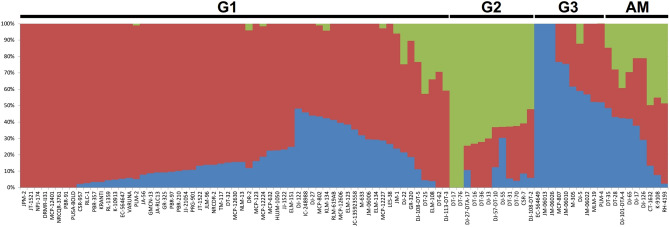
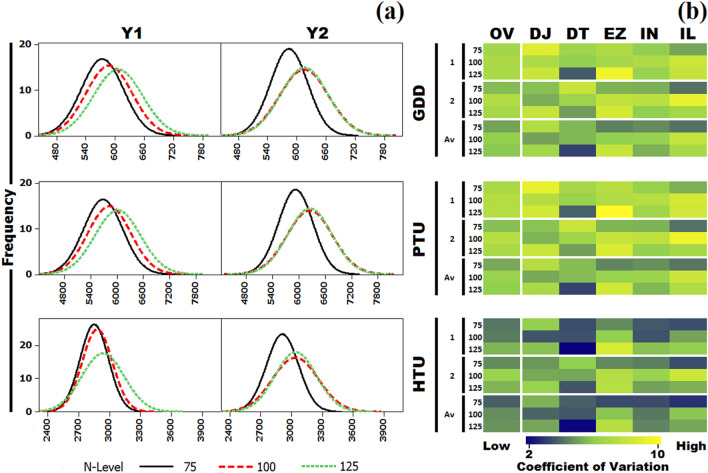
Timely transition to flowering, maturity and plant height are important for agronomic adaptation and productivity of Indian mustard (B. juncea), which is a major edible oilseed crop of low input ecologies in Indian subcontinent. Breeding manipulation for these traits is difficult because of the involvement of multiple interacting genetic and environmental factors. Here, we report a genetic analysis of these traits using a population comprising 92 diverse genotypes of mustard. These genotypes were evaluated under deficient (N75), normal (N100) or excess (N125) conditions of nitrogen (N) application. Lower N availability induced early flowering and maturity in most genotypes, while high N conditions delayed both. A genotyping-by-sequencing approach helped to identify 406,888 SNP markers and undertake genome wide association studies (GWAS). 282 significant marker-trait associations (MTA's) were identified. We detected strong interactions between GWAS loci and nitrogen levels. Though some trait associated SNPs were detected repeatedly across fertility gradients, majority were identified under deficient or normal levels of N applications. Annotation of the genomic region (s) within ± 50 kb of the peak SNPs facilitated prediction of 30 candidate genes belonging to light perception, circadian, floral meristem identity, flowering regulation, gibberellic acid pathways and plant development. These included over one copy each of AGL24, AP1, FVE, FRI, GID1A and GNC. FLC and CO were predicted on chromosomes A02 and B08 respectively. CDF1, CO, FLC, AGL24, GNC and FAF2 appeared to influence the variation for plant height. Our findings may help in improving phenotypic plasticity of mustard across fertility gradients through marker-assisted breeding strategies.
开花、成熟和株高的适时转变对印度芥菜(B. juncea)的农艺适应性和生产力很重要,印度芥菜是印度次大陆低投入生态系统的主要食用油料作物。由于涉及多个相互作用的遗传和环境因素,对这些性状进行育种操纵很困难。在这里,我们使用包含 92 个不同芥菜基因型的群体报告了这些性状的遗传分析。这些基因型在氮(N)施用量不足(N75)、正常(N100)或过量(N125)条件下进行了评估。较低的 N 可利用性诱导大多数基因型提前开花和成熟,而高 N 条件则延迟了两者。基于测序的基因分型方法有助于鉴定 406,888 个 SNP 标记并进行全基因组关联研究(GWAS)。鉴定出 282 个显著的标记-性状关联(MTA)。我们检测到 GWAS 基因座和氮水平之间存在强烈的相互作用。尽管在生育力梯度上检测到一些与性状相关的 SNP 多次出现,但大多数 SNP 是在氮应用不足或正常水平下鉴定出来的。在峰 SNP 的 ±50 kb 内的基因组区域注释促进了 30 个候选基因的预测,这些候选基因属于光感知、昼夜节律、花分生组织身份、开花调控、赤霉素途径和植物发育。其中包括 AGL24、AP1、FVE、FRI、GID1A 和 GNC 各一个以上的拷贝。FLC 和 CO 分别预测在染色体 A02 和 B08 上。CDF1、CO、FLC、AGL24、GNC 和 FAF2 似乎影响了植物高度的变化。我们的发现可能有助于通过标记辅助育种策略提高芥菜在肥力梯度上的表型可塑性。