Zeng Junjie, Zhao Wenying, Yue Shuhua
Institute of Medical Photonics, Beijing Advanced Innovation Center for Biomedical Engineering, School of Biological Science and Medical Engineering, Beihang University, Beijing, China.
Wuhan National Laboratory for Optoelectronics, Huazhong University of Science and Technology, Wuhan, China.
Front Pharmacol. 2021 Feb 3;12:630167. doi: 10.3389/fphar.2021.630167. eCollection 2021.
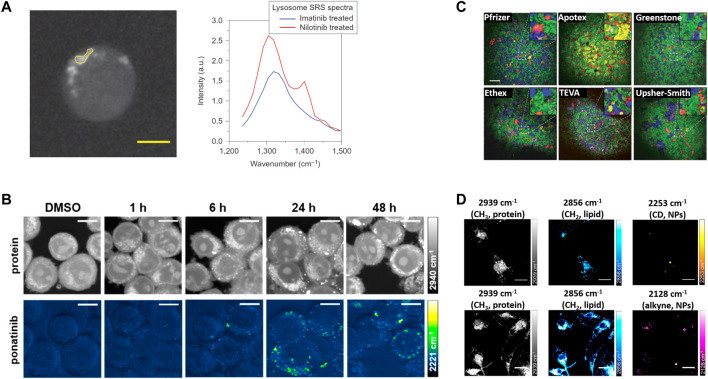
The high attrition rates of anti-cancer drugs during clinical development remains a bottleneck problem in pharmaceutical industry. This is partially due to the lack of quantitative, selective, and rapid readouts of anti-cancer drug activity with high resolution. Although fluorescence microscopy has been commonly used in oncology pharmacological research, fluorescent labels are often too large in size for small drug molecules, and thus may disturb the function or metabolism of these molecules. Such challenge can be overcome by coherent Raman scattering microscopy, which is capable of chemically selective, highly sensitive, high spatial resolution, and high-speed imaging, without the need of any labeling. Coherent Raman scattering microscopy has tremendously improved the understanding of pharmaceutical materials in the solid state, pharmacokinetics of anti-cancer drugs and nanocarriers and . This review focuses on the latest applications of coherent Raman scattering microscopy as a new emerging platform to facilitate oncology pharmacokinetic research.
抗癌药物在临床开发过程中的高损耗率仍然是制药行业的一个瓶颈问题。部分原因是缺乏高分辨率的定量、选择性和快速的抗癌药物活性读数。尽管荧光显微镜已广泛应用于肿瘤药理学研究,但荧光标签对于小药物分子来说往往太大,可能会干扰这些分子的功能或代谢。相干拉曼散射显微镜可以克服这一挑战,它能够进行化学选择性、高灵敏度、高空间分辨率和高速成像,无需任何标记。相干拉曼散射显微镜极大地增进了我们对固态药物材料、抗癌药物和纳米载体的药代动力学的理解。本综述重点介绍相干拉曼散射显微镜作为一个新兴平台在促进肿瘤药代动力学研究方面的最新应用。