Department of Psychology, Chemnitz University of Technology, Chemnitz, Germany.
Int J Psychol. 2021 Aug;56(4):532-550. doi: 10.1002/ijop.12743. Epub 2021 Feb 21.
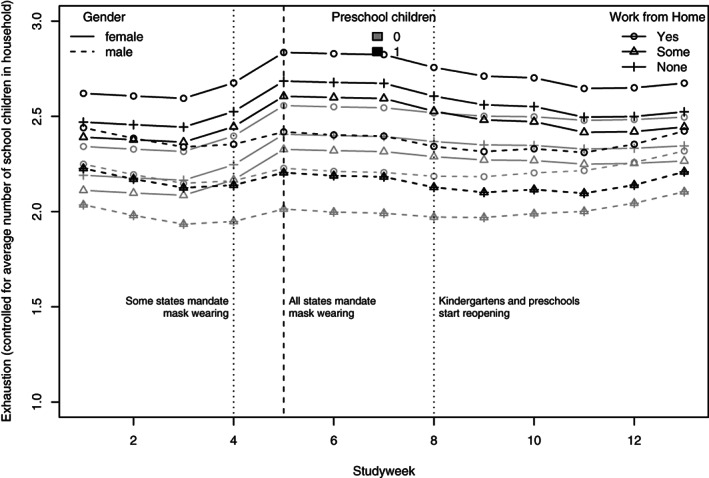
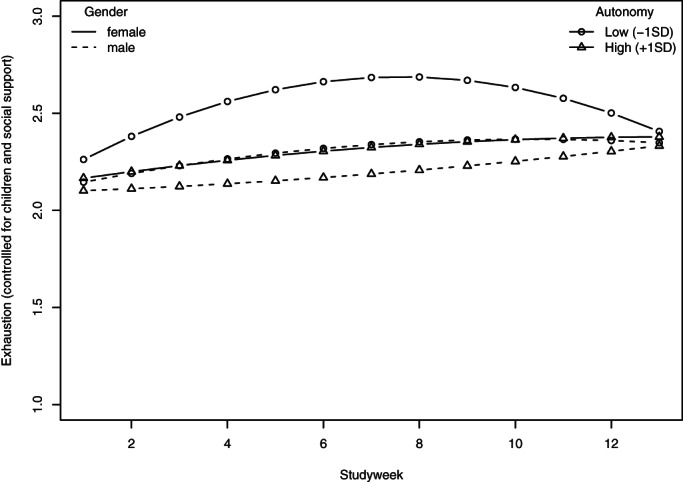
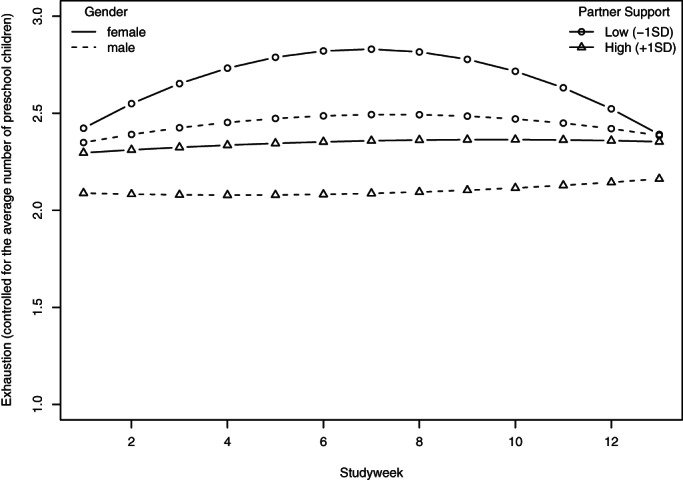
Many governments react to the current coronavirus/COVID-19 pandemic by restricting daily (work) life. On the basis of theories from occupational health, we propose that the duration of the pandemic, its demands (e.g., having to work from home, closing of childcare facilities, job insecurity, work-privacy conflicts, privacy-work conflicts) and personal- and job-related resources (co-worker social support, job autonomy, partner support and corona self-efficacy) interact in their effect on employee exhaustion. We test the hypotheses with a three-wave sample of German employees during the pandemic from April to June 2020 (N = 2900, N = 1237, N = 789). Our findings show a curvilinear effect of pandemic duration on working women's exhaustion. The data also show that the introduction and the easing of lockdown measures affect exhaustion, and that women with children who work from home while childcare is unavailable are especially exhausted. Job autonomy and partner support mitigated some of these effects. In sum, women's psychological health was more strongly affected by the pandemic than men's. We discuss implications for occupational health theories and that interventions targeted at mitigating the psychological consequences of the COVID-19 pandemic should target women specifically.
许多政府通过限制日常生活(工作)来应对当前的冠状病毒/COVID-19 大流行。基于职业健康理论,我们提出大流行的持续时间、其需求(例如,必须在家工作、儿童保育设施关闭、工作不安全、工作-隐私冲突、隐私-工作冲突)以及个人和工作相关资源(同事社会支持、工作自主性、伴侣支持和冠状病毒自我效能)在其对员工疲惫的影响中相互作用。我们使用 2020 年 4 月至 6 月期间德国员工的三波疫情样本(N=2900,N=1237,N=789)来检验这些假设。我们的研究结果表明,大流行持续时间对女性员工的疲惫感呈曲线影响。数据还表明,封锁措施的引入和放宽会影响疲惫感,而在家工作且儿童保育不可用的有子女的女性尤其疲惫。工作自主性和伴侣支持减轻了其中的一些影响。总之,女性的心理健康受到大流行的影响比男性更严重。我们讨论了职业健康理论的影响,并且针对减轻 COVID-19 大流行心理后果的干预措施应专门针对女性。