Department of Neurology, Huashan Hospital Fudan University, Shanghai, China.
Department of Biostatistics, School of Public Health and Key Laboratory of Public Health Safety, Fudan University, Shanghai, China.
Ann Clin Transl Neurol. 2021 Apr;8(4):749-762. doi: 10.1002/acn3.51312. Epub 2021 Feb 22.
Myasthenia gravis (MG) is an autoimmune disease caused by autoantibodies against neuromuscular junctions. Myasthenic crisis (MC) represents the most severe state of MG with high in-hospital mortality. We aimed to identify immune signatures using in-depth profiling in MC, and to assess the correlations between immune biomarkers with clinical severity longitudinally.
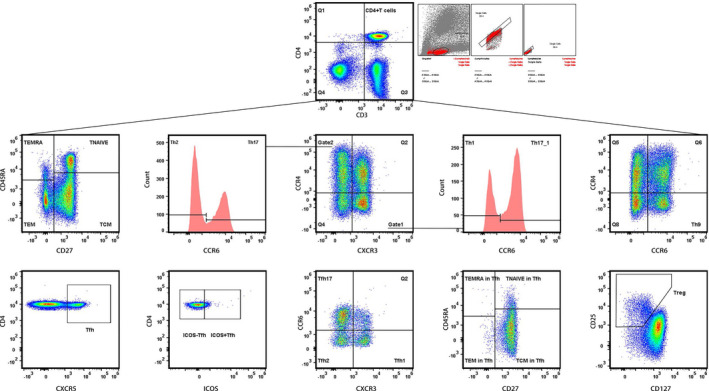
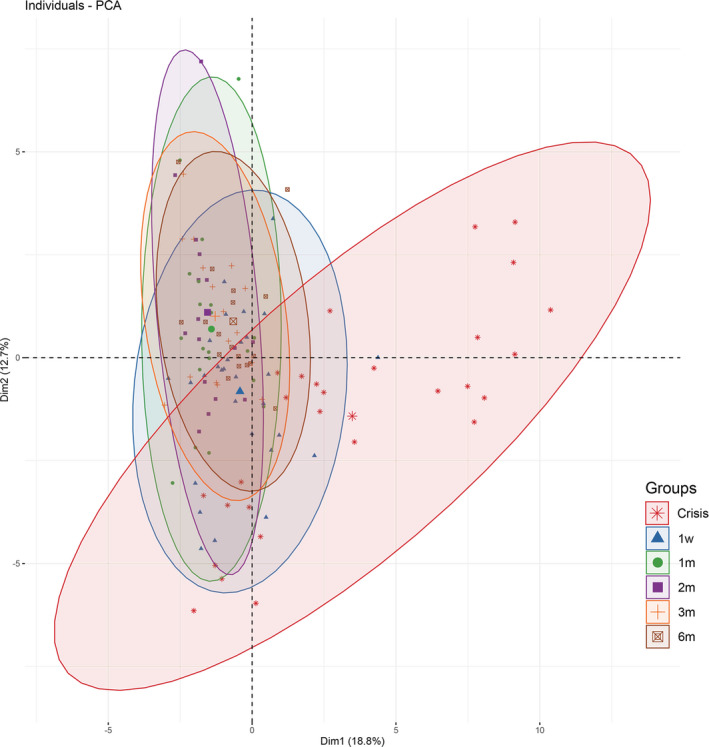
We studied 181 participants including 57 healthy controls, 96 patients with MG who never experienced crisis and 28 MC patients from December 2018 through June 2020. Follow-up visits occurred prospectively from crisis to 6 months off-mechanical ventilation. The frequencies of 20 CD4 T subpopulations and 18 serum cytokines were associated with clinical scores using correlations and principal component analysis.
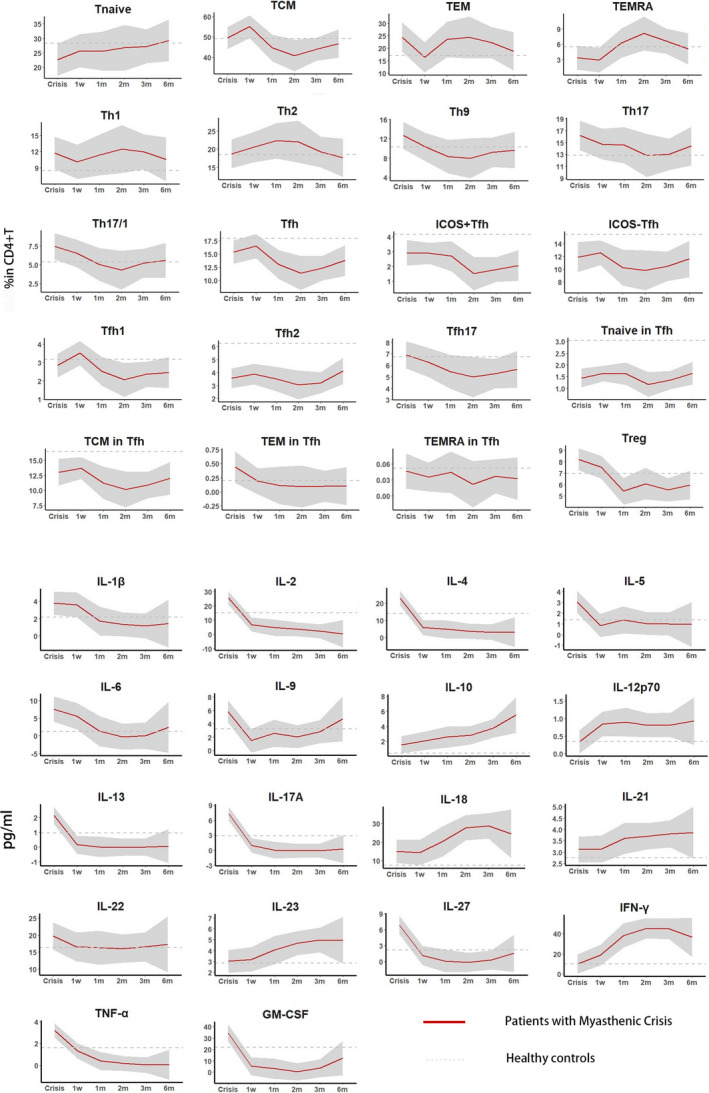
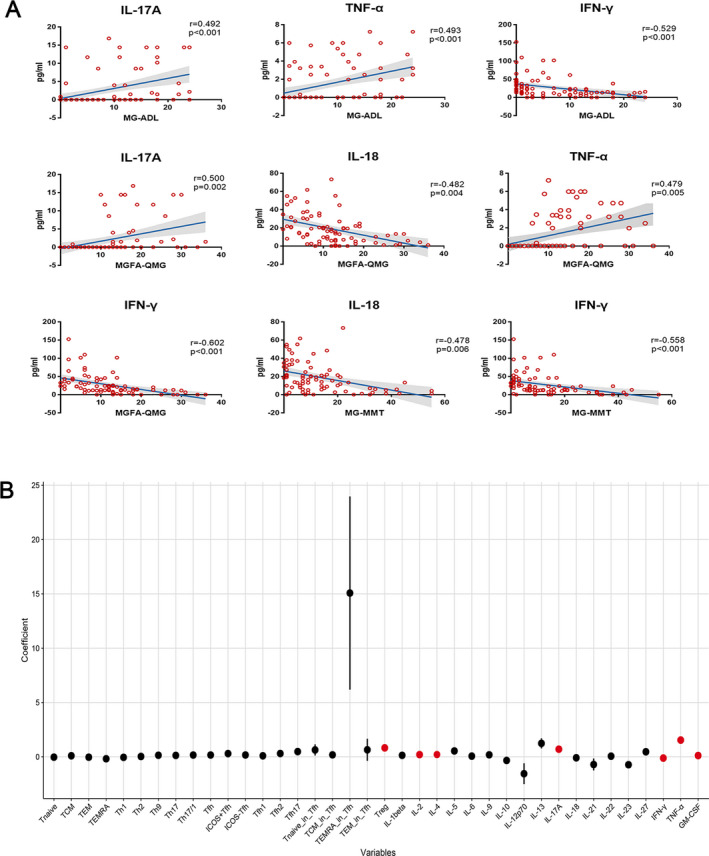
Patients in crisis exhibited a proinflammatory CD4 T response with elevated Th1 (P = 0.026), and Th17 cells (P = 0.032); decreased T follicular helper 2 (Tfh2) cells (P < 0.001), Tnaive in Tfh cells (P < 0.001), ICOS Tfh cells (P = 0.017), and T central memory in Tfh (P = 0.022) compared with controls, and increased frequencies of Tregs (P = 0.026) and Tfh17 (P = 0.045) compared with non-crisis MG. Cytokine cascade was identified in crisis including the ones associated with Th1 (IL-1β/2/12p70/18/27/IFN-γ/TNF-α), Th2 (IL-4/5/13), Th17 (IL-6/17A/21/22/23/GM-CSF), Th9 (IL-9), and Treg (IL-10). Longitudinally, seven immune biomarkers including Tregs, IL-2/4/17A/IFN-γ/TNF-α/GM-CSF had significant correlations with MG-activities of daily living score.
Vigorous inflammatory CD4 T signatures were identified in MC and are associated with clinical severity. Future research is needed to explore its potential candidacy for therapeutic intervention and predicting impending crisis.
重症肌无力(MG)是一种由针对神经肌肉接头的自身抗体引起的自身免疫性疾病。肌无力危象(MC)代表 MG 最严重的状态,院内死亡率高。我们旨在使用 MC 中的深度分析来识别免疫特征,并评估免疫生物标志物与临床严重程度的纵向相关性。
我们研究了 181 名参与者,包括 57 名健康对照者、96 名从未经历过危象的 MG 患者和 2018 年 12 月至 2020 年 6 月期间的 28 名 MC 患者。从危机到 6 个月停用机械通气进行前瞻性随访。使用相关性和主成分分析将 20 种 CD4 T 亚群和 18 种血清细胞因子的频率与临床评分相关联。
处于危象中的患者表现出促炎 CD4 T 反应,Th1 细胞增多(P=0.026),Th17 细胞增多(P=0.032);T 滤泡辅助 2(Tfh2)细胞减少(P<0.001),Tfh 细胞中的 Tnaive(P<0.001),ICOS Tfh 细胞(P=0.017)和 Tfh 中的 T 中央记忆细胞(P=0.022)与对照组相比,Tregs(P=0.026)和 Tfh17(P=0.045)的频率增加与非危机性 MG 相比。在危象中鉴定出细胞因子级联,包括与 Th1(IL-1β/2/12p70/18/27/IFN-γ/TNF-α)、Th2(IL-4/5/13)、Th17(IL-6/17A/21/22/23/GM-CSF)、Th9(IL-9)和 Treg(IL-10)相关的细胞因子。纵向分析显示,包括 Tregs、IL-2/4/17A/IFN-γ/TNF-α/GM-CSF 在内的 7 种免疫生物标志物与 MG 日常生活活动评分显著相关。
在 MC 中鉴定出强烈的炎症性 CD4 T 特征,与临床严重程度相关。需要进一步研究以探索其作为治疗干预和预测即将发生的危象的潜在候选物的潜力。