• 文献检索
  • 文档翻译
  • 深度研究
  • 学术资讯
  • Suppr Zotero 插件Zotero 插件
  • 邀请有礼
  • 套餐&价格
  • 历史记录
应用&插件
Suppr Zotero 插件Zotero 插件浏览器插件Mac 客户端Windows 客户端微信小程序
定价
高级版会员购买积分包购买API积分包
服务
文献检索文档翻译深度研究API 文档MCP 服务
关于我们
关于 Suppr公司介绍联系我们用户协议隐私条款
关注我们

Suppr 超能文献

核心技术专利:CN118964589B侵权必究
粤ICP备2023148730 号-1Suppr @ 2026

文献检索

告别复杂PubMed语法,用中文像聊天一样搜索,搜遍4000万医学文献。AI智能推荐,让科研检索更轻松。

立即免费搜索

文件翻译

保留排版,准确专业,支持PDF/Word/PPT等文件格式,支持 12+语言互译。

免费翻译文档

深度研究

AI帮你快速写综述,25分钟生成高质量综述,智能提取关键信息,辅助科研写作。

立即免费体验

急性心肌梗死合并心源性休克患者使用机械循环支持装置的情况

Use of Mechanical Circulatory Support Devices Among Patients With Acute Myocardial Infarction Complicated by Cardiogenic Shock.

作者信息

Dhruva Sanket S, Ross Joseph S, Mortazavi Bobak J, Hurley Nathan C, Krumholz Harlan M, Curtis Jeptha P, Berkowitz Alyssa P, Masoudi Frederick A, Messenger John C, Parzynski Craig S, Ngufor Che G, Girotra Saket, Amin Amit P, Shah Nilay D, Desai Nihar R

机构信息

University of California, San Francisco School of Medicine, San Francisco.

Section of Cardiology, Department of Medicine, San Francisco Veterans Affairs Medical Center, San Francisco, California.

出版信息

JAMA Netw Open. 2021 Feb 1;4(2):e2037748. doi: 10.1001/jamanetworkopen.2020.37748.

DOI:10.1001/jamanetworkopen.2020.37748
PMID:33616664
原文链接:https://pmc.ncbi.nlm.nih.gov/articles/PMC7900859/
Abstract

IMPORTANCE

Mechanical circulatory support (MCS) devices, including intravascular microaxial left ventricular assist devices (LVADs) and intra-aortic balloon pumps (IABPs), are used in patients who undergo percutaneous coronary intervention (PCI) for acute myocardial infarction (AMI) complicated by cardiogenic shock despite limited evidence of their clinical benefit.

OBJECTIVE

To examine trends in the use of MCS devices among patients who underwent PCI for AMI with cardiogenic shock, hospital-level use variation, and factors associated with use.

DESIGN, SETTING, AND PARTICIPANTS: This cross-sectional study used the CathPCI and Chest Pain-MI Registries of the American College of Cardiology National Cardiovascular Data Registry. Patients who underwent PCI for AMI complicated by cardiogenic shock between October 1, 2015, and December 31, 2017, were identified from both registries. Data were analyzed from October 2018 to August 2020.

EXPOSURES

Therapies to provide hemodynamic support were categorized as intravascular microaxial LVAD, IABP, TandemHeart, extracorporeal membrane oxygenation, LVAD, other devices, combined IABP and intravascular microaxial LVAD, combined IABP and other device (defined as TandemHeart, extracorporeal membrane oxygenation, LVAD, or another MCS device), or medical therapy only.

MAIN OUTCOMES AND MEASURES

Use of MCS devices overall and specific MCS devices, including intravascular microaxial LVAD, at both patient and hospital levels and variables associated with use.

RESULTS

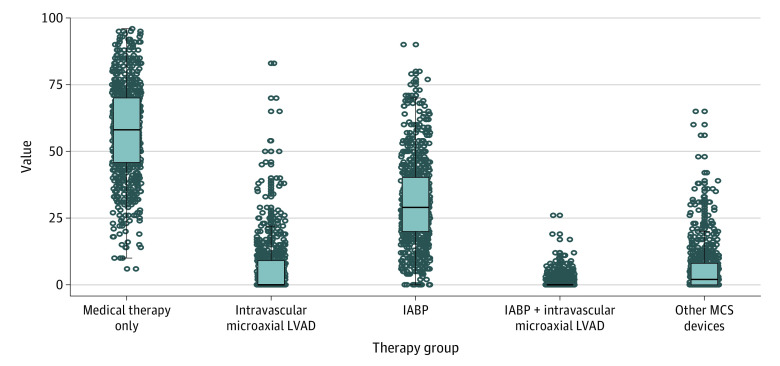
Among the 28 304 patients included in the study, the mean (SD) age was 65.4 (12.6) years and 18 968 were men (67.0%). The overall MCS device use was constant from the fourth quarter of 2015 to the fourth quarter of 2017, although use of intravascular microaxial LVADs significantly increased (from 4.1% to 9.8%; P < .001), whereas use of IABPs significantly decreased (from 34.8% to 30.0%; P < .001). A significant hospital-level variation in MCS device use was found. The median (interquartile range [IQR]) proportion of patients who received MCS devices was 42% (30%-54%), and the median proportion of patients who received intravascular microaxial LVADs was 1% (0%-10%). In multivariable analyses, cardiac arrest at first medical contact or during hospitalization (odds ratio [OR], 1.82; 95% CI, 1.58-2.09) and severe left main and/or proximal left anterior descending coronary artery stenosis (OR, 1.36; 95% CI, 1.20-1.54) were patient characteristics that were associated with higher odds of receiving intravascular microaxial LVADs only compared with IABPs only.

CONCLUSIONS AND RELEVANCE

This study found that, among patients who underwent PCI for AMI complicated by cardiogenic shock, overall use of MCS devices was constant, and a 2.5-fold increase in intravascular microaxial LVAD use was found along with a corresponding decrease in IABP use and a significant hospital-level variation in MCS device use. These trends were observed despite limited clinical trial evidence of improved outcomes associated with device use.

摘要

重要性

机械循环支持(MCS)设备,包括血管内微轴左心室辅助设备(LVAD)和主动脉内球囊泵(IABP),被用于接受经皮冠状动脉介入治疗(PCI)的急性心肌梗死(AMI)合并心源性休克的患者,尽管其临床益处的证据有限。

目的

研究接受PCI治疗的AMI合并心源性休克患者中MCS设备的使用趋势、医院层面的使用差异以及与使用相关的因素。

设计、设置和参与者:这项横断面研究使用了美国心脏病学会国家心血管数据注册中心的CathPCI和胸痛-心肌梗死注册库。从这两个注册库中识别出2015年10月1日至2017年12月31日期间接受PCI治疗的AMI合并心源性休克的患者。数据于2018年10月至2020年8月进行分析。

暴露因素

提供血流动力学支持的治疗方法分为血管内微轴LVAD、IABP、TandemHeart、体外膜肺氧合、LVAD、其他设备、IABP与血管内微轴LVAD联合使用、IABP与其他设备联合使用(定义为TandemHeart、体外膜肺氧合、LVAD或其他MCS设备)或仅药物治疗。

主要结局和测量指标

患者和医院层面MCS设备的总体使用情况以及特定MCS设备(包括血管内微轴LVAD)的使用情况,以及与使用相关的变量。

结果

在纳入研究的28304例患者中,平均(标准差)年龄为65.4(12.6)岁,男性18968例(67.0%)。从2015年第四季度到2017年第四季度,MCS设备的总体使用情况保持不变,尽管血管内微轴LVAD的使用显著增加(从4.1%增至9.8%;P<0.001),而IABP的使用显著减少(从34.8%降至30.0%;P<0.001)。发现MCS设备的使用在医院层面存在显著差异。接受MCS设备治疗的患者比例中位数(四分位间距[IQR])为42%(30%-54%),接受血管内微轴LVAD治疗的患者比例中位数为1%(0%-10%)。在多变量分析中,首次医疗接触时或住院期间发生心脏骤停(比值比[OR],1.82;95%可信区间[CI],1.58-2.09)和严重左主干和/或左前降支近端冠状动脉狭窄(OR,1.36;95%CI,1.20-1.54)是与仅接受血管内微轴LVAD治疗相比仅接受IABP治疗可能性更高相关的患者特征。

结论与相关性

本研究发现,在接受PCI治疗的AMI合并心源性休克患者中,MCS设备的总体使用情况保持不变,血管内微轴LVAD的使用增加了2.5倍,同时IABP的使用相应减少,且MCS设备的使用在医院层面存在显著差异。尽管关于设备使用改善结局的临床试验证据有限,但仍观察到了这些趋势。

https://cdn.ncbi.nlm.nih.gov/pmc/blobs/cac1/7900859/5eb740d99f47/jamanetwopen-e2037748-g002.jpg
https://cdn.ncbi.nlm.nih.gov/pmc/blobs/cac1/7900859/17514c434c8f/jamanetwopen-e2037748-g001.jpg
https://cdn.ncbi.nlm.nih.gov/pmc/blobs/cac1/7900859/5eb740d99f47/jamanetwopen-e2037748-g002.jpg
https://cdn.ncbi.nlm.nih.gov/pmc/blobs/cac1/7900859/17514c434c8f/jamanetwopen-e2037748-g001.jpg
https://cdn.ncbi.nlm.nih.gov/pmc/blobs/cac1/7900859/5eb740d99f47/jamanetwopen-e2037748-g002.jpg

相似文献

1
Use of Mechanical Circulatory Support Devices Among Patients With Acute Myocardial Infarction Complicated by Cardiogenic Shock.急性心肌梗死合并心源性休克患者使用机械循环支持装置的情况
JAMA Netw Open. 2021 Feb 1;4(2):e2037748. doi: 10.1001/jamanetworkopen.2020.37748.
2
Association of Use of an Intravascular Microaxial Left Ventricular Assist Device vs Intra-aortic Balloon Pump With In-Hospital Mortality and Major Bleeding Among Patients With Acute Myocardial Infarction Complicated by Cardiogenic Shock.血管内微型轴流左心室辅助装置与主动脉内球囊泵在急性心肌梗死合并心源性休克患者中的应用与院内死亡率和大出血的关系。
JAMA. 2020 Feb 25;323(8):734-745. doi: 10.1001/jama.2020.0254.
3
Clinical Outcomes and Cost Associated With an Intravascular Microaxial Left Ventricular Assist Device vs Intra-aortic Balloon Pump in Patients Presenting With Acute Myocardial Infarction Complicated by Cardiogenic Shock.临床结局和成本与血管内微轴左心室辅助装置与主动脉内球囊泵在急性心肌梗死合并心源性休克患者。
JAMA Intern Med. 2022 Sep 1;182(9):926-933. doi: 10.1001/jamainternmed.2022.2735.
4
Use of mechanical circulatory support in patients undergoing percutaneous coronary intervention: insights from the National Cardiovascular Data Registry.在接受经皮冠状动脉介入治疗的患者中使用机械循环支持:来自国家心血管数据注册中心的见解。
Circulation. 2015 Sep 29;132(13):1243-51. doi: 10.1161/CIRCULATIONAHA.114.014451. Epub 2015 Aug 18.
5
Trends in mechanical circulatory support use and hospital mortality among patients with acute myocardial infarction and non-infarction related cardiogenic shock in the United States.美国急性心肌梗死合并非梗死相关心原性休克患者应用机械循环支持治疗的趋势和院内死亡率。
Clin Res Cardiol. 2018 Apr;107(4):287-303. doi: 10.1007/s00392-017-1182-2. Epub 2017 Nov 13.
6
Contemporary trends in use of mechanical circulatory support in patients with acute MI and cardiogenic shock.急性心肌梗死合并心源性休克患者使用机械循环支持的当代趋势。
Open Heart. 2020 Mar 4;7(1):e001214. doi: 10.1136/openhrt-2019-001214. eCollection 2020.
7
Hospital Variation in the Utilization of Short-Term Nondurable Mechanical Circulatory Support in Myocardial Infarction Complicated by Cardiogenic Shock.心肌梗死后合并心源性休克患者短期非耐久性机械循环支持的应用在医院间的差异。
Circ Cardiovasc Interv. 2019 Jan;12(1):e007270. doi: 10.1161/CIRCINTERVENTIONS.118.007270.
8
Comparative Effectiveness of Percutaneous Microaxial Left Ventricular Assist Device vs Intra-Aortic Balloon Pump or No Mechanical Circulatory Support in Patients With Cardiogenic Shock.经皮微轴左心室辅助装置与主动脉内球囊泵或无机械循环支持治疗心源性休克患者的比较效果。
JAMA Cardiol. 2023 Aug 1;8(8):744-754. doi: 10.1001/jamacardio.2023.1643.
9
Escalation strategies, management, and outcomes of acute myocardial infarction-cardiogenic shock patients receiving percutaneous left ventricular support.接受经皮左心室辅助的急性心肌梗死合并心原性休克患者的升级策略、管理和结局。
Catheter Cardiovasc Interv. 2023 Sep;102(3):403-414. doi: 10.1002/ccd.30786. Epub 2023 Jul 20.
10
Feasibility of early mechanical circulatory support in acute myocardial infarction complicated by cardiogenic shock: The Detroit cardiogenic shock initiative.急性心肌梗死合并心源性休克早期机械循环支持的可行性:底特律心源性休克倡议
Catheter Cardiovasc Interv. 2018 Feb 15;91(3):454-461. doi: 10.1002/ccd.27427. Epub 2017 Dec 20.

引用本文的文献

1
Outcomes of prolonged support on surgically implanted microaxial left ventricular assist devices for refractory cardiogenic shock.外科植入式微轴左心室辅助装置对难治性心源性休克长期支持的效果
JTCVS Open. 2025 May 2;25:173-189. doi: 10.1016/j.xjon.2025.03.023. eCollection 2025 Jun.
2
Real-world interventional outcomes for cardiogenic shock complicating acute myocardial infarction.急性心肌梗死并发心源性休克的真实世界介入治疗结果。
Am Heart J Plus. 2025 Apr 5;53:100540. doi: 10.1016/j.ahjo.2025.100540. eCollection 2025 May.
3
Anatomic Suitability for Axillary Intra-Aortic Balloon Pump Circulatory Support.

本文引用的文献

1
Microaxial Left Ventricular Assist Devices: In Search of an Appropriate Indication.微轴向左心室辅助装置:寻找合适的适应症
JAMA. 2020 Feb 25;323(8):716-718. doi: 10.1001/jama.2019.22382.
2
Association of Use of an Intravascular Microaxial Left Ventricular Assist Device vs Intra-aortic Balloon Pump With In-Hospital Mortality and Major Bleeding Among Patients With Acute Myocardial Infarction Complicated by Cardiogenic Shock.血管内微型轴流左心室辅助装置与主动脉内球囊泵在急性心肌梗死合并心源性休克患者中的应用与院内死亡率和大出血的关系。
JAMA. 2020 Feb 25;323(8):734-745. doi: 10.1001/jama.2020.0254.
3
The Evolving Landscape of Impella Use in the United States Among Patients Undergoing Percutaneous Coronary Intervention With Mechanical Circulatory Support.
腋动脉主动脉内球囊反搏循环支持的解剖学适宜性
Artif Organs. 2025 Jul;49(7):1207-1214. doi: 10.1111/aor.14994. Epub 2025 Mar 17.
4
Variations in the Medical Device Authorization and Reimbursement Landscape: A Case Study of 2 Cardiovascular Devices Across 4 Countries.医疗器械授权与报销情况的差异:以4个国家的2种心血管器械为例的案例研究
Circ Cardiovasc Qual Outcomes. 2025 Apr;18(4):e011636. doi: 10.1161/CIRCOUTCOMES.124.011636. Epub 2025 Feb 21.
5
Clinical use and impact of mechanical circulatory support for myocardial infarction-related cardiogenic shock in the Netherlands: a registry-based propensity-matched analysis.荷兰机械循环支持用于心肌梗死相关心源性休克的临床应用及影响:一项基于注册登记的倾向评分匹配分析
Open Heart. 2025 Feb 17;12(1):e002846. doi: 10.1136/openhrt-2024-002846.
6
Resource utilization associated with extracorporeal membrane oxygenation vs. microaxial flow pump for infarct-related cardiogenic shock.体外膜肺氧合与微轴流泵用于梗死相关心源性休克的资源利用情况
Eur Heart J Acute Cardiovasc Care. 2025 May 16;14(5):279-287. doi: 10.1093/ehjacc/zuaf024.
7
ECMO in the Cardiac Catheterization Lab-Patient Selection Is Key.心脏导管室中的体外膜肺氧合——患者选择是关键。
J Cardiovasc Dev Dis. 2024 Dec 31;12(1):12. doi: 10.3390/jcdd12010012.
8
Microaxial Flow Pump Hemodynamic and Metabolic Effects in Infarct-Related Cardiogenic Shock: A Substudy of the DanGer Shock Randomized Clinical Trial.微轴流泵在梗死相关心源性休克中的血流动力学和代谢效应:DanGer休克随机临床试验的一项子研究
JAMA Cardiol. 2025 Jan 1;10(1):9-16. doi: 10.1001/jamacardio.2024.4197.
9
Long-term outcomes of cardiogenic shock and cardiac arrest complicating ST-elevation myocardial infarction according to timing of occurrence.根据发生时间,ST段抬高型心肌梗死并发心源性休克和心脏骤停的长期预后。
Eur Heart J Open. 2024 Sep 3;4(5):oeae075. doi: 10.1093/ehjopen/oeae075. eCollection 2024 Sep.
10
Racial, Ethnic, Socioeconomic, and Geographic Inequities in Access to Mechanical Circulatory Support.获得机械循环支持方面的种族、族裔、社会经济和地理不平等。
J Soc Cardiovasc Angiogr Interv. 2023 Oct 25;3(1):101193. doi: 10.1016/j.jscai.2023.101193. eCollection 2024 Jan.
美国经皮冠状动脉介入治疗中机械循环支持患者中 Impella 使用的演变情况。
Circulation. 2020 Jan 28;141(4):273-284. doi: 10.1161/CIRCULATIONAHA.119.044007. Epub 2019 Nov 17.
4
Clinical Practice Patterns in Temporary Mechanical Circulatory Support for Shock in the Critical Care Cardiology Trials Network (CCCTN) Registry.在重症心脏病学试验网络(CCCTN)注册中心,临时机械循环支持在休克中的临床实践模式。
Circ Heart Fail. 2019 Nov;12(11):e006635. doi: 10.1161/CIRCHEARTFAILURE.119.006635. Epub 2019 Nov 11.
5
SCAI clinical expert consensus statement on the classification of cardiogenic shock: This document was endorsed by the American College of Cardiology (ACC), the American Heart Association (AHA), the Society of Critical Care Medicine (SCCM), and the Society of Thoracic Surgeons (STS) in April 2019.美国心脏病学会(ACC)、美国心脏协会(AHA)、重症医学会(SCCM)和胸外科医师学会(STS)于 2019 年 4 月共同发布了心血管造影协会(SCAI)关于心源性休克分类的临床专家共识声明。
Catheter Cardiovasc Interv. 2019 Jul 1;94(1):29-37. doi: 10.1002/ccd.28329. Epub 2019 May 19.
6
Hospital Variation in the Utilization of Short-Term Nondurable Mechanical Circulatory Support in Myocardial Infarction Complicated by Cardiogenic Shock.心肌梗死后合并心源性休克患者短期非耐久性机械循环支持的应用在医院间的差异。
Circ Cardiovasc Interv. 2019 Jan;12(1):e007270. doi: 10.1161/CIRCINTERVENTIONS.118.007270.
7
National trends, predictors of use, and in-hospital outcomes in mechanical circulatory support for cardiogenic shock.机械循环支持治疗心原性休克的全国趋势、使用预测因素和院内结局。
EuroIntervention. 2018 Apr 6;13(18):e2152-e2159. doi: 10.4244/EIJ-D-17-00947.
8
Contemporary Management of Cardiogenic Shock: A Scientific Statement From the American Heart Association.当代心源性休克管理:美国心脏协会的科学声明
Circulation. 2017 Oct 17;136(16):e232-e268. doi: 10.1161/CIR.0000000000000525. Epub 2017 Sep 18.
9
2017 ESC Guidelines for the management of acute myocardial infarction in patients presenting with ST-segment elevation: The Task Force for the management of acute myocardial infarction in patients presenting with ST-segment elevation of the European Society of Cardiology (ESC).2017年欧洲心脏病学会(ESC)ST段抬高型急性心肌梗死患者管理指南:欧洲心脏病学会(ESC)ST段抬高型急性心肌梗死患者管理工作组
Eur Heart J. 2018 Jan 7;39(2):119-177. doi: 10.1093/eurheartj/ehx393.
10
Percutaneous Mechanical Circulatory Support Versus Intra-Aortic Balloon Pump in Cardiogenic Shock After Acute Myocardial Infarction.经皮机械循环支持与急性心肌梗死后心源性休克中的主动脉内球囊反搏。
J Am Coll Cardiol. 2017 Jan 24;69(3):278-287. doi: 10.1016/j.jacc.2016.10.022. Epub 2016 Oct 31.